

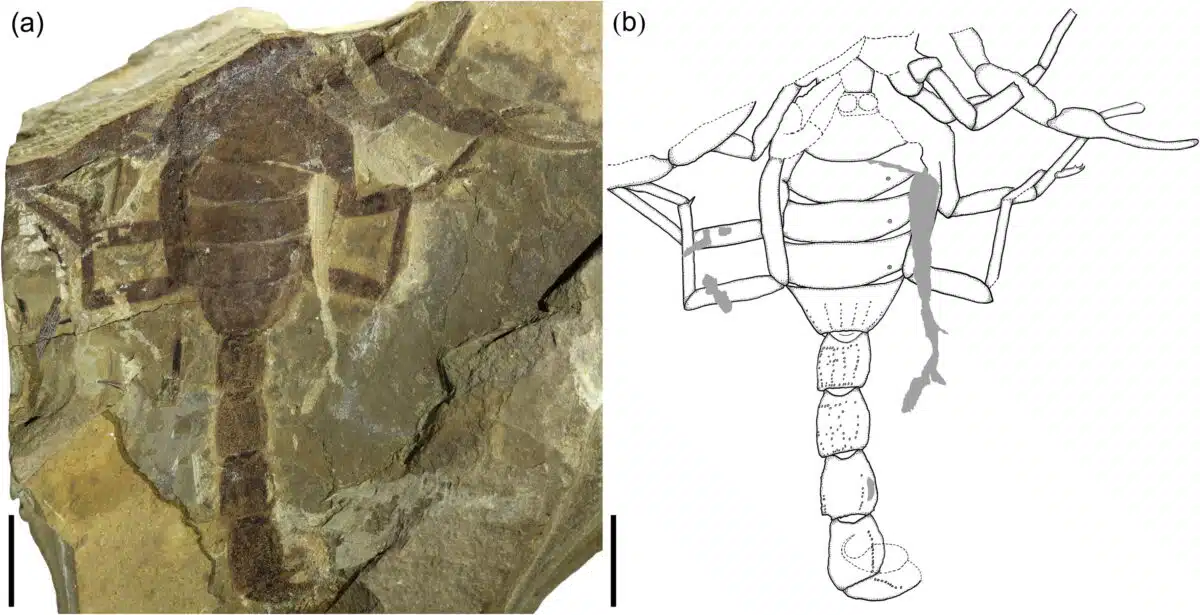
Paleontologists have uncovered the fossil of a new scorpion species, Jeholia longchengi, in China’s famous Yixian Formation. Dating back about 125 million years to the Early Cretaceous period, this marks the first Mesozoic scorpion ever found in China.
The Yixian Formation, already famous for its well-preserved fossils of early birds, dinosaurs, and other ancient creatures, just got even more interesting with this rare discovery. This ancient hunter helps paint a more detailed picture of life in the Cretaceous period and shows how they fit into the larger food webs of the time.
A First for China
This species is the first of its kind found in China from the Mesozoic era. The fossil was discovered in Heishangou village, Chifeng City, Nei Mongol, an area known for its incredible collection of fossils.
Unlike most scorpions from this time period, which are usually found preserved in amber, this one was preserved in mudstones, providing a different perspective on scorpion life.
According to a study published in Science Bulletin, Jeholia longchengi measured about 10 cm (4 inches) in length, making it larger than many other eight-legged hunters from the same era.
What Was on the Menu for Ancient Scorpions?
Jeholia longchengi likely played a key role in its ecosystem, preying on a variety of insects and maybe even small vertebrates like frogs and lizards. With no preserved mouthparts to confirm exactly what it ate, scientists have to speculate based on other evidence.
However, it’s believed that this sting creature was part of a complex food web, interacting with many species in its environment, including possibly early mammals, birds, and dinosaurs.
The fossil shows that venomous predators like Jeholia longchengi may have been important predators, controlling insect populations and potentially acting as prey for larger animals. As stated by the research team:
“In the Jehol Biota food web, large scorpions exhibit the highest betweenness centrality among all guilds, underscoring the likelihood that the fossil scorpion may have had extensive ecological interactions with other species in the early terrestrial ecosystem.”
A Treasure Trove of Ancient Life
The Jehol Biota, known for its rich fossil collection, is one of the world’s most important sites for studying the Early Cretaceous period. It has already yielded remarkable specimens, from feathered dinosaurs to early birds.
Before this find, scorpions were missing from the Jehol Biota’s fossil record, making Jeholia longchengi a significant and unexpected discovery.
“Despite the numerous fossil species reported, no fossil scorpions have been recorded until now,” said the authors.
With Jeholia longchengi, paleontologists can now study scorpions’ roles in ecosystems alongside other well-known species from the period.
First Appeared on
Source link






Leave feedback about this