

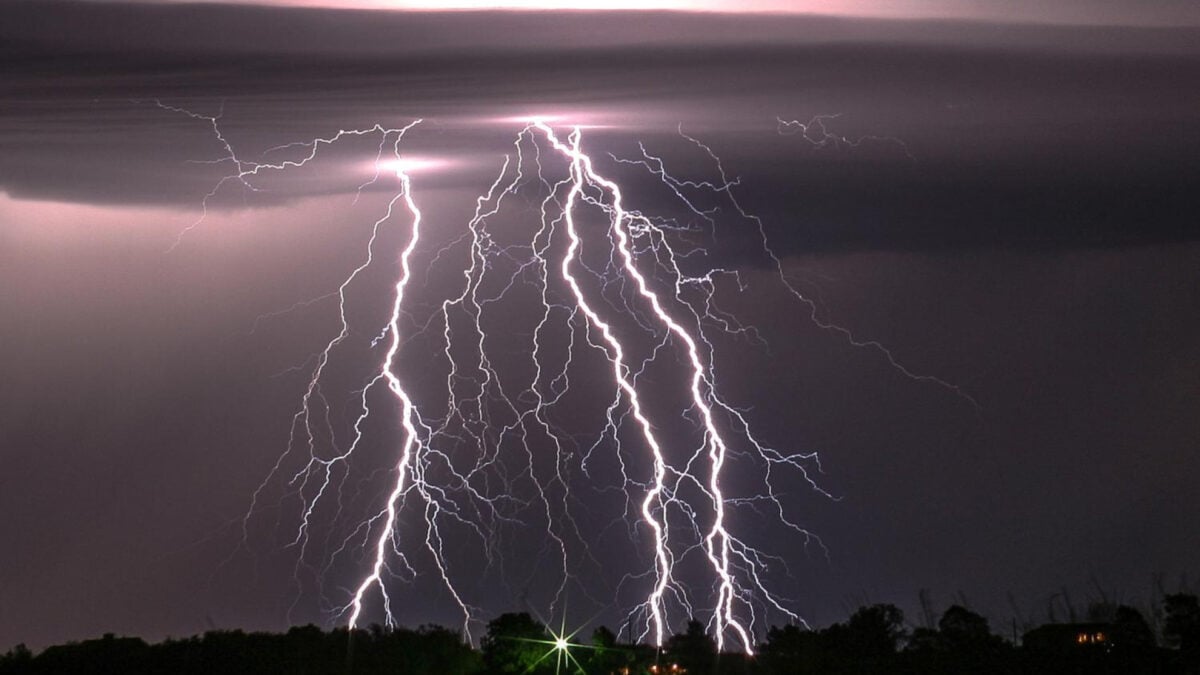
Thunderstorms belong to a non-exhaustive list of surprisingly mundane things that we know surprisingly little about. Last year, a team of engineers identified how lightning forms on cloud tops. The same team is now back with another surprising contraption: a miniature, plastic “lightning-in-a-box.”
In a recent study published in Physical Review Letters, engineers led by Victor Pasko of Penn State University reported that they devised a concept for an apparatus to model lightning strikes. That might not sound so impressive, but according to their simulations, the box would be slightly larger than a deck of cards and require relatively cheap, accessible materials to create.
That all hinges on whether the team can experimentally prove their concept. But if they’re successful, engineers, atmospheric scientists, and physicists could have a field day exploring lightning with unprecedented convenience.
“If you’re able to experiment with lightning-like conditions on a desktop under controlled conditions, it would be wonderful—much more cost-effective and could answer so many questions,” Pasko said in a statement.
The physics of an imminent thunderstorm
The results are the latest in a series of studies from Pasko, who in 2023 devised a mathematical model to simulate physical conditions that produce lightning. In last year’s findings, Pasko and his colleagues compared the model with field observations using ground-based sensors, satellite data, and high-altitude spy planes.
From the analysis, the team concluded that lightning strikes come from a chain reaction of powerful electric fields accelerating electrons, which then produce X-ray radiation after colliding with the nitrogen and oxygen particles in the air. The chaotic particles eventually release a burst of photons that we recognize as an arc of light crackling across the sky.
Scaling down a massive strike
For the new study, the team wondered whether that feedback loop—formally called a relativistic runaway electron avalanche—could be replicated inside much smaller physical spaces. Even better, could these spaces be made of common insulating materials, like glass, acrylic, or quartz?
The simulations evaluated whether a supply of high-energy electrons in the lab could trigger lightning-like radiation in small solid blocks. Shockingly (sorry), the team found that—theoretically, at least—a dense, solid block smaller than a thumb could mimic the same electric conditions as real thunderstorms.
That’s quite wild, considering real storms “produce electric potentials of about 100 million volts across kilometer-scale regions of cloud,” Pasko said. This is possible due to the high density of these materials, which can be up to one thousand times denser than air. The frictional force in these solids is “much greater than in the atmosphere, which shrinks the spatial scale of the process,” according to a commentary on the paper by Physics Magazine.
Once the first links of the chain reaction are reproduced in the tiny block, the sheer force of the feedback loop would be enough to keep the avalanche going, the paper hypothesized.
Lightning-in-a-box coming when?
This assumes the team manages to experimentally confirm its findings. In the paper, the researchers sketch out some factors in need of confirmation should their proposed mini-lightning methods come to fruition, such as the minimum electric field required for the reactions or how the electron “beam” would have to be applied to the solid.
Still, the expected gains are large, Pasko said, given how expensive it is for researchers to perform “massive-scale” experiments to observe extreme weather patterns. A previous study also demonstrated it was possible to reproduce lightning-like reactions in a relatively small apparatus, so the new study’s predictions might not be so unrealistic, he added.
I admit I was slightly disappointed when I couldn’t find a photograph of the so-called “lightning-in-a-box.” But thankfully, the team is already on the case, and given Pasko’s track record on delivering the latest lightning research, we’ll hopefully see one soon.
First Appeared on
Source link





Leave feedback about this