

Stay informed with free updates
Simply sign up to the Artificial intelligence myFT Digest — delivered directly to your inbox.
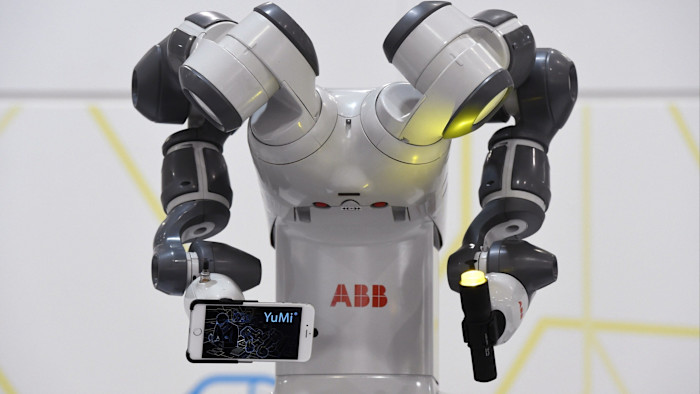
Nvidia and ABB Robotics are partnering to produce a new generation of autonomous industrial robots for clients including Apple supplier Foxconn, which is trialling the machines.
The companies said on Monday they were integrating ABB’s robot training software with Nvidia’s Omniverse simulation platform to produce robots that can be trained in virtual environments and be used by a range of industries.
The new robots, which are being tested by Taiwanese consumer electronics manufacturer Foxconn and will be commercially available in the second half of this year, can train themselves as they gather more experience, the companies said.
Marc Segura, president of ABB Robotics, said that by closing the disparity in performance between robots trained in virtual environments and their “digital twins” operating in the physical world, the system would speed deployment and reduce costs, enabling small and medium-sized companies to afford industrial robots for the first time.
“We have removed the last barriers to making industrial and physical AI a reality at a global scale,” said Segura.
The installed cost of robotic arms currently ranges from $40,000 for collaborative robot arms, or “cobots”, to up to $500,000 for industrial-scale robot arms, a high-cost hurdle for smaller manufacturers.
ABB Robotics is in the process of being acquired by Japanese tech group SoftBank, which agreed in November to buy it from European industrial conglomerate ABB in a deal worth $5.4bn.
Deepu Talla, vice-president of robotics and edge AI at Nvidia, said the new system, dubbed “RobotStudio HyperReality”, was a “big step” towards so-called full autonomy, when a robot can perform tasks without human direction.
“This will enable us to solve problems of small and medium enterprises, anybody that’s doing any logistics, anybody doing any sort of manufacturing with an industrial arm or a couple of cobot arms, especially moving things from Point A to Point B,” said Talla.
Nvidia chief executive Jensen Huang has predicted that a new phase of growth for the $4.3tn semiconductor company will come from the adoption of its chips and hardware by companies looking to cut costs and fill labour shortages with intelligent robots.
Huang has called robotics a “multitrillion-dollar opportunity” creating the “largest technology industry the world has ever seen”.
Nvidia has struck partnerships with multiple companies to use its products for training and running robots, including Uber, LG Electronics, Boston Dynamics and humanoid robotics companies such as Figure AI and Skild AI.
Nvidia has been building the software that allows companies to train and deploy robots, from those used in smart factories and warehouses to self-driving cars and humanoids, pushing to expand the uses of AI running on its chips.
Analysts say there are still obstacles to mass deployment of physical AI, from energy and labour bottlenecks to the unproven durability of precision components. Regulators could also raise concerns over implications for employment and safety.
However, its advocates say the technology will help western countries to close the industrial competitiveness gap with China, especially through the alleviation of chronic shortages of technical skills.
First Appeared on
Source link






Leave feedback about this