

For decades, the so-called Baghdad Battery has been a curiosity, dismissed by many as nothing more than an ancient artifact that might’ve had a purpose far removed from the electrical world. But, according to recent experiments by independent craftsman Alexander Bazes, it turns out this 2,000-year-old device might actually work as a battery.
Discovered near Baghdad in 1936, the Baghdad Battery consists of a ceramic jar, a copper cylinder, and an iron rod inside it. Its exact purpose has been up for debate ever since, with most experts agreeing it wasn’t meant to be a power source…until now. Various attempts to replicate it have failed, but Bazes‘ recent efforts have uncovered something the earlier experiments missed, sparking new interest in this odd, ancient object.
The Missing Ingredient
According to Alexander Bazes, past experiments, including the well-known “Mythbusters” episode, ignored a key design feature, the soldering at the top of the ceramic jar. The original device, he suggested, had this soldered seal, which made it watertight. Without it, earlier attempts simply couldn’t generate enough voltage, and the battery didn’t work as intended.
“I decided to approach my experiment instead from the perspective of looking at something crafted by a master,” he explained. “If this artifact had once truly functioned as a battery, then I assumed it probably would not have been the first device of its kind to have been made.”
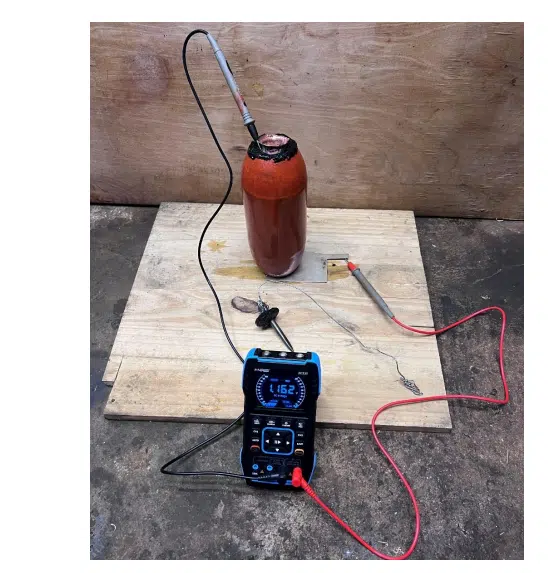
As explained by the research, published in Sino-Platonic Papers, when he recreated the device, he carefully added the solder to seal the copper cylinder inside the ceramic jar. He then filled the jar with an electrolyte, such as saltwater or lemon juice, which were likely available to ancient people. This change led to a noticeable difference: the device began generating a stable voltage of over 1.4 volts.
That’s a lot more than the mere 0.4 volts produced by the Mythbusters version, which barely had enough power to do anything. Bazes explained that this amount of voltage is more than enough to power processes, something that would’ve been incredibly useful for ancient metalworkers.
How Ancient Craftsmen Could Have Used the Battery
Now that the Baghdad Battery actually works, it raises an interesting question: how might ancient people have used it? Bazes‘ research suggests they could have used its voltage for practical stuff like electroplating or even electrolysis, which are still used today.
For example, electroplating was used in ancient times to coat metals for strength or decoration. The idea that ancient craftsmen might have used electricity for these tasks is pretty fascinating. The type of liquid used in the battery also plays a role. Bazes discovered that:
“If you put in electrolytes that were readily available 2,000 years ago, it ends up working as a much better battery than previously thought,” he stated. “You get a big boost in voltage, and the battery’s two terminals are now convenient to access. I find this recreation more believable, at least, as something an ancient craftsperson might have made.”
This setup makes the device much easier to use, since the positive terminal is on the outside, unlike earlier versions where the wiring was awkward. It’s a small design change, but it shows that the original makers of the Baghdad Battery were thinking practically and efficiently.
First Appeared on
Source link






Leave feedback about this