

Sign up for the Slatest to get the most insightful analysis, criticism, and advice out there, delivered to your inbox daily.
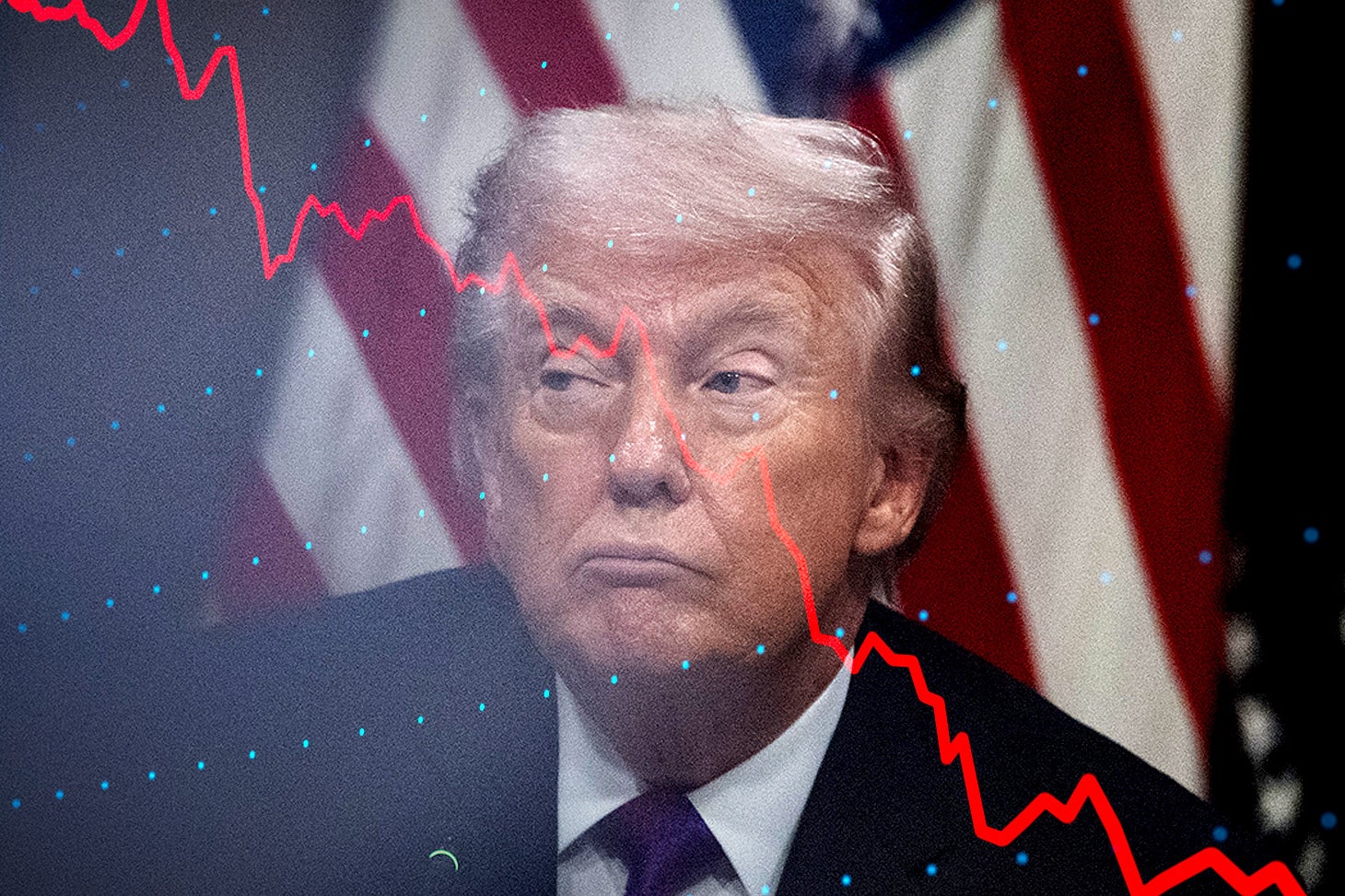
For any president, it’s not a great sign when you see job numbers going down and gas prices going up. That’s particularly true when you’re a president who has bragged of ushering the American economy into a “golden age.” And that’s exactly where Donald Trump finds himself Friday, thanks to two economic developments that add up to bad politics news. One is the latest twist in a slow-moving story about the health of the job market. The other is the predictable fallout of Trump’s days-old war against Iran.
First, the twist. Friday morning, the Labor Department released the latest figures on how many jobs the U.S. economy created in February. Except “created” turns out to be the wrong word. The new numbers show that the economy lost 92,000 jobs last month. Worse still, the department reported that the federal government had overestimated the number of jobs employers added in its two previous reports. (It often refines its estimates as more data comes in, but in this case the revisions have essentially zeroed out any job creation over the past three months.)
The numbers surprised forecasters, reviving fears of a potential recession. Investors recoiled, sending stocks falling. Even Trump officials struggled to sugarcoat the situation. “I think we have to address the fact that this is not a good report in its raw numbers,” Labor Secretary Lori Chavez-DeRemer conceded on Fox Business, before blaming a labor strike in California and the weather. (As New York Times economics reporter Ben Casselman notes, bad weather can depress job numbers. But that doesn’t seem to have been a big factor this time, with fewer people reporting being unable to work because of the weather than did a year earlier.)
The government reports job figures on a predetermined schedule, but there’s no question that the latest ones land at an inopportune moment for Trump. Which leads to the second economic development this week that should worry the president: skyrocketing gas prices. Trump’s bombing campaign against Iran has disrupted the pumping and shipping of crude oil, driving up gas prices worldwide. In the U.S., a gallon now costs $3.32 on average, an 11 percent jump since last week and the highest recorded sticker price during either of Trump’s presidencies. What happens in Tehran, it turns out, doesn’t stay in Tehran.
Wars—as well as claiming civilian lives and producing horrifying humanitarian crises—sometimes cause one-off price shocks. But sustained fighting could also further logjam oil production and drive up the cost of other goods the region exports, including aluminum, farm fertilizer, and natural gas. The cost of anything that uses oil as an input, from making an iPhone to buying a plane ticket, could soon rise. The war has strangled shipping through the Strait of Hormuz, a U-bend-like chokepoint off the Iranian coast that acts as a highway for more than a third of the world’s oceangoing oil exports each year. On Wednesday, the number of tankers that passed through the strait was zero.
OK, so the economy—despite Trump’s incessant promises of a “new golden age”—is hitting a rough patch. How much of that is Trump’s fault?
Certainly not none! There’s a clear causal link between his decision to bomb Iran, the rising price of oil, and growing kinks in the supply lines of international trade. The story of the labor market, which can sometimes resemble a pendulum, is more complicated. Trump took office following a furious burst of post-pandemic job growth during Joe Biden’s presidency. The government’s latest figures also show solid wage growth and an unemployment rate that’s virtually unchanged since last summer.
Still, Trump’s restrictionist immigration policies and aggressive deportation efforts may be shrinking the labor market. His tariffs have hurt small businesses, while his threats and lawsuits have upended notions of the U.S. as a safe environment for big corporations. His deep cuts to Medicaid are undermining hospitals’ ability to hire and retain workers, even though health care is among the few sectors consistently creating jobs.
Whatever the cause, history suggests that unpopular wars in the Middle East and economic numbers with lots of negative signs in front of them bode poorly for presidents. Trump, though, may be particularly vulnerable to both. Most Republicans support the attack on Iran, polls show. But it has angered some key allies who apparently took Trump’s campaign pledge not to start new wars at face value, putting further pressure on a MAGA coalition already strained by his handling of documents related to Jeffrey Epstein, cost-burdening tariffs, and trigger-happy intervention in Venezuela.
Presidents often get blamed for bad economic numbers (just ask Biden). But it makes an added kind of sense for voters to hold accountable a president who loves claiming credit when things go well. Trump boasts of negotiating trade deals, trots out CEOs to announce new investments in America, and claims a better understanding of monetary policy than the chairman of the Federal Reserve. During his State of the Union address last week, Trump cited a rising stock market and falling gas prices to argue that the U.S. economy was “roaring like never before.” The war he started days later undermined both talking points.
A president need not be as hands-on as Trump to appreciate the politically toxic mix that may be brewing. Two decades ago, an unpopular overseas war and a guttering national economy helped Democrats retake Congress and the White House under the last Republican commander in chief, George W. Bush. And while there’s been plenty of speculation about whether a new Middle East war might prove the bunker-busting bomb that finally breaks Trump’s grip on the MAGA faithful, the broader coalition of voters that returned him to power in 2024 has long since shattered. Polls suggest that Trump’s standing has eroded with Americans of every age, race, gender, and income bracket since he retook office—including the independents, young people, and disaffected voters of color whose unhappiness with the Biden economy helped put him over the top.
So far, though, Trump seems undeterred. He told CNN on Thursday that higher gas prices will “be short term time” and “go way down very quickly.” Yet he has also refused to say how long the war will last, claiming in the same sentence that it might be four or five weeks and that “we have capability to go far longer than that.” This week, a former Bush adviser named Robert McNally told the Times that how long the Strait of Hormuz remains closed will determine how high gas prices could go. With Trump and his party’s political fortunes, the question is how low.

First Appeared on
Source link


Leave feedback about this