

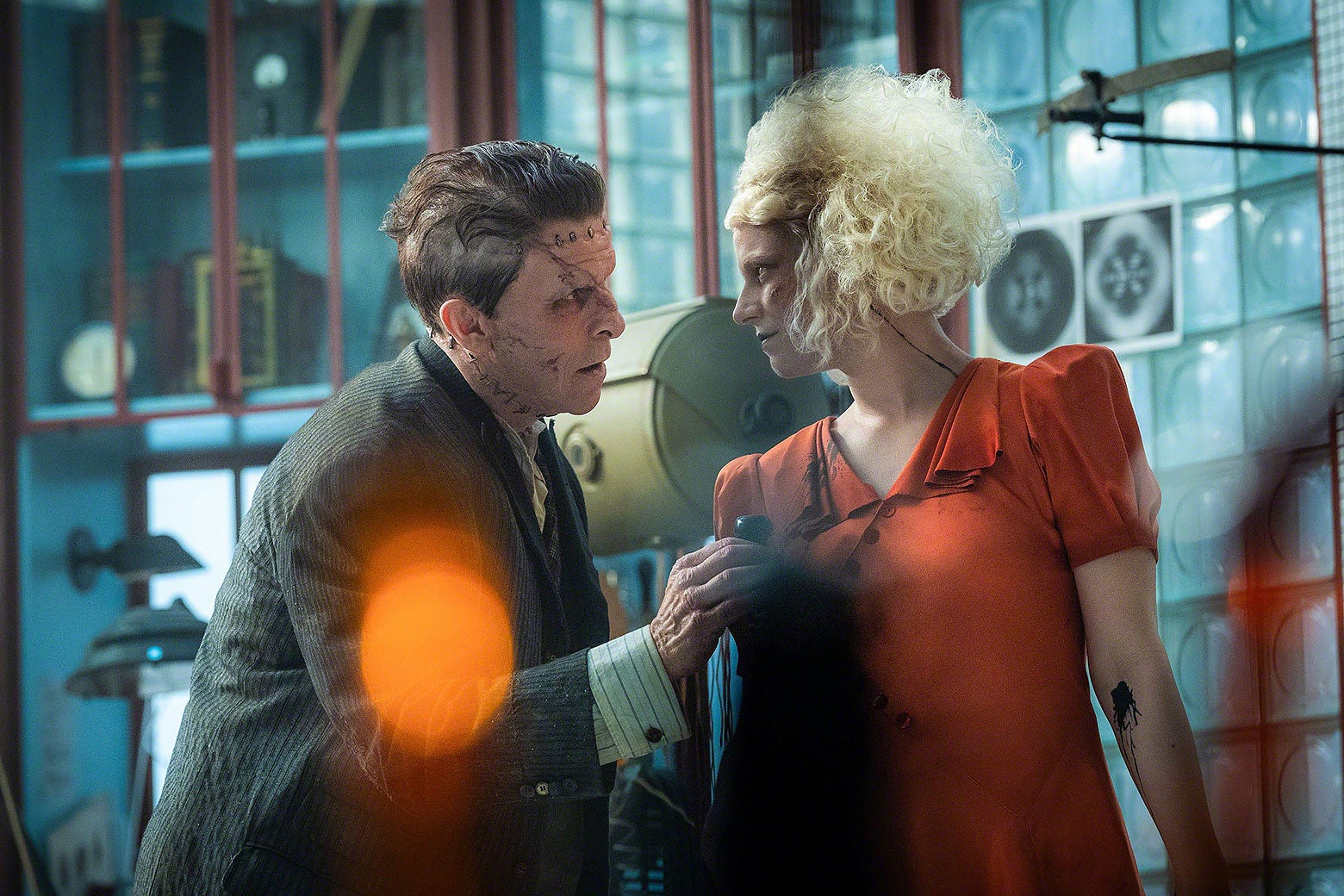
Titular punctuation is the bane of a movie critic’s existence. Is it 28 Days Later or 28 Days Later … ? Do we really have to put quotation marks around “Wuthering Heights,” no matter how often Emerald Fennell explains why they’re there? And don’t even get me started on Good Night, and Good Luck. or Crazy, Stupid, Love. But Maggie Gyllenhaal’s The Bride! earns its exclamation point like no movie since Moulin Rouge! Narrated by the wayward ghost of Mary Shelley, Gyllenhaal’s loopy, overstuffed fable is maddeningly uneven and just plain mad, in both the furious and off-its-rocker sense. I liked it more than any movie I’ve also considered walking out of.
Like her heroine, whose body Shelley periodically seizes control of through what she describes as a crack in her mind, Gyllenhaal directs like a woman possessed—or at least like a hopeful medium feigning symptoms in the hopes that it might coax a real spirit to manifest. Despite achieving literary immortality of a kind few of her contemporaries could rival, this Shelley is a restless phantom, still furious about being held back by the patriarchal norms that required her to publish her best-known work without her name on it, not to mention the brain tumor that is thought to have taken her life at 53. She doesn’t seem entirely thrilled about what’s become of her creation in the two centuries since, either—his status as a pop-culture punchline and breakfast-cereal mascot, not to mention all the ways her unlicensed IP has been spun off and outright plundered. So, she tells the camera from a black-and-white netherworld, she’s back to finish what she started, the way she would have if circumstances hadn’t held her back. It’s Frankenstein, unbound.
There’s something a little presumptuous about Gyllenhaal putting herself in the position of correcting Mary Shelley’s own work, especially since The Bride! doesn’t offer a mountain of evidence that the writer-director fully understands it. But this isn’t a narrow act of literary salvage. It’s a guns-blazing homage to classic gangster movies and punk rock and Bonnie and Clyde, with a prominent Mel Brooks reference, and maybe a little Law & Order: SVU, thrown in for good measure. Gyllenhaal is acting in what she understands as Shelley’s spirit rather than trying to pick up the fine threads of her work—specifically, the impulse that led Shelley to write her tale, as the movie’s opening titles put it, “On a Dare.”
The Bride! is daring, all right, unafraid of the grandest of gestures, even at the risk of courting ridicule. When Christian Bale’s monster, now more than 100 years old, travels to the 1930s U.S. in search of a scientist who’s studying how to “reinvigorate” dead tissue, he asks the lab-coated woman (Annette Bening) who answers the door where he might find Dr. Euphronius, never mind that anyone who’s navigated a middle-school brainteaser can see the punch line coming a mile away. The movie’s narrator may be fond of quoting Bartleby the Scrivener and Romeo and Juliet, but she also frames her screeds in terms of knock-knock jokes and groan-worthy puns. There are moments that drew titters from the audience I saw it with, and eventually guffaws. But a movie that establishes its political context by having its main character scream “Me too!” several times in a row is not interested in the contemporary fetish for subtlety and understatement. It’s as if Gyllenhaal’s saying, We tried hinting. Now: time to scream.
That’s certainly the brief that Gyllenhaal must have passed on to her lead actress. Jessie Buckley enters The Bride! at a 10 and rarely dips below it. It’s a supremely mannered performance, whether she’s taking on Shelley’s upper-crust tone (the actress pulls double duty as the author) or the brassy snarl of a streetwise party girl whose name might be Ida, or Penelope, but eventually, like Uma Thurman’s yellow-jumpsuited angel of vengeance, decides the name that best suits her is simply the Bride. (You can leave off the “of Frankenstein,” thank you very much.) Ida, or whatever her name is, takes a tumble down a flight of stairs early on, after two low-level crooks (John Magaro and Matthew Maher) try to ease her out of a bar where she’s been loudly complaining about the behavior of a creepy-looking mob boss (Zlatko Burić). Gyllenhaal stretches out her fall, suspending her body in midair and amping up the crunch as her neck and leg snap, but for all the body parts mangled, stomped, and torn out in the rest of the film, it’s the last time we’ll see that kind of violence directed against a woman. Most of the female characters have suffered in one way or another at the hands of a man, but Gyllenhaal assumes we know that without having to be shown in detail.
The Bride doesn’t consent to be brought back after death, and in fact, doesn’t for much of the time know that’s what’s happened to her. The monster, who eventually opts to go by Frank, tells her she’s been in an accident and her memory is gone, both things technically true, but neglects to mention that her accident was fatal, or that they’d never seen her before Frank and his mad doctor dragged her corpse out of its grave. Yet she shares Frank’s appetite for life, whether or not they technically count as alive, and they start to cut a wide swath through the world, with the Bride especially inspiring a league of imitators, trumpeted by headlines proclaiming “Grrrls Riot!”
It was around this point, when costume designer Sandy Powell started dressing the legions of Bride-ified rebels like they were on their way to a Sex Pistols show, that I decided to stop worrying and learn to love The Bride! The movie is absurd on almost every level, but it’s too interesting, too full of thoughts and desires and cornea-searing images, to categorize as a simple failure. Somehow, despite Buckley evidently being urged to play every scene to the hilt and beyond, Bale turns in a gentle and considered performance that’s full of Frank’s zest and curiosity—it might be the most fun Bale’s had on screen since American Psycho. And with Warner Bros., the studio that put some $90 million behind Gyllenhaal’s thrillingly uncommercial vision, in the process of being acquired by a studio whose idea of fomenting creativity is assigning two unknowing writers to the same G.I. Joe reboot, The Bride! stands a vanishingly rare example of a movie being made simply because people thought it had to be. Like the monsters at its center, it’s built from parts that don’t always fit together, but dammit: It’s alive.
First Appeared on
Source link

Leave feedback about this