

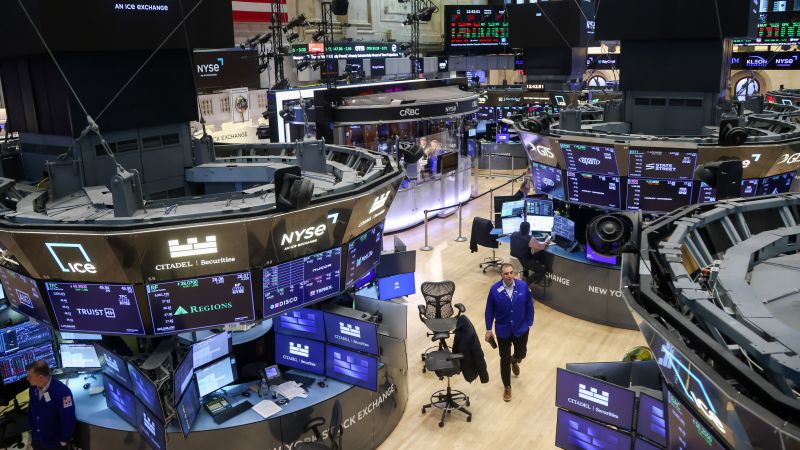
New York
—
US stocks opened lower Friday, with the major indexes on track for weekly losses, as weaker-than-expected jobs data added to concerns rippling through markets.
The Dow was down 676 points, or 1.41%. The S&P 500 fell 1.26% and the tech-heavy Nasdaq sank 1%. Wall Street’s fear gauge, the VIX, jumped 12%.
Oil prices continued to climb: US crude surged 9.2%, to $88.47 per barrel. Brent crude, the international benchmark, gained 6.7%, to $91.16 per barrel.
US oil and Brent prices have surged 32% and 25%, respectively, this week as the conflict with Iran has halted the flow of oil through the Strait of Hormuz and caused disruptions to oil producers in the region.
“The stock market is becoming increasingly vulnerable to turmoil in the Middle East, making the path of least resistance lower,” Craig Johnson, chief market technician at Piper Sandler, said in a note.
President Donald Trump on Friday said in a post on social media “there will be no deal with Iran” except unconditional surrender.
Saad al-Kaabi, Qatar’s energy minister, told the Financial Times that he predicts all Gulf energy exporters will be forced to shut down production, pushing oil prices higher. Higher oil and energy prices could ignite inflation. That’s stoking nerves on Wall Street.
Concerns about energy inflation were paired with nerves about a weaker-than-expected jobs report Friday morning. The US economy lost 92,000 jobs in February and the unemployment rate ticked higher to 4.4%, according to the latest data from the Bureau of Labor Statistics.
“The combination of trade uncertainty and a lack of population growth points toward a weaker economy at the same time energy prices spike,” David Russell, global head of market strategy at TradeStation, said in an email.
Treasury yields climbed Friday morning despite the weak jobs report as concerns about inflation linger. The 10-year yield traded at 4.17%, up from 3.96% on Monday.
“Add higher oil prices given conflict in the Middle East and renewed tariff uncertainty to the convoluted jobs markets story, and you have a tricky, stagflationary mix of risks in the backdrop for the Fed,” Elyse Ausenbaugh, head of investment strategy at JP Morgan Wealth Management, said in a note.
The US dollar index traded flat after the weaker-than-anticipated jobs report, pausing its recent gains. The index is up 1.7% this week and set for its best week since late 2024 as investors have flocked to the greenback as a safe haven.
“Today’s numbers may have put the Fed between a rock and a hard place,” Ellen Zentner, chief economic strategist at Morgan Stanley Wealth Management, said in a note.
“Significant weakening in the labor market would support a rate cut, but given the risk that higher-for-longer oil prices could trigger another inflation surge, the Fed may feel compelled remain on the sidelines,” Zentner said.
First Appeared on
Source link





Leave feedback about this