

Meineke, E. K., Davies, T. J., Daru, B. H. & Davis, C. C. Biological collections for understanding biodiversity in the Anthropocene. Philos. Trans. R. Soc. Lond. B Biol. Sci. https://doi.org/10.1098/rstb.2017.0386 (2018).
Arnold, S. J. Morphology, performance and fitness. Am. Zool. 23, 347–361 (1983).
Wainwright, P. C. Functional versus morphological diversity in macroevolution. Annu. Rev. Ecol. Evol. Syst. 38, 381–401 (2007).
Raxworthy, C. J. & Smith, B. T. Mining museums for historical DNA: advances and challenges in museomics. Trends Ecol. Evol. 36, 1049–1060 (2021).
Blagoderov, V., Kitching, I. J., Livermore, L., Simonsen, T. J. & Smith, V. S. No specimen left behind: industrial scale digitization of natural history collections. Zookeys 209, 133–146 (2012).
Ströbel, B., Schmelzle, S., Blüthgen, N. & Heethoff, M. An automated device for the digitization and 3D modelling of insects, combining extended-depth-of-field and all-side multi-view imaging. Zookeys 759, 1–27 (2018).
Plum, F. & Labonte, D. scAnt-an open-source platform for the creation of 3D models of arthropods (and other small objects). PeerJ 9, e11155 (2021).
Davies, T. G. et al. Open data and digital morphology. Proc. Biol. Sci. https://doi.org/10.1098/rspb.2017.0194 (2017).
Short, A. E. Z., Dikow, T. & Moreau, C. S. Entomological collections in the age of big data. Annu Rev. Entomol. 63, 513–530 (2018).
Nelson, G. & Ellis, S. The history and impact of digitization and digital data mobilization on biodiversity research. Philos. Trans. R. Soc. Lond. B Biol. Sci. https://doi.org/10.1098/rstb.2017.0391 (2018).
Hedrick, B. P. et al. Digitization and the future of natural history collections. BioScience 70, 243–251 (2020).
Wipfler, B., Pohl, H., Yavorskaya, M. I. & Beutel, R. G. A review of methods for analysing insect structures – the role of morphology in the age of phylogenomics. Curr. Opin. Insect Sci. 18, 60–68 (2016).
Deans, A. R., Mikó, I., Wipfler, B. & Friedrich, F. Evolutionary phenomics and the emerging enlightenment of arthropod systematics. Invertebr. Syst. https://doi.org/10.1071/is12063 (2012).
Friedrich, F. et al. Insect morphology in the age of phylogenomics: innovative techniques and its future role in systematics. Entomol. Sci. 17, 1–24 (2014).
Blackburn, D. C. et al. Increasing the impact of vertebrate scientific collections through 3D imaging: the openVertebrate (oVert) Thematic Collections Network. Bioscience 74, 169–186 (2024).
Sombke, A., Lipke, E., Michalik, P., Uhl, G. & Harzsch, S. Potential and limitations of X-Ray micro-computed tomography in arthropod neuroanatomy: a methodological and comparative survey. J. Comp. Neurol. 523, 1281–1295 (2015).
Metscher, B. D. MicroCT for comparative morphology: simple staining methods allow high-contrast 3D imaging of diverse non-mineralized animal tissues. BMC Physiol. 9, 11 (2009).
Gignac, P. M. et al. Diffusible iodine-based contrast-enhanced computed tomography (diceCT): an emerging tool for rapid, high-resolution, 3-D imaging of metazoan soft tissues. J. Anat. 228, 889–909 (2016).
Pauwels, E., Van Loo, D., Cornillie, P., Brabant, L. & Van Hoorebeke, L. An exploratory study of contrast agents for soft tissue visualization by means of high resolution X-ray computed tomography imaging. J. Microsc. 250, 21–31 (2013).
Muñoz, M. M. & Price, S. A. The future is bright for evolutionary morphology and biomechanics in the era of big data. Integr. Comp. Biol. 59, 599–603 (2019).
Lösel, P. D. et al. Natural variability in bee brain size and symmetry revealed by micro-CT imaging and deep learning. PLoS Comput. Biol. 19, e1011529 (2023).
Toulkeridou, E., Gutierrez, C. E., Baum, D., Doya, K. & Economo, E. P. Automated segmentation of insect anatomy from micro-CT images using deep learning. Nat. Sci. https://doi.org/10.1002/ntls.20230010 (2023).
Handschuh, S., Beisser, C. J., Ruthensteiner, B. & Metscher, B. D. Microscopic dual-energy CT (microDECT): a flexible tool for multichannel ex vivo 3D imaging of biological specimens. J. Microsc. 267, 3–26 (2017).
van de Kamp, T. et al. Parasitoid biology preserved in mineralized fossils. Nat. Commun. 9, 3325 (2018).
Rühr, P. T. et al. Juvenile ecology drives adult morphology in two insect orders. Proc. R. Soc. Lond. B Biol. Sci. https://doi.org/10.1098/rspb.2021.0616 (2021).
Ward, P. S., Brady, S. G., Fisher, B. L. & Schultz, T. R. Phylogeny and biogeography of dolichoderine ants: effects of data partitioning and relict taxa on historical inference. Syst. Biol. 59, 342–362 (2010).
Ward, P. S., Blaimer, B. B. & Fisher, B. L. A revised phylogenetic classification of the ant subfamily Formicinae (Hymenoptera: Formicidae), with resurrection of the genera Colobopsis and Dinomyrmex. Zootaxa 4072, 343–357 (2016).
Ward, P. S., Brady, S. G., Fisher, B. L. & Schultz, T. R. The evolution of myrmicine ants: phylogeny and biogeography of a hyperdiverse ant clade (Hymenoptera: Formicidae). Syst. Entomol. 40, 61–81 (2015).
Schmidt, C. A. & Shattuck, S. O. The higher classification of the ant subfamily Ponerinae (Hymenoptera: Formicidae), with a review of ponerine ecology and behavior. Zootaxa 3817, 1–242 (2014).
Camacho, G. P. et al. UCE phylogenomics resolves major relationships among ectaheteromorph ants (Hymenoptera: Formicidae: Ectatomminae, Heteroponerinae): a new classification for the subfamilies and the description of a new genus. Insect Syst. Divers. https://doi.org/10.1093/isd/ixab026 (2022).
Blaimer, B. B., Ward, P. S., Schultz, T. R., Fisher, B. L. & Brady, S. G. Paleotropical diversification dominates the evolution of the hyperdiverse ant tribe Crematogastrini (Hymenoptera: Formicidae). Insect Syst. Divers. https://doi.org/10.1093/isd/ixy013 (2018).
Borowiec, M. L. Convergent evolution of the army ant syndrome and congruence in big-data phylogenetics. Syst. Biol. 68, 642–656 (2019).
Economo, E. P., Narula, N., Friedman, N. R., Weiser, M. D. & Guenard, B. Macroecology and macroevolution of the latitudinal diversity gradient in ants. Nat. Commun. 9, 1778 (2018).
Parr, C. L. et al. GlobalAnts: a new database on the geography of ant traits (Hymenoptera: Formicidae). Insect Conserv. Divers. 10, 5–20 (2017).
Lach, L., Parr, C. L. & Abbott, K. L. Ant Ecology (Oxford Univ. Press, 2010).
Boomsma, J. J. et al. The Global Ant Genomics Alliance (GAGA). Myrmecol N. 25, 61–66 (2017).
Vizueta, J. et al. Adaptive radiation and social evolution of the ants. Cell https://doi.org/10.1016/j.cell.2025.05.030 (2025).
Bolton, B. An online catalog of the ants of the world. AntCat https://antcat.org (2026).
Mokso, R. et al. Advantages of phase retrieval for fast X-ray tomographic microscopy. J. Phys. D Appl. Phys. https://doi.org/10.1088/0022-3727/46/49/494004 (2013).
Lösel, P. D. et al. Introducing Biomedisa as an open-source online platform for biomedical image segmentation. Nat. Commun. 11, 5577 (2020).
Li, H. et al. Biomineral armor in leaf-cutter ants. Nat. Commun. 11, 5792 (2020).
Branstetter, M. G. et al. Dry habitats were crucibles of domestication in the evolution of agriculture in ants. Proc. Biol. Sci. https://doi.org/10.1098/rspb.2017.0095 (2017).
Hanisch, P. E., Sosa-Calvo, J., Schultz, T. R. & Camacho, G. P. The last piece of the puzzle? Phylogenetic position and natural history of the monotypic fungus-farming ant genus Paramycetophylax (Formicidae: Attini). Insect Syst. Divers. https://doi.org/10.1093/isd/ixab029 (2022).
Beal-Neves, M., Mielke, A., Gamarra, S. d. P., Beier, C. & Fontana, C. S. A students’ opinion on the importance of natural history collections and taxonomy in Brazil. Zoologia (Curitiba) https://doi.org/10.1590/s1984-4689.v39.e21045 (2022).
Aibekova, L. The skeletomuscular system of the mesosoma of Formica rufa workers (Hymenoptera: Formicidae). Insect Syst. Divers. https://doi.org/10.1093/isd/ixac002 (2022).
Koch, S., Tahara, R., Vasquez-Correa, A. & Abouheif, E. Nano-CT imaging of larvae in the ant Pheidole hyatti reveals coordinated growth of a rudimentary organ necessary for soldier development. J. Exp. Zool. B Mol. Dev. Evol. 336, 540–553 (2021).
Lürig, M. D., Donoughe, S., Svensson, E. I., Porto, A. & Tsuboi, M. Computer vision, machine learning, and the promise of phenomics in ecology and evolutionary biology. Front. Ecol. Evol. https://doi.org/10.3389/fevo.2021.642774 (2021).
Cotte, M. et al. New opportunities offered by the ESRF to the cultural and natural heritage communities. Synchrotron Radiat. N. 35, 3–9 (2022).
Spiecker, R. et al. Dose-efficient in vivo X-ray phase contrast imaging at micrometer resolution by Bragg magnifiers. Optica https://doi.org/10.1364/optica.500978 (2023).
Semple, T. L., Peakall, R. & Tatarnic, N. J. A comprehensive and user-friendly framework for 3D-data visualisation in invertebrates and other organisms. J. Morphol. 280, 223–231 (2019).
Buser, T. J. et al. The natural historian’s guide to the CT galaxy: step-by-step instructions for preparing and analyzing computed tomographic (CT) data using cross-platform, open access software. Integr. Org. Biol. https://doi.org/10.1093/iob/obaa009 (2020).
Poinapen, D. et al. Micro-CT imaging of live insects using carbon dioxide gas-induced hypoxia as anesthetic with minimal impact on certain subsequent life history traits. BMC Zool. https://doi.org/10.1186/s40850-017-0018-x (2017).
Alba-Tercedor, J., Hunter, W. B. & Alba-Alejandre, I. Using micro-computed tomography to reveal the anatomy of adult Diaphorina citri Kuwayama (Insecta: Hemiptera, Liviidae) and how it pierces and feeds within a citrus leaf. Sci. Rep. 11, 1358 (2021).
van de Kamp, T., dos Santos Rolo, T., Vagovič, P., Baumbach, T. & Riedel, A. Three-dimensional reconstructions come to life–interactive 3D PDF animations in functional morphology. PLoS ONE 9, e102355 (2014).
Matte, A. C. et al. The evolution of cheaper workers facilitated larger societies and accelerated diversification in ants. Sci. Adv. 11, eadx8068 (2025).
AntWiki https://www.antwiki.org (2026).
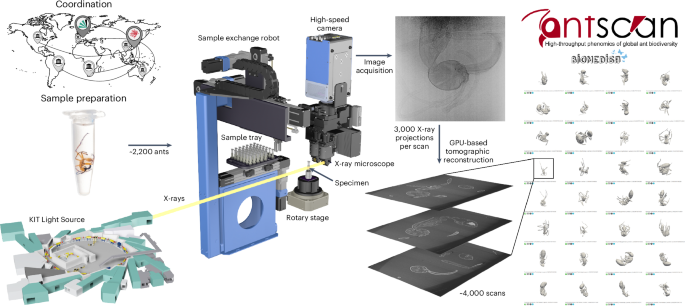
Rack, A. et al. The micro-imaging station of the TopoTomo beamline at the ANKA synchrotron light source. Nucl. Instrum. Methods Phys. Res. B 267, 1978–1988 (2009).
Cecilia, A. et al. The IMAGE beamline at the KIT Light Source. J. Synchrotron Radiat. 32, 1036–1051 (2025).
Douissard, P. A. et al. A versatile indirect detector design for hard X-ray microimaging. J. Instrum. 7, P09016–P09016 (2012).
Vogelgesang, M. et al. Real-time image-content-based beamline control for smart 4D X-ray imaging. J. Synchrotron Radiat. 23, 1254–1263 (2016).
Paganin, D., Mayo, S. C., Gureyev, T. E., Miller, P. R. & Wilkins, S. W. Simultaneous phase and amplitude extraction from a single defocused image of a homogeneous object. J. Microsc. 206, 33–40 (2002).
Faragó, T. et al. syris: a flexible and efficient framework for X-ray imaging experiments simulation. J. Synchrotron Radiat. 24, 1283–1295 (2017).
Vogelgesang, M., Chilingaryan, S., dos Santos Rolo, T. & Kopmann, A. UFO: a scalable GPU-based image processing framework for on-line monitoring. In Proc. IEEE 14th International Conference on High Performance Computing and Communication & IEEE 9th International Conference on Embedded Software and Systems 824–829 (IEEE, 2012).
Faragó, T. et al. Tofu: a fast, versatile and user-friendly image processing toolkit for computed tomography. J. Synchrotron Radiat. 29, 916–927 (2022).
Lowekamp, B. C., Chen, D. T., Ibanez, L. & Blezek, D. The design of SimpleITK. Front. Neuroinform. 7, 45 (2013).
Yaniv, Z., Lowekamp, B. C., Johnson, H. J. & Beare, R. SimpleITK image-analysis notebooks: a collaborative environment for education and reproducible research. J. Digit. Imaging 31, 290–303 (2018).
Lösel, P. & Heuveline, V. Enhancing a diffusion algorithm for 4D image segmentation using local information. Proc. SPIE Int. Soc. Opt. Eng. 9784, 97842L (2016).
Ayachit, U. The Paraview Guide: A Parallel Visualization Application (Kitware, 2015).
Schindelin, J. et al. Fiji: an open-source platform for biological-image analysis. Nat. Methods 9, 676–682 (2012).
Lösel, P. D. GPU-basierte Verfahren zur Segmentierung biomedizinischer Bilddaten. PhD thesis, Heidelberg Univ. (2022); https://doi.org/10.11588/heidok.00031525
First Appeared on
Source link





Leave feedback about this