

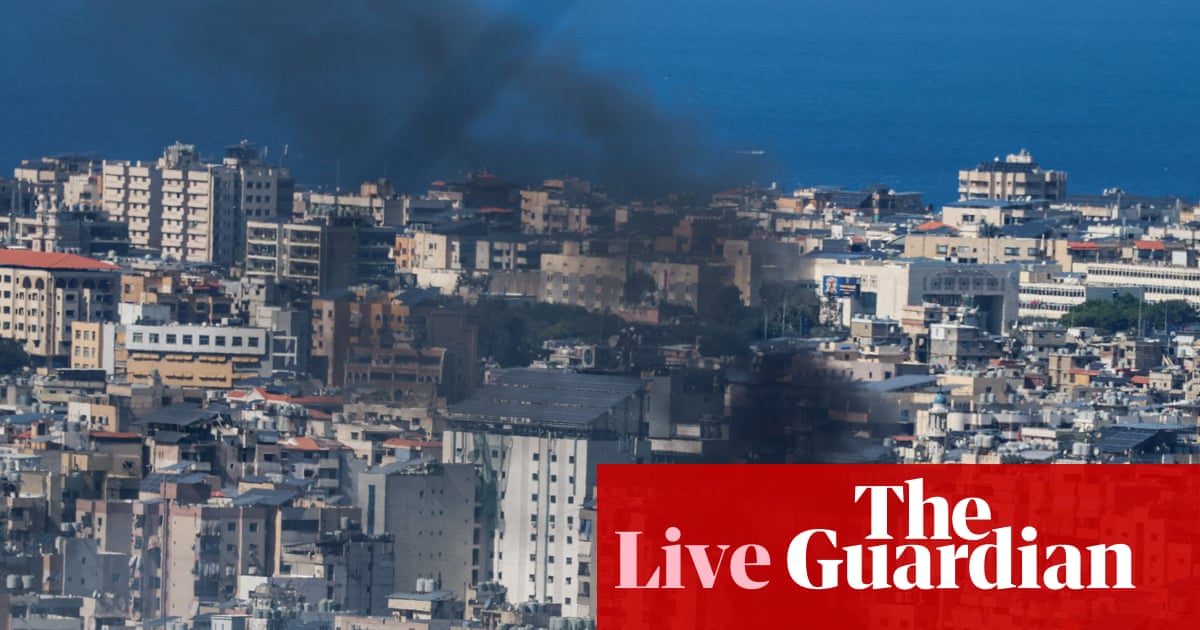
Hundreds of thousands of people in southern Lebanon told to flee by Israeli military
The Israeli military has issued an evacuation order for all of the southern suburbs of Beirut, in an area called the Dahiyeh which it says is a Hezbollah stronghold.
There’s no definitive figure on how big the population is here but some estimates put it between 300,000 to 700,000. It is believed to be the first time the Israeli military has ordered large swathes of the Lebanese capital to flee, when before they would force people out of specific buildings that the Israel Defense Forces (IDF) would then strike.
The IDF’s Arabic-language spokesperson, Avichay Adraee, said the latest order covers four major neighbourhoods in the southern suburbs of Beirut – Bourj el-Barajneh, Hadath, Haret Hreik and Shiyyah.
“Save your lives and evacuate your homes immediately,” he said in a message posted on social media.
“Beware, heading south is prohibited. Any southward movement could endanger your lives.
“We will inform you of the safe time to return to your homes.”
Key events
US asked Ukraine for help against Iranian drones, Zelenskyy says
In a dramatic turn of the proverbial tables, Ukrainian president Volodymyr Zelenskyy has said he received a request from the United States “for specific support” in dealing with Iran’s Shahed attack drones, as the US and its allies in the Middle East seek Ukraine’s expertise in countering such attacks.
It follows reporting from my colleague Hugo Powell yesterday that top US military officials told lawmakers in a closed-door briefing on Tuesday that they may not be able to shoot down every Iranian drone being launched against US military installations and assets in retaliatory attacks.
Ukraine has been countering Russian attacks using Shahed drones – one of Iran’s best known weapons – for the last four years. Last year lone, Russia launched over 50,000 of them into Ukraine, the majority of which were intercepted.
“I gave instructions to provide the necessary means and ensure the presence of Ukrainian specialists who can guarantee the required security,” Zelenskyy wrote on X. “Ukraine helps partners who help ensure our security and protect the lives of our people.”
Yesterday, Zelenskyy said he said he has spoken in recent days with the leaders of the United Arab Emirates, Qatar, Bahrain, Jordan and Kuwait about possible cooperation.
He has said that Ukrainian assistance in countering Iranian drones will be provided only if it does not weaken Ukraine’s own defenses, and if it adds leverage to Kyiv’s diplomatic efforts to stop the Russian invasion.
The irony of the Trump administration, which has for the last year held leverage over – and been highly erratic towards – Ukraine regarding military assistance and supplies of weapons, now needing help from a country whose leader it has publicly berated, is not lost on us – and will certainly not be lost Zelenskyy.
Was Trump ever in control of the Iran war? – podcast
This week on Politics Weekly America, my colleague Rachel Leingang speaks with foreign policy expert Ali Vaez about what it was like to take part in war game exercises for the Pentagon, and how they compare with what he has seen play out this week.
Then the Guardian’s Andrew Roth talks us through the inner chaos in the Trump administration and Congress over Trump’s decision to go to war with Iran.
UK defence secretary fails to rule out Britain joining offensive action in Iran
The UK’s defence secretary John Healey earlier declined to rule out Britain joining US-Israeli strikes on Iran.
As we reported earlier, Healey flew into Cyprus to calm the diplomatic fallout over a drone that evaded detection and hit an RAF base, prompting fury from local ministers.
UK officials believe the drone evaded detection by flying low and slow when it was launched by pro-Iranian militia in Lebanon or western Iraq.
Speaking to Sky News, Healey was asked if he would rule out the UK joining the conflict in an offensive capacity. He replied:
As circumstances in any conflict change, you’ve got to be willing to adapt the action you take.
Pressed again on whether he would rule out British aircraft taking part in offensive operations over Iran, he said:
Everything that we have done is defensive, is legal, and is coordinated with other allies.
As my colleague Helena Smith reports, this is the first time the Cypriot political and diplomatic elite have expressed consternation over the dangers posed by the facilities, saying Britain has not done enough to protect the installations and surrounding areas where locals live.
Speaking to the media, Healey listed defensive measures that were being taken by the UK, including the use of anti-drone helicopters, deploying HMS Dragon to the eastern Mediterranean, and bringing in planners to co-ordinate an international response.
Per the BBC, he said the HMS Dragon would arrive “within the next couple of weeks”.
The UK has “got more jets in Cyprus than any other nation” and “400 air defence specialists on top of what we would normally have”, he said.
That’s because we want to make sure we can defend our British personnel, we can defend our British base, we can defend this island of Cyprus and we’re defending also allies across region.
In addition the defensive measures Healey outlined above, the British PM, Keir Starmer, has allowed the United States to use British airfields to carry out “defensive” missions.
Earlier this week, Starmer said the UK would not join in the initial US-Israeli offensive strikes, citing a lack of a “lawful basis” and stating that his government does not believe in “regime change from the skies”.
Trump says he must ‘be involved in’ choosing Iran’s next leader
Donald Trump has said he must “be involved in the appointment” of Iran’s next leader as he was in Venezuela, and dismissed the idea of the assassinated ayatollah’s son, Mojtaba Khamenei, succeeding his father as supreme leader as “unacceptable”.
“They are wasting their time. Khamenei’s son is a lightweight. I have to be involved in the appointment, like with Delcy [Rodriguez] in Venezuela,” Trump told Axios today. You will remember that Rodriguez took over after US forces captured president Nicolás Maduro in January.
Trump added that he could not accept a new Iranian leader who would continue Khamenei’s policies.
“Khamenei’s son is unacceptable to me. We want someone that will bring harmony and peace to Iran,” he said.
Selecting a leader who followed the policies of the former supreme leader could force the US back to war “in five years”, he added.
It comes a day after Trump’s defense secretary Pete Hegseth insisted that regime change was not the primary goal of the US military operation in Iran. Other Trump administration officials have made the same claim since the US and Israel launched attacks on Iran last Saturday, which killed the former supreme leader Ali Khamenei .
This, even though Trump himself has pushed for Iranian regime change previously. His administration has pivoted its messaging in recent days to focus on destroying Iran’s nuclear and military capabilities.
Since the US-Israeli military assault began, Trump has suggested several times that he had a good idea who he wanted to succeed Khamenei in Iran.
But these latest comments to Axios come after he told reporters at the White House on Tuesday:
Most of the people we had in mind are dead.
No formal announcement has been made from Iran regarding the selection of a new leader, though Mojtaba Khamenei is considered the frontrunner.
Why does Trump want Kurdish fighters to join the war in Iran? – podcast
As we’ve been reporting, intense waves of US-Israeli airstrikes have hit dozens of military positions, frontier posts and police stations along northern parts of Iran’s border with Iraq in what appears to be preparation by the US and Israel for a new front in their war.
Iran has warned “separatist groups” in this region against joining the widening conflict and launched strikes against Iraq-based Kurdish groups it described as “opposed to the revolution”.
In today’s edition of our Today in Focus: The Latest podcast, Nosheen Iqbal speaks to the Guardian’s deputy head of international news Devika Bhat to find out: could the involvement of these militant groups increase the risk of a civil war in Iran if the regime collapses?
Here are some images coming out of Lebanon, where an estimated tens of thousands have been displaced after the Israeli military issued evacuation orders for the suburbs south of Beirut on Thursday.
More than 80,000 people registered as displaced as Israeli military orders evacuations in Lebanon
Marianne Samaha with the relief organisation Basmeh and Zeitooneh said in a statement that official figures show that more than 80,000 people have registered as displaced as of Wednesday, but aid workers in the region believe that the number is much higher because the official figure doesn’t take into account those who are not staying in collective shelters.
“We have been talking about a figure that’s more around 180,000 people,” Samaha said.
Aid workers have witnessed entire families still stuck on the roads, searching for a place to take shelter, Samaha said. “Some of them have found temporary shelters in schools that have been opened by the government, some have found temporary shelters with extended family members or in informal settings, but many, many people remain to this day sleeping on the streets, or in their cars,” she said.
Samaha added that even those who have found space for themselve sand their families in the collective shelters are still lacking mattresses, mats, pillows and blankets.
Death toll in Lebanon rises to 102
Lebanon’s Ministry of Public Health said 102 people have been killed and 638 wounded in Israeli strikes into the country that began Monday, the state-run Lebanese National News Agency reports.
On Thursday, the Israeli military said the Israeli Navy killed Wasim Attallah Ali, a Hamas commander, in the area of Tripoli.
The Guardian have not been able to independently verify this, or the figures from the Ministry of Public Health.

Patrick Wintour
The US proposal to pull Kurdish fighters into the conflict with Iran would open a Pandora’s box that would risk fragmenting Iraq as well as Iran, said H A Hellyer, a senior associate fellow for geopolitics and security at the Royal United Services Institute.
“I’ve never seen such a resounding opposition to a policy idea in Washington from all sides of the political spectrum as I have when it came to this particular idea,” Hellyer said Thursday at a Chatham House seminar in London.
A US official with knowledge of the discussions between Washington and Kurdish officials told the Guardian earlier this week that the US was ready to provide air support if Kurdish fighters crossed the border from northern Iraq. On Wednesday, Khalil Nadiri, an official with the Kurdistan Freedom Party (PAK) said US officials have contacted Kurdish opposition group leaders regarding a potential operation, and that some of their forces had moved to areas near the Iranian border in Sulaymaniyah province and were on standby.
Hellyer said bringing the Kurds into this conflict risks drawing in other countries in the region, like Turkey. “And you also risk igniting something among other ethnic groups in Iran, including the Azeris, and the Baluchis,” Hellyer said.
“All of this, I think, is very risky, very dangerous, and the next order consequences could be very serious indeed,” he said.
Nechirvan Barzani, president of the Kurdistan region of Iraq, appeared to allude to the current conflict unfolding in the Middle East in a statement posted on social media to commemorate the 35th anniversary of the 1991 Kurdish uprising.
“In this commemoration, we reiterate that the Kurdistan region, as always, must remain a key factor in peace and stability and must not become part of any conflict or military escalation that harms the lives and security of our fellow citizens,” Barzani posted on social media.
“Protecting the territorial integrity of the Kurdistan region and our constitutional achievements can only be achieved through the unity, cohesion, and shared national responsibility of all political forces and components in Kurdistan.”
Pakistani man on trial in Brooklyn for Trump assassination plot says he was recruited by Iran
Joseph Gedeon
A Pakistani businessman accused of plotting to kill Donald Trump told a federal jury on Wednesday that he was coerced into the scheme by Iran’s Revolutionary Guard Corps, which he said had threatened his family to secure his participation.
On Wednesday, defense secretary Pete Hegseth said that the person who led a plot to assassinate Trump had been killed in the airstrikes on Iran.
The plot dates back to 2024, when federal prosecutors under the Biden administration charged 51-year-old Iranian national Farhad Shakeri and two New York men with running a murder-for-hire operation on behalf of Iran’s Revolutionary Guard Corps. The aim, the department of justice said at the time, was revenge for Trump’s killing of Iranian general Qasem Soleimani in 2020.
Read more here:

Siraj Datoo
Oil prices have continued to rise as the crisis in the Middle East fails to show any signs of deescalation.
Iran has said it is halting all traffic through the strait of Hormuz, one of the busiest shipping corridors for oil and gas but the US president has tried to calm both constituents and businesses. Donald Trump said that the US will provide the risk insurance necessary for boats (many insurance providers have either doubled their premiums or canceled the policies) and also pledged that the US navy will escort ships through the strait if necessary.
There’s another line too, from White House press secretary Karoline Leavitt who in a post in on X, sought to reassure Americans on gas prices: “The Trump Administration will continue to unleash American energy dominance, and tap into our newfound oil in Venezuela.”
Today so far
-
Azerbaijan has responded strongly to the alleged drone strike in the Nakhchivan region near the border of Iran. Though Iran has denied any involvement, Ilham Aliyev, the president of Azerbaijan, has ordered the country’s armed forces to be at “the highest level of readiness” for any retaliatory action and summoned Iran’s ambassador to the foreign ministry in Baku.
-
Iran claimed it had hit a US oil tanker in the northern Persian Gulf and that the vessel was on fire. There was no immediate confirmation of the incident or comment from the US. Iran’s Islamic Revolutionary Guard Corps (IRGC) said it maintains full control of the Strait of Hormuz and has effectively closed it to oil and gas exports.
-
UK defence secretary John Healey flew into Cyprus to calm the diplomatic fallout over a drone that evaded detection and hit an RAF base, prompting fury from local ministers. UK officials believe a drone that hit an RAF base in Cyprus evaded detection by flying low and slow when it was launched by pro-Iranian militia in Lebanon or western Iraq.
-
Iran continued to launch a wave of missiles at Israel, sending millions of residents into bomb shelters, just hours after moves to limit Donald Trump and his ability to prolong the war were blocked in Washington. Other countries in the Gulf region continued to deal with the fallout: six people were injured in Abu Dhabi in the United Arab Emirates from falling debris after air defences intercepted a drone and Qatar officials urged residents to stay inside as air defences worked to halt an attack. The ministry of defence in Bahrain said on Thursday that their air defences had destroyed 75 missiles and 123 drones since the start of the conflict.
-
The Israeli military said it was beginning a new widespread wave of attacks in Tehran. Israel also said it carried out strikes on Beirut targeting Hezbollah while Lebanese state media reported an Israeli drone strike killed a Hamas official.
-
The World Health Organization (WHO) said it has verified more than a dozen attacks on health infrastructure in Iran amid the US-Israeli campaign. Four healthcare workers have been killed and 25 others injured, according to the organisation.
Hundreds of thousands of people in southern Lebanon told to flee by Israeli military
The Israeli military has issued an evacuation order for all of the southern suburbs of Beirut, in an area called the Dahiyeh which it says is a Hezbollah stronghold.
There’s no definitive figure on how big the population is here but some estimates put it between 300,000 to 700,000. It is believed to be the first time the Israeli military has ordered large swathes of the Lebanese capital to flee, when before they would force people out of specific buildings that the Israel Defense Forces (IDF) would then strike.
The IDF’s Arabic-language spokesperson, Avichay Adraee, said the latest order covers four major neighbourhoods in the southern suburbs of Beirut – Bourj el-Barajneh, Hadath, Haret Hreik and Shiyyah.
“Save your lives and evacuate your homes immediately,” he said in a message posted on social media.
“Beware, heading south is prohibited. Any southward movement could endanger your lives.
“We will inform you of the safe time to return to your homes.”
Key points from Starmer press conference
UK prime minister Keir Starmer addressed the nation in a press conference this afternoon to give an update on the escalating conflict in the Middle East. Here are the main points from the briefing:
-
Starmer said he stands by his decision not to join the US-Israeli strikes on Iran. He added that the best way forward for both Iran and the world is a negotiated settlement.
-
Responding to questions on Trump’s remarks that he has “ruined the special relationship”, Starmer said it was “in operation right now”. He added that it was up to Trump to make the right decisions for the US, and for him to do the same for the UK. “There’s nothing controversial about that.”
-
The UK is sending four additional Typhoon jets to Qatar, as well as Wildcat helicopters with anti-drone capabilities being sent to Cyprus. Starmer said the US has been allowed to use British airfields to carry out defensive missions and that HMS Dragon is heading for the Mediterranean.
-
The first charter flight from Oman took off today. The prime minister said more than 4,000 people have arrived back in the UK on commercial flights from the UAE. This comes after a repatriation flight from Oman scheduled last night was delayed due to what officials said were “operational issues”.
-
There was no specific request from US to use UK bases until Saturday afternoon. When asked to responds to reports that he wanted to give the US permission to use UK airfields last week but was blocked by cabinet ministers, he said there was no request from the US on Friday and therefore there was no decision to be made. The US-Israeli strikes on Iran began on Saturday morning.
For more details on the news conference, head over to our UK politics blog here:
First Appeared on
Source link





Leave feedback about this