

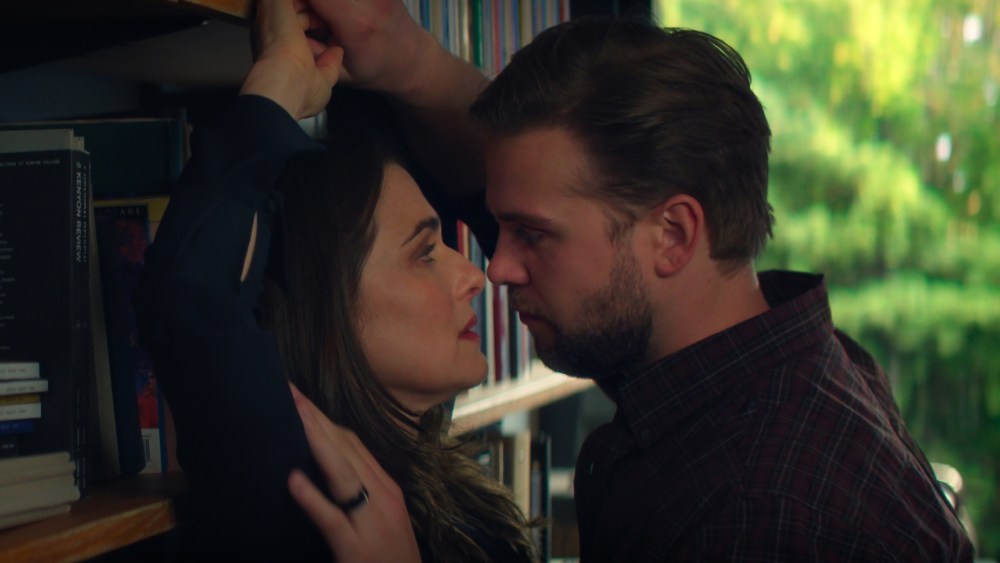
When attached to a story about sexually indiscreet academics of fine literature, the name “Vladimir” automatically invokes the author Nabokov. (Problematic age gaps in teacher-student relationships recall “Lolita,” though a closer analog might be the campus satire “Pnin.”) But when attached to a television show about an unnamed, unreliable narrator (Rachel Weisz) directly addressing the camera, another influence comes to the fore: “Fleabag,” in which Phoebe Waller-Bridge elevated breaking the fourth wall into an art form.
That one-woman show turned Emmy magnet is a high bar to set for oneself, and in adapting her own debut novel as a Netflix limited series, creator Julia May Jonas doesn’t clear it. “Vladimir” takes on a host of knotty issues, from changing sexual mores to aging to infidelity to — imagine the loudest sigh ever sighed — cancel culture. Given that self-assigned degree of difficulty, “Vladimir” is far from the catastrophe it could easily be in clumsier hands. But while Weisz is reliably magnetic and the eight episodes often amusing as farce, “Vladimir” is an imperfect translation of the novel’s hothouse subjectivity to TV’s three-dimensional space, where canvases for projection and conduits for desire take the form of flesh-and-blood human beings. The ensuing issues with casting and pacing aren’t fatal, but they are significant.
Weisz’s antiheroine is a middle-aged professor with chronic writer’s block and mounting insecurity about her potential irrelevance, both erotic and pedagogical. Having gone decades without producing a follow-up to her breakout book, she’s settled for lecturing rapt undergrads on why Daphne du Maurier’s “Rebecca” is akin to Instagram-stalking an ex. With her husband John (John Slattery, TV’s go-to silver fox for a reason) facing a Title IX hearing for a series of affairs with younger pupils, our protagonist could use a distraction. Lucky for her, one walks into a faculty meeting: the titular Vladimir (Leo Woodall), a new, younger colleague whose idea of stress relief is going to the gym — and it shows.
Like the novel, “Vladimir” begins with a flash-forward to its namesake tied to a chair. (The in medias res opening closely followed by a rewind is vastly overused these days, but “Vladimir” comes by this one honestly.) Unlike the novel, “Vladimir” shows the reality bracketing the Weisz character’s obsessive, intrusive fantasies about her crush. Or at least, some of it: producing directors Shari Springer Berman and Robert Pulcini firmly situate us in the lustful professor’s point of view through constant cutaways that detail exactly what she’d like to do with Vladimir in breathless close-ups and swooning slow motion. Exactly how much of these sequences are inspired by actual chemistry is left deliberately ambiguous, to the point where she eventually asks Vladimir outright if she made it all up.
By the time that question is posed, however, the device has worn out its welcome, reiterating the basic fact of the academic’s desire over and over again without complications or narrative advancement. As the story inches toward John’s hearing and the accompanying judgement on whether what was once a routine, consensual practice is now an unforgivable abuse of power, Weisz’s reveries start to feel like padding where they should be an organizing principle. Some of the time could be better spent on other characters: the central couple’s daughter Sid (Ellen Robertson) remains stubbornly underdeveloped, a collection of stereotypes about sensitive, gender-bending youths and convenient plot shortcuts. (John’s accusers are painted with a similarly broad brush, undercutting nuance in favor of generational satire.) Sid is a lawyer, which spares “Vladimir” the need to introduce someone new to represent John in his de facto trial.
“Vladimir” also waits far too long to unpack the mechanics of what our narrator calls “an open marriage, but without all the awful communication.” This “arrangement” is alluded to early on, to explain that John’s dalliances are not exactly the betrayals they appear to be. But “Vladimir” takes its time to reveal how and when the other half of John’s marriage has taken advantage of these liberties in the past. Perhaps the intent is to cultivate suspense, yet the effect is a frustrating vagueness around the base conditions for the show’s central infatuation.
These hiccups could be hand-waved if Woodall and Weisz, also an executive producer, slotted more neatly into the novel’s assigned roles. “It has recently come to my attention that I may never again have power over another human being,” our narrator explains by way of introduction. It’s one thing to read this on the page; it’s another to see the statement emerge from the mouth of a performer very much in possession of the seductive pull her character fears is in her past. To put this as respectfully as I can: I don’t believe Rachel Weisz would or should feel any ambiguity over whether Vladimir is out of her league! Weisz showed her range wonderfully as identical twins in Cronenberg remake “Dead Ringers,” her last TV role. “Vladimir” may push her powers of illusion a hair too far to serve the story.
Woodall, too, reads as out of place, if not as crucially. As on “The White Lotus” and “One Day,” the up-and-coming actor projects enough charm and bravado to justify his coworker’s attraction — just not the intellectualism one associates with a hot-shot scholar. Vladimir is also no boy toy. He’s married to another writer, Cynthia (Jessica Henwick), with whom he shares a three-year-old daughter. The 29-year-old Woodall slots easily into Weisz’s flagrant objectification, yet less so into the real person (who, it’s implied, is using the flirtation as an easy escape from his own complicated home life) beneath the fantasy. Though that dissonance is somewhat purposeful; it’s not like “Vladimir” is told from the perspective of someone who’s interested in Vladimir as more than a means for her own satisfaction.
“Satisfaction” here doesn’t just mean getting off. More than masturbatory daydreams, Vladimir inspires our heroine to write with abandon, ignoring professional and personal obligations in service to her muse. To “Vladimir,” desire is a creative act, a thesis it shares with the profoundly niche Joey Soloway series “I Love Dick,” from 2017. “I Love Dick,” too, adapts a novel about the self-actualizing power of a woman over 40 abjecting herself before her own appetites. It’s an earthier, more holistically sensual show than “Vladimir,” which soundtracks Weisz’s awakening to incongruous pop music that simplifies a complicated subject. (The final sync is a particularly poor note to go out on.) Weisz aces the slapstick comedy of being hot and bothered in an inappropriate setting. But if “Vladimir” wants to prove erotic fixation can lead to artistic transcendence, it never fully walks the walk.
All eight episodes of “Vladimir” are now streaming on Netflix.
First Appeared on
Source link




Leave feedback about this