

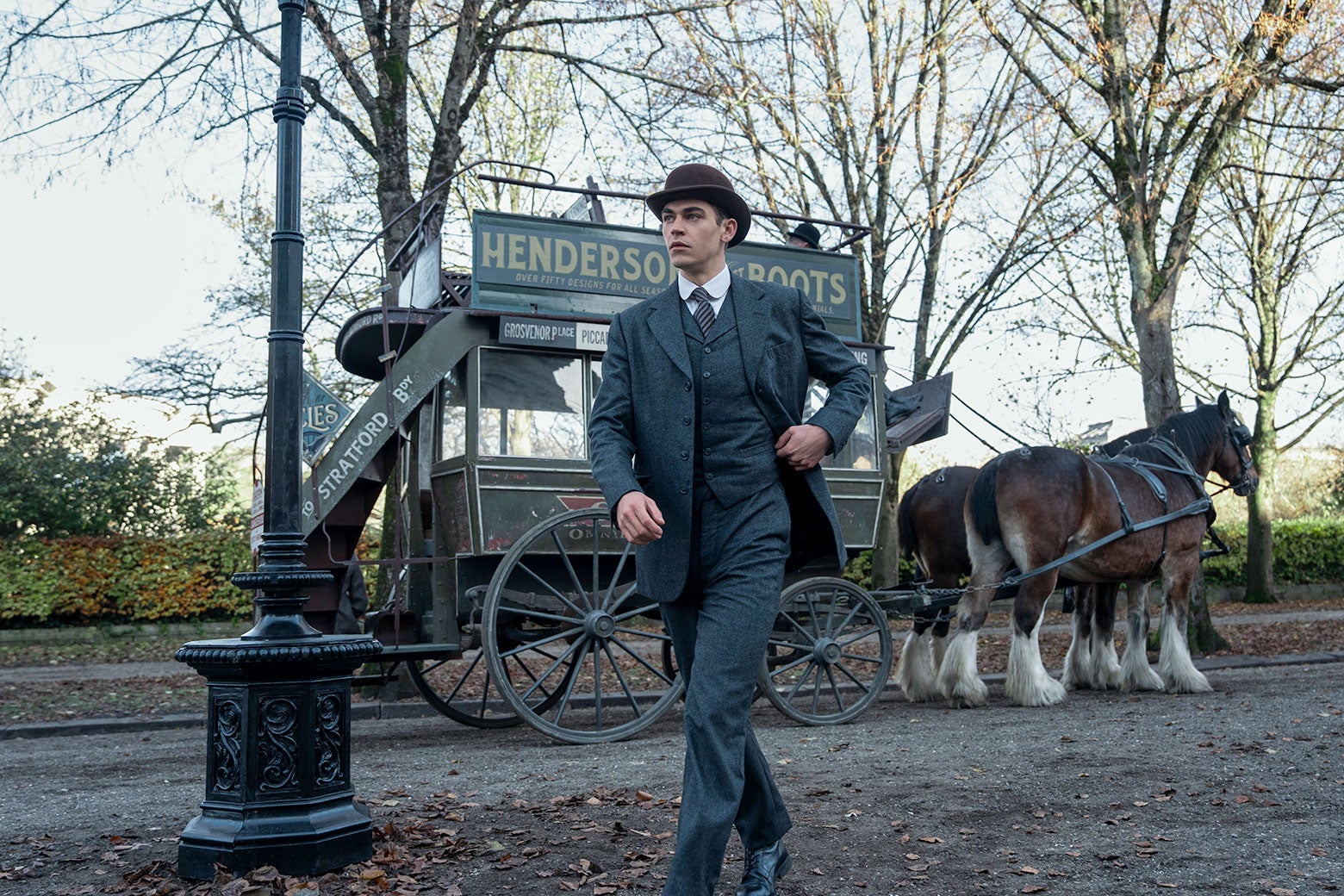
Within the first five minutes of the new Amazon Prime series Young Sherlock, there’s a bare-chested fistfight in a prison yard. Naturally, it’s the work of director Guy Ritchie, and is his second stab at filming the adventures of the great detective, after the 2009 feature film Sherlock Holmes, followed by a sequel two years later, both starring Robert Downey Jr. as Holmes and Jude Law as Dr. Watson. This return is itself something of a mystery, given the mismatch between Arthur Conan Doyle’s beloved source material and Ritchie’s brash, pugnacious aesthetic. What die-hard Holmes fans love about the character—his cerebral methods, his eccentricities, and his serene rationality—seems the antithesis of Ritchie’s love of bare-knuckle brawling, ramshackle plots, and frantic crosscutting timed to big, thumping, bass-driven music cues.
The music, though, does offer a clue. The sinuous title sequence of Young Sherlock, set to Kasabian’s squalling “Days Are Forgotten,” looks and sounds just like the opener for a James Bond film. In fact, all of Young Sherlock suggests that Ritchie wishes he were making Young James Bond, instead, but Sherlock Holmes is in the public domain, while 007 most definitely is not. Set in 1871, but with anachronisms galore, Young Sherlock gallivants from gritty London to the dreaming spires of Oxford and then on to Paris and Constantinople, with a chase scene or fight every 15 minutes or so, and a soundtrack of ’90s indie and folk rock with a bit of Nancy Sinatra tossed in for good measure.
Ritchie’s Sherlock Holmes feature films benefited from the star power of Downey and Law, both actors capable of suggesting some depth beneath the movies’ rakish surface. This time around, his lead is Hero Fiennes Tiffin, best known for playing Tom Riddle in Harry Potter and the Half-Blood Prince and the lead in the After series of young-adult romance films. He’s also the nephew of Ralph and Joseph Fiennes, the latter of whom plays Sherlock’s father, Silas, in the series. Pretty in a pouty, vaguely dissolute way, Fiennes Tiffin is miscast as the ascetic Holmes. Even British filmmakers like Ritchie are apparently resigned to portraying the English class system as a fancy version of the society in an American high school, and Fiennes Tiffin seems better suited to the role of the cruel, arrogant rich kid who gets his comeuppance at the end.
Although Young Sherlock is credited as “inspired” by a series of middle-grade novels by Andrew Lane, considerable liberties have been taken with this source. Lane’s Sherlock was younger, only 14 at the start of the series, while Ritchie’s is 19. (Fiennes Tiffin is 28.) Locked up for sassing a judge, Ritchie’s Sherlock gets sprung by his older brother Mycroft (Max Irons), who informs Sherlock that he’s found a place for him at Oxford, explaining that this is “arguably the greatest university in the world”—because a 19th-century member of the British gentry might not be aware of that? The “place” turns out, absurdly, to be a servant’s job, a position that gets Sherlock embroiled in an incoherent plot involving a Chinese princess and the murders of some professors, for which the young man is blamed. A new friend, an Irish undergraduate named James Moriarty (Dónal Finn), serves as his sidekick in chasing down a series of nonsensical clues that ultimately, of course, lead to both Holmes family drama and a mission to save the world.
Once, in the early years of the 21st century, it registered as clever and insouciant to take some staid Victorian IP, tart it up with au courant tunes and action sequences, then add lashings of saucy wisecracks. Today, however, it feels a bit stale, especially when it comes so lavishly sauced with testosterone. Young Sherlock would have viewers know that both Sherlock and Moriarty are cheeky rapscallions. The two friends spend much of their time smirking and needling each other in a fashion that swiftly becomes tiresome. Even Ritchie seems to realize how punchable Fiennes Tiffin’s Sherlock is, as he gets belted in the face no fewer than three times in the first episode—a rate that, sadly, tapers off as the two buddies turn to investigating the childhood death of Sherlock’s younger sister.
“Investigating” is perhaps too generous a term for the detection practiced in Young Sherlock. In one particularly preposterous scene, the two friends search the office of a professor on the run from the mysterious assassin. Initially puzzled by an arrangement of 13 semi-full glasses on a table, they realize that the glasses are in fact a map to the bell towers of Oxford, which leads to the conclusion that the professor must be hiding in the tallest bell tower. Not a single step in this reasoning makes a bit of sense.
While the other characters in the series talk a lot about how smart Sherlock is, Ritchie hasn’t got the patience or confidence to persuasively demonstrate this. What the script lacks in procedural credibility, the direction makes up for in an almost desperate speed. The storyline is a farrago of secret rooms, hidden passages, keys stashed in hollowed-out books, and chase scenes reminiscent of an Indiana Jones movie—the other IP Ritchie seems to wish he were working with instead of Conan Doyle’s detective.
Sherlock Holmes spawned the first recognizably modern fandom—complete with fanfiction expanding on the canon. Writers and filmmakers have produced countless Holmes pastiches, exploring his cocaine addiction (Nicholas Meyer’s 1974 novel The Seven-Per-Cent Solution), childhood (Barry Levinson’s 1985 film Young Sherlock Holmes), and old age (Mitch Cullin’s 2005 novel A Slight Trick of the Mind). TV showrunners have reimagined the great detective in present-day and American settings (Steven Moffat’s Sherlock and the CBS series Elementary). Gender-flipped TV versions of the Holmes and Watson pairing have aired in Japan and France. The 2021 Netflix series The Irregulars and 2020 film Enola Holmes turned the focus to supporting and outright invented characters in the Holmes canon.
In this vast dispersion of Conan Doyle’s narrative DNA, what makes a story a Sherlock Holmes story? Much as some fans insist upon the late-Victorian setting, with its top hats and hansom cabs, to me the core elements are Holmes’ emotional detachment and deductive wizardry—it only looks like magic until he explains it—and the bond between Holmes and Watson. You won’t find any of that in Young Sherlock, whose hero is a fairly basic upper-class bad boy who shares a jostling, fratty camaraderie with his best friend. The most interesting thing about that best friend is that we know Sherlock and Moriarty will one day end up as archenemies. But, for now, neither young man is engaging enough to make you care how, and no amount of fisticuffs can fix that.
First Appeared on
Source link





Leave feedback about this