

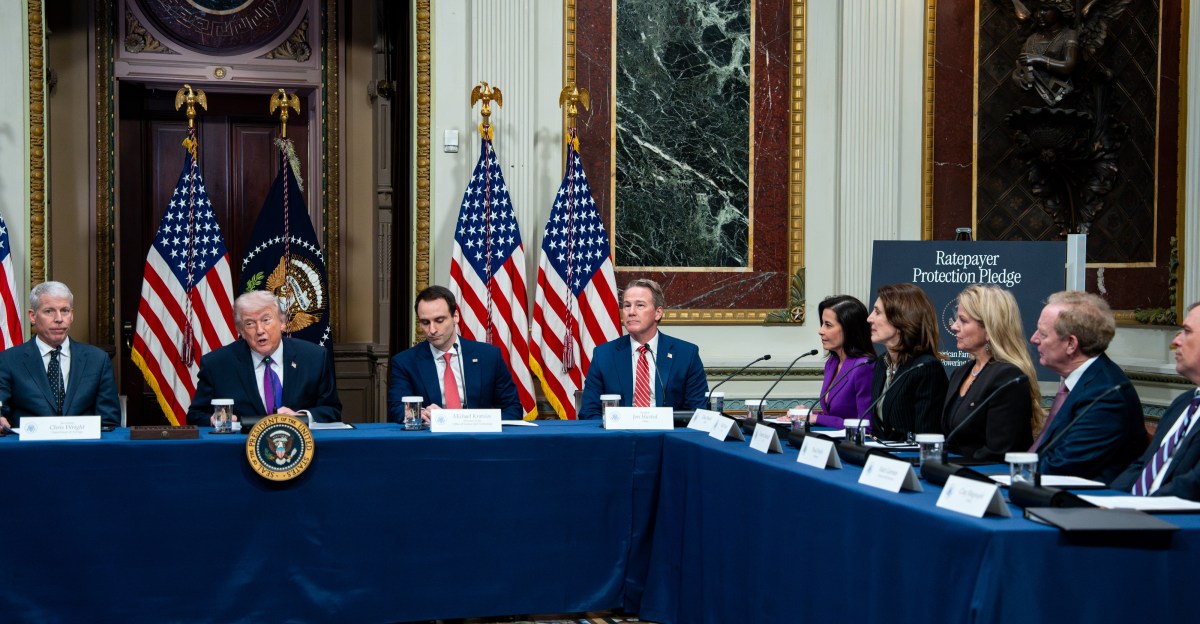
“[Tech companies] need some PR help because people think that if a data center goes in, their electricity prices are going to go up,” Trump said during the event. “Some centers were rejected by communities for that and now I think it’s going to be the opposite.”
“People think that if a data center goes in, their electricity prices are going to go up.”
According to the proclamation, the seven companies present at the event have “accepted the terms of the Ratepayer Protection Pledge” and that “the commitments embodied therein effectuate the national policy of the United States.” It adds, however, that the companies would still need to “voluntarily negotiate” agreements with utilities and state governments.
The president said that the companies will be responsible for adding capacity to the grid “where possible.” He also said they would cover the costs of upgrading existing power infrastructure to meet growing electricity demand. Trump added that the companies should negotiate separate rate structures with utilities, an attempt at ensuring they pay a fair rate for all the extra pressure a data center puts on the grid. Companies would be on the hook for these costs even if data centers don’t wind up using all of the additional electricity generated. That’s a key measure that could address fears that local communities would be left holding the tab for new power plants and transmission lines that become stranded assets if hype around AI fizzles out and data center projects fall flat.
Trump said that the tech giants would “use their infrastructure to contribute back up power to local grids during times of need.” Reducing how much power a data center uses when electricity demand peaks — during a severe winter storm or heatwave, for example — is a measure that could help prevent power outages during disasters. This year’s winter storms have raised concerns about how new data centers could further stress power grids and hike up electricity prices during disasters. Texas passed a law last year giving the local grid operator the authority to cut data centers’ energy use during an emergency. The pledge itself is more vague, saying that companies would “whenever possible, make available their backup generation resources at times of scarcity.”
During the event, Gwynne Shotwell, President and COO of SpaceX (which recently announced it’s merging with xAI with the idea of pursuing plans to shoot data centers into space), said that xAI would develop a 1.2 gigawatt power plant as its supercomputer’s primary power source. The company would similarly develop as much power generation for “every additional data center,” Shotwell said. xAi also plans to expand its Megapack installation to provide backup power to Memphis, Tennessee and Southaven, Mississippi. The NAACP has already threatened to sue xAI twice over pollution from temporary gas turbines it has installed in Tennessee and Mississippi to power its data centers.
The pledge also includes a commitment to hire from local communities where data centers are under construction. Meta announced today that it launched a pilot program in Ohio to train fiber technicians, including some who attended today’s event.
First Appeared on
Source link






Leave feedback about this