

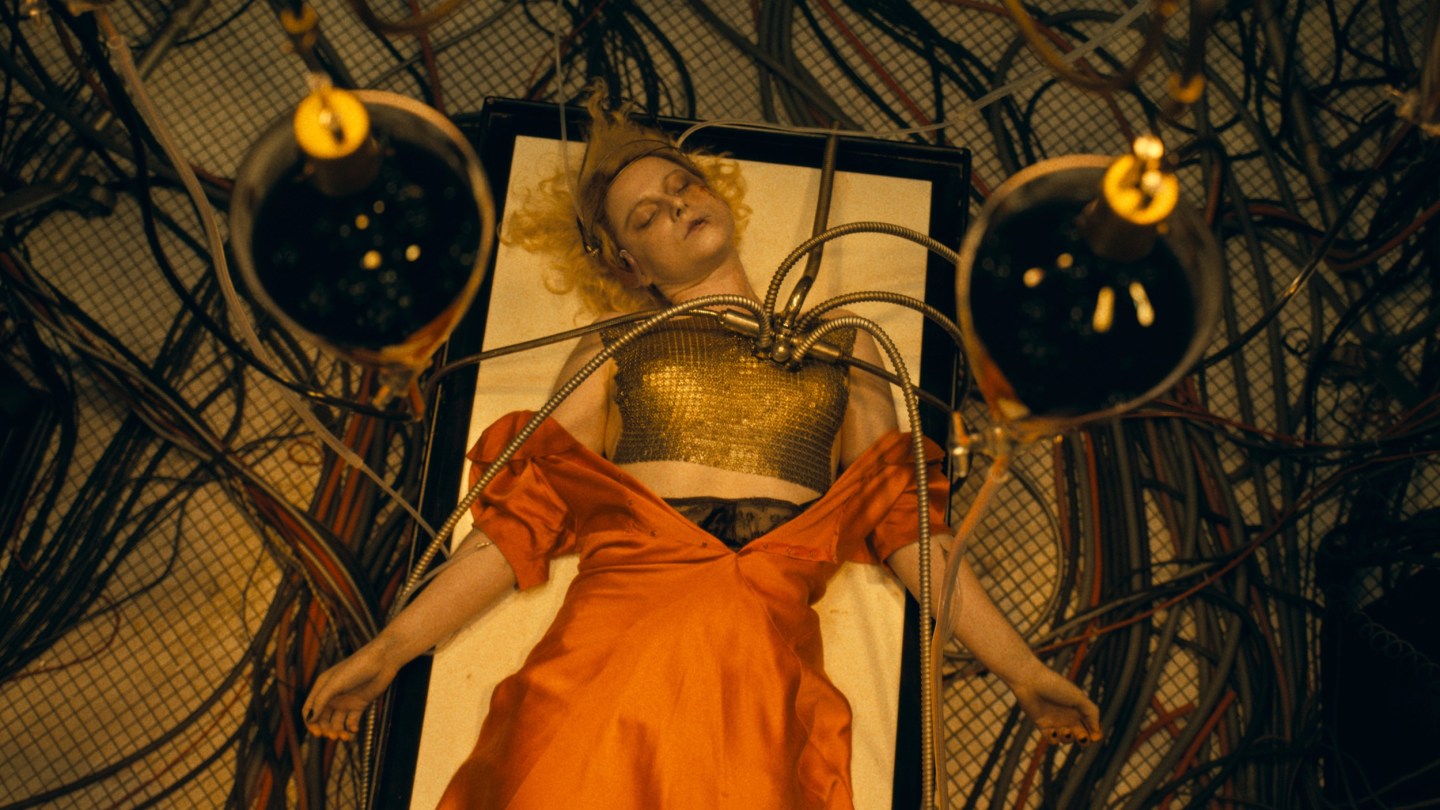
In James Whale’s 1935 gothic horror masterpiece The Bride of Frankenstein, the title character played so indelibly by Elsa Lanchester screams and hisses but otherwise has no dialogue, and yet she has endured as an iconic movie-lore figure for almost a century. (That Marge Simpson electroshock skunk-stripe updo probably helped.) In Maggie Gyllenhaal’s aggressively punky reconsideration of the reanimated monster spouse, she becomes a laborious study guide for a Feminism 101 class, emphatically indicating points on sexual violence, consent, bodily autonomy and female power. She even yells “Me too!” late in the film.
Gyllenhaal’s second feature as writer-director, following the more modestly scaled and psychologically layered The Lost Daughter, is certainly a big swing and The Bride! deserves credit for its ambition and its stylish visuals. But I found myself being pushed away by the movie even before Jessie Buckley bellows “Here comes the motherfucking bride!” at the end of an abrasively distancing prologue. I was already thinking wistfully of the sublime Madeline Kahn’s monster marriage in Young Frankenstein.
The Bride!
The Bottom Line
Best left at the altar.
Release date: Friday, March 6
Cast: Jessie Buckley, Christian Bale, Peter Sarsgaard, Annette Bening, Jake Gyllenhaal, Penélope Cruz, John Magaro, Matthew Maher, Jeannie Berlin, Zlatko Burić, Louis Cancelmi, Julianne Hough
Director-screenwriter: Maggie Gyllenhaal
Rated R,
2 hours 6 minutes
Like Lanchester before her, Buckley plays both the novelist Mary Shelley and her creation, who this time never stops talking. She goes by a handful of names but settles on “The Bride.” Not “of Frankenstein,” in case you missed that point, but a personage in her own right, fully capable of expressing her own needs and defining her own boundaries, bolstered by tenacious agency where once she had none. Even when the title character is freshly reanimated and unable to recall who she was or how she died, her frequent refrain of “I would prefer not to” indicates clear ideas about what she does not want.
Cackling with maniacal glee from the inky black-and-white gloom of the afterlife, Mary seethes tiresomely about a hellish eternity in which she can’t get a story out of her head — “Is it a ghost story, a horror story, or most frightening of all, a love story?” I sure couldn’t tell you.
Cut to 1930s Chicago, where the woman eventually identified as Ida (Buckley) is among a crowd of revelers in a ritzy restaurant, her erratic behavior creating a spectacle, especially once she starts calling out the misdeeds of mob kingpin Lupino (Zlatko Burić) dining at the bar. (The character names I guess must be a nod from Gyllenhaal to studio system trailblazer Ida Lupino?)
It’s unclear at first what Ida’s connection is with two men at the table, Clyde (John Magaro) and James (Matthew Maher), but when James starts trying to force-feed her an oyster — that sound you hear is clanging symbolism — she reacts like someone possessed. Which doesn’t help her when the two men whisk her out onto a stairwell to silence her.
Gyllenhaal blurs the lines between Shelley and her creation as she declares she has a lot more to say, describing herself as disobedient, ungovernable. She leaves out unbearable. “Be warned, the sequel is coming!” she cries, like a portent. With the eeriness dialed up to maximum intensity, the author promises: “If Frankenstein frightened you, my next story will make you stand up and yell, ‘Help!’” Except it doesn’t. The implied terror is merely grating dialogue and a central performance so loud, fussy and mannered that it mutes any power to unsettle that the story might have had.
Frank (Christian Bale), as the stapled scalp monster is addressed here, turns up at the scientific institute and home of Dr. Cornelia Euphronious (Annette Bening), who seems only mildly disconcerted to meet a man well over 100 years old. Having read her extensive writings on reinvigoration, Frank was not expecting a woman. She explains that she publishes as C. Euphronious: “It’s simpler.” That parallel to Shelley, who originally published Frankenstein anonymously at age 20, is one of many unsubtle dings about women being denied authorship, literary or otherwise.
Yearning for a companion, Frank implores the doc to make him a bride and end his loneliness. She refuses, but of course it’s not long before they’re digging up the fresh corpse of Ida, instantly identifiable by her kicky red boots. Frank says she’s too beautiful, but Dr. Euphronious says, “It’s now or never.”
One of many times in which The Bride! is unfortunate in its timing so soon after Guillermo del Toro’s ravishing Frankenstein is the lab reanimation process, absent here of any mounting tension. The same applies to Bale’s monster, who swoons and chuckles over elegant movie musicals featuring matinee idol Ronnie Reed (Jake Gyllenhaal), but can’t match the depth of feeling Jacob Elordi brought to the role for del Toro. (The strains of “Puttin’ on the Ritz” as Frank imagines himself up on screen are another reason to wish you were watching Young Frankenstein.)
Dr. Euphronious has only previously brought small animals back from the dead, but the director shows little interest in that core transformation part of any Frankenstein story. The doctor simply pulls a lever, a voltage surge lights up the room, and hey presto there’s the Bride, sitting up like a broken doll. Having taken possession of Ida, annoying Mary Shelley butts in at random intervals to whisper spooky things like, “Yes, darling, you’re my monster.”
There’s some mumbled business about a reaction to the “crystalloid solution” causing the Bride to spit up black chemicals that stain her face and tongue. But the splatter mark merely serves to give her a distinctive look, the equivalent of the Joker’s smile when she becomes an outlaw killer and inspires a wave of women to ink their faces and go on a copycat crime spree.
The evolution into a fugitive story happens after an interlude in a freaky underground nightclub where the Bride celebrates her newfound freedom in a sexually charged dance to the contemporary music of electronica duo Fever Ray. A couple of unfortunates in the alley outside make the mistake of brushing off Frank and getting rapey with the Bride (a recurring motif), which sets the undead couple’s murderous flight from city to city in motion.
Don’t be mistaken, there’s no lack of eventfulness in Gyllenhaal’s plotting, which strings together genre homages like Christmas tree lights — monster movie, gangster thriller, outlaw escapade, musical romantic comedy, noir. The latter comes courtesy of Detective Jake Wiles (Peter Sarsgaard) and his quick-thinking Girl Friday Myrna Malloy (Penélope Cruz), who is really the brains of the operation but gets no credit because, duh, no one’s ever heard of a “lady detective.”
If any of this were amusing or suspenseful or frightening or tender or soulful or something, it wouldn’t be such a joyless slog. But the movie becomes like a shrill Bonnie and Clyde fever dream in which we have no reason to care about the fugitives so we just wait for them to be apprehended or plugged full of bullets — though possibly not terminated if the good doctor Cornelia and her devoted maid Greta (Jeannie Berlin, wasted) have anything to do with it.
The Bride! looks impressive in IMAX, with sharp large-canvas visuals from DP Lawrence Sher, evocative production design from Karen Murphy and the usual boldly eye-catching costumes from the great Sandy Powell, with an occasional punkish twist on the 1930s. (The Bride’s black and white fox fur shrug is a must-have accessory.) Hildur Gudnadóttir’s big string-energy score does the job, but the movie is more committed to its anachronistic use of contemporary music to shake up the attitude — at one point with a kind of flash mob coordinated dance routine.
The very capable ensemble, all of whom have done impressive work elsewhere, mostly gets smothered by the over-conceptualized, over-intellectualized approach to the material. There’s a glimmer of pathos, nicely played by Bale, as Frank urges his new Bride to flee a crime scene rather than be killed again: “I’ve been through this before. It’s terrible.” But pretty much everything here feels like it’s being done for effect rather than to convey real emotion.
That’s the case especially with Buckley’s shouty performance in the title role. What a strange quirk of timing that the Irish actress will likely be winning an Oscar for Hamnet just as this wretched mess is unleashed upon the world.
First Appeared on
Source link




Leave feedback about this