

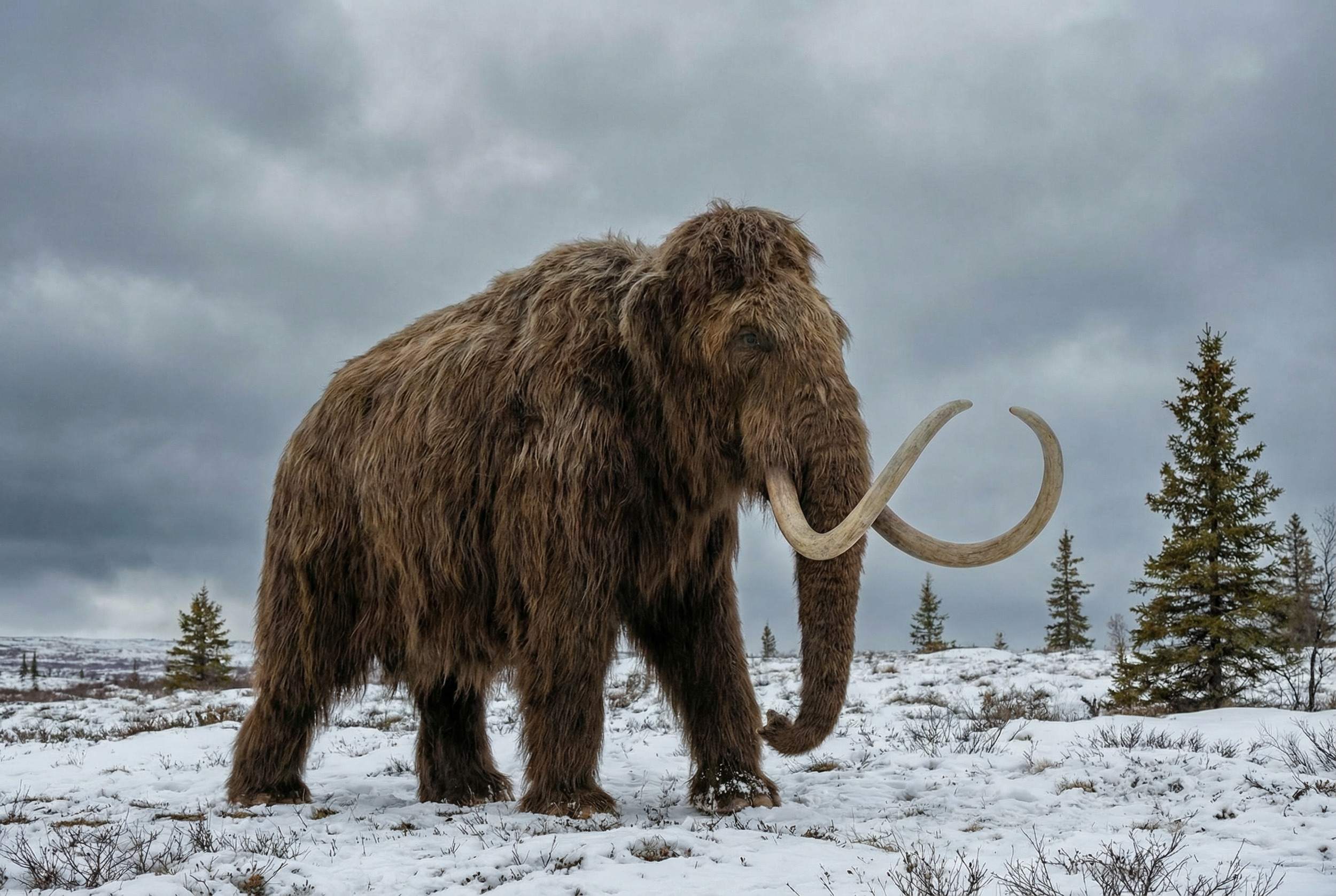
The woolly mammoth is one of the most researched and revered creatures to have ever walked the Earth. These shaggy giants coexisted with early humans, shaped the Northern Hemisphere’s frozen landscapes, and sustained entire ecosystems for roughly 700,000 years. Nothing has filled the ecological void left by their disappearance from the Arctic.
Now, a team of scientists at Colossal Biosciences is attempting to reverse that loss inside a 55,000-square-foot laboratory in Dallas, Texas. The company has assembled over 50 woolly mammoth genomes spanning 1.2 million years of evolutionary history. Its goal is to modify the DNA of the Asian elephant, the mammoth’s closest living relative, to produce an animal that mirrors the mammoth’s appearance, behavior, and ecological function.
The pipeline spans from the extraction of ancient DNA to precise gene editing, validation in mouse models, and embryo cloning. Each stage is currently underway. Colossal says it hopes to produce its first mammoth-like elephant embryos by 2028.
However, for the science of resurrection to succeed, it’s crucial to comprehend the precise loss.
Giants of the mammoth steppe
Woolly mammoths (Mammuthus primigenius) first emerged in northeastern Siberia about 700,000 years ago. They descended from the older steppe mammoth (Mammuthus trogontherii). From Siberia, they dispersed throughout the mammoth steppe, a vast grassland ecosystem that stretched from Western Europe through Siberia and into North America via the Bering Land Bridge.
Adult males stood about 11 feet (3.4 meters) at the shoulder and weighed up to six tons. Their bodies carried a suite of cold-adaptation features. A thick double-layered coat consisting of a dense undercoat beneath long guard hairs reaching up to 28 inches (70 centimeters) protected them from temperatures that routinely plunged below minus 40 degrees Fahrenheit (minus 40 degrees Celsius).
Beneath the skin, a fat layer up to three inches (eight centimeters) thick served as both insulation and an energy reserve. A camel-like hump of fat on their backs functioned as additional storage during lean winter months.
Their iconic curved tusks could grow as long as 15 feet (4.6 meters) and served several purposes. Mammoths used them to sweep snow away while foraging for grasses, sedges, and shrubs buried beneath the surface. The tusks also played a role in male combat and likely functioned as social signals. Researchers who have examined permafrost-preserved mammoth remains have discovered remarkably intact specimens, including calves with preserved trunks, ears, and eye sockets, providing anatomical details a skeleton alone could never reveal.
A study published in Current Biology found that mammoths had ears significantly smaller than those of modern elephants. This trait follows Allen’s rule, which holds that animals in colder climates evolve shorter appendages to minimize heat loss. Woolly mammoth ears measured only about one foot (30 centimeters) across, compared to the ears of an African elephant, which can weigh up to 100 pounds (45 kilograms) and stand nearly as tall as an adult human.
Social creatures with complex lives
Like modern elephants, woolly mammoths lived in matriarchal herds led by an older, experienced female. Males left the herd upon reaching adolescence and either formed small bachelor groups or roamed alone. Core groups typically consisted of related females and their offspring.
Communication within these groups was essential. Elephant culture depends on the survival of elders, whose deep cultural knowledge and social structures pass from generation to generation. Mammoths most likely relied on a range of vocalizations and physical gestures, much as modern elephants do. When those matriarchs disappear, the knowledge vanishes with them.
In a related discovery, Stockholm University researchers recently recovered the world’s oldest RNA from a 39,000-year-old mammoth known as Yuka. The RNA revealed which genes were active at the time of death, including those related to cellular stress and muscle contraction. Researchers also identified microRNAs that regulate gene activity. This marked the first concrete evidence of gene regulation in an extinct animal.
Mammoths as ecosystem engineers
Mammoths did not merely inhabit their environment. They actively shaped it. As keystone species, they maintained the mammoth steppe’s grasslands by uprooting small trees and shrubs, preventing forests from advancing, and promoting grass growth. Their foraging habits spread plant seeds across great distances, boosting the health and diversity of Ice Age plant communities.
This ecological role has drawn the attention of scientists studying climate change in the Arctic. Some researchers propose that the extinction of large grazers such as mammoths led the mammoth steppe to give way to the mossy tundra and boreal forests that now dominate the region. Without herds to compact the snow and expose frozen ground to frigid winter air, permafrost warmed faster.
Colossal’s broader argument for de-extinction hinges on this theory. The company contends that reintroducing large, mammoth-like grazers to the Arctic could help slow permafrost thaw and the release of trapped greenhouse gases.
Humans and mammoths shared millennia
For tens of thousands of years, humans and woolly mammoths lived side by side. Archaeological evidence from sites in Europe, Asia, and North America shows that early humans hunted mammoths for food, constructed shelters from their bones and tusks, and carved ivory into tools, weapons, and artwork.
At the Swan Point archaeological site in interior Alaska, a 14,000-year-old woolly mammoth known as Élmayųujey’eh, or Elma, was discovered. Isotope analysis of her tusk revealed that early Alaskan settlers deliberately positioned their camps in areas frequented by mammoths, suggesting a close, intentional relationship between the two species.
The Clovis people, who arrived in North America roughly 13,000 years ago, relied heavily on mammoths as a food source. A 2024 study published in Science Advances estimated that mammoths composed about 40% of the Clovis diet. These skilled hunters used fluted stone projectile points and sophisticated techniques refined over millennia in Eurasia.
On Kotelny Island in the Russian Arctic, researchers uncovered 10,000-year-old mammoth bones alongside hand-made weapons fashioned from sharpened tusk ivory. The findings demonstrated that humans continued to hunt mammoths and scavenge their remains to fashion tools long after populations had collapsed.
The cause of the woolly mammoth’s extinction
The woolly mammoth’s extinction remains one of paleontology’s most contested questions. Most mainland populations vanished between 13,000 and 10,000 years ago. A small population persisted on Wrangel Island in the Arctic Ocean until roughly 4,000 years ago.
According to Earth.com, research from Aarhus University’s ECONOVO Center indicates that human hunting was the primary driver of megafauna extinctions worldwide. After analyzing the DNA of 139 living large mammal species, scientists found that a universal population decline beginning about 50,000 years ago tracked precisely with the global spread of modern humans. This pattern held across all continents and ecosystems.
Climate change also played a significant role. As the last Ice Age ended, rising temperatures converted the grasslands that mammoths depended on into tundra and forests. A genomic study published in Cell examined the Wrangel Island population and found that it grew from roughly eight founders to about 300 individuals in approximately 20 generations. Despite inbreeding and diminished genetic diversity, the population survived for 6,000 years before vanishing abruptly. This suggests that a random catastrophic event, rather than a genetic decline, caused the final blow.
Studies have also revealed that Columbian and woolly mammoths were frequent hybridizers rather than isolated species. DNA extracted from fossil teeth in western Canada showed that one animal carried more than 21% Columbian ancestry, while another had nearly 35%. This two-way genetic exchange occurred repeatedly over thousands of years and may have helped some populations adapt to shifting Ice Age climates.
The most plausible explanation for the mammoth’s extinction involves the cooperation of both forces. Climate change diminished and fragmented mammoth habitat, while ongoing human hunting pressure prevented populations from recovering.
Examining DNA older than a million years
Ancient teeth represent the first step in Colossal’s de-extinction effort. The team extracts DNA from mammoth molars collected across the species’ historical range, including specimens from Europe, Siberia, and North America. Molars make an excellent source material because their thick enamel preserves genetic information far better than bone, skin, or hair.
The oldest sample in the collection dates to roughly 1.2 million years ago. When researchers at the Centre for Palaeogenetics in Stockholm examined that specimen in 2021, it shattered the previous record for the oldest DNA ever sequenced. Russian paleontologist Andrei Sher originally recovered the specimen from Siberian permafrost in the 1970s. The study, published in the journal Nature, also identified a previously unknown mammoth lineage called Krestovka, which gave rise to the Columbian mammoths of North America through hybridization with woolly mammoths.
Working with DNA this old presents enormous challenges. The genetic material has degraded into billions of tiny, overlapping fragments. Scientists must reassemble these pieces like a shattered mosaic, using contemporary elephant genomes as a guide.
A study conducted at the Centre for Palaeogenetics compared the genomes of 23 Siberian mammoths with those of 28 contemporary elephants. It found that many of the mammoth’s defining characteristics were already present in the earliest woolly mammoths. Traits such as thick fur, fat metabolism, and the ability to perceive cold continued to develop and refine over hundreds of thousands of years. The earliest woolly mammoths probably had larger ears and less insulating fur than their later descendants.
Precise edits reveal the mammoth within
Asian elephants and woolly mammoths share 99.6% of their nuclear DNA. Despite their outward appearances, the Asian elephant is genetically much closer to the mammoth than to the African elephant.
Colossal‘s computational biology team compares mammoth genomes with those of Asian and African elephants to identify the specific genetic variations behind key mammoth traits. These include the iconic shaggy coat, a domed skull, markedly smaller ears, additional fat deposits, and oxygen-carrying proteins adapted to function in extreme cold.
The remaining 0.4% of divergent DNA still represents a considerable stretch of genetic territory in a genome roughly the same size as the human genome. However, Colossal‘s scientists do not need to change everything. They focus on a few hundred specific genes that control the fundamental characteristics that distinguish mammoths.
The team employs a suite of sophisticated gene editing tools, including CRISPR-Cas9, base editors, and prime editors. By swapping individual DNA letters without cutting both strands of the double helix, these precise instruments reduce the risk of introducing unwanted mutations.
Woolly mice test the theory
Before making any changes to an elephant cell, Colossal uses the laboratory mouse as a rapid testing platform. Elephants require two years to gestate. Mice need only three weeks. This speed allows the team to test, refine, and iterate its approach in months rather than decades.
In March 2025, Colossal announced the birth of its woolly mice. Scientists simultaneously altered seven genes in mouse embryos to target pathways that regulate hair length, texture, color, and fat metabolism. The resulting mice displayed noticeably longer, golden-colored, wavy coats that echoed the fur of woolly mammoths.
The colony now numbers in the hundreds. Every modification proved heritable and passed unchanged to subsequent generations. All of the project’s mice survived, and none displayed adverse health effects from the genetic alterations.
According to Colossal, the mouse model allows the team to identify which genetic pathways cooperate and which combinations could prove problematic. Because the three-week gestation cycle enables rapid iteration, scientists will have “absolute greatest confidence” in each edit by the time they engineer an actual Asian elephant cell.
The team also plans to investigate whether these coat traits provide measurable cold tolerance. Future experiments will expose woolly mice and unmodified control mice to varying temperatures to measure behavioral and metabolic responses.
Cloning transforms an edited cell into an embryo
Once a cell has been edited, it moves to the embryology lab for the final step: somatic cell nuclear transfer, the scientific term for cloning. The same fundamental method produced Dolly the sheep in 1996, though Colossal has refined the process considerably.
The procedure begins with an oocyte, or egg cell. Using a precision laser to create a tiny opening in the cell membrane, an embryologist removes the original DNA from the egg. The edited cell carrying mammoth-modified DNA is then placed inside the empty egg.
According to Dr. Alba Ledesma, a veterinarian specialized in embryology at Colossal Biosciences, the team must artificially activate the embryo after removing the original DNA from the egg and inserting the modified cell. The sperm initiates this process during natural reproduction. In the lab, scientists often use electricity to trigger cell division by opening calcium channels.
The embryo then develops the same way any naturally fertilized embryo would. Over the course of several days, it divides repeatedly until it reaches a stage robust enough for implantation into a surrogate mother.
The process demands hundreds of attempts. Cloning remains inefficient despite recent improvements. In November 2025, Colossal acquired ViaGen, the world’s leading animal cloning company. According to Matt James, Colossal’s chief animal officer, ViaGen has cloned more than 3,000 animals across multiple species. That acquisition added decades of real-world reproductive expertise to Colossal’s pipeline.
The same cloning system produced every mammalian species in Colossal’s de-extinction program, including the woolly mouse and the dire wolf.
Next for the woolly mammoth
Colossal now aims to produce its first mammoth-like calves by 2028. The company acknowledges that the timeline is ambitious, particularly given the elephant’s two-year gestation period. Instead of adding traits one at a time, scientists plan to package all mammoth edits into a single engineering cycle.
The stakes extend well beyond a single species. Colossal argues that the genome engineering tools it develops for mammoth de-extinction can bolster conservation efforts for endangered species. In late 2024, the company established the Colossal Foundation, a nonprofit division with a $20 million annual budget and more than 40 conservation projects spanning ten to twelve countries.
Dr. Beth Shapiro, chief science officer of Colossal and a professor of ecology and evolutionary biology at the University of California, Santa Cruz, co-authored the landmark 2021 Nature study that sequenced the world’s oldest mammoth DNA. Dr. Shapiro has emphasized that de-extinction technologies developed for the mammoth can also shield endangered species from contemporary threats, including disease, habitat loss, and climate change.
De-extinction sparks honest scientific debate
Any project of this ambition naturally invites scrutiny, and the scientific community has raised thoughtful questions worth acknowledging. Some researchers question whether a gene-edited Asian elephant truly qualifies as a mammoth. Vincent Lynch, an evolutionary biologist at the University at Buffalo, has argued that editing an elephant to display mammoth-like features amounts to genome engineering rather than genuine de-extinction. Others have asked whether funding directed toward the resurrection of lost species could be better spent on protecting animals that still exist.
These are fair questions, and Colossal has engaged with them directly. The company maintains that de-extinction and conventional conservation are not competing priorities but complementary ones. The Colossal Foundation funds over 40 active conservation projects worldwide, and the genome editing platforms the team builds for the mammoth are already being adapted to help living species. Dr. Shapiro has framed the work as a pipeline that flows in both directions. “The same technological advances that allow us to introduce the genes of mammoths into the genome of an elephant can be harnessed to rescue species teetering on the brink of extinction,” she has stated.
There is also the question of what happens after a mammoth-like calf is born. Reintroducing a large grazer to Arctic ecosystems would require extensive ecological planning, collaboration with Indigenous communities, and long-term monitoring. Colossal has already established partnerships with conservation groups, governments, and Indigenous peoples in the Arctic Circle to prepare for that possibility.
The debate reflects healthy scientific discourse, not a verdict on the project’s merits. Every transformative technology faces probing questions at its outset. What distinguishes Colossal’s approach is that the company treats conservation not as an afterthought but as a core objective built into its research from the ground up.
Why the mammoth’s closest relative needs help now
The urgency behind Colossal’s work extends beyond the mammoth itself. The Asian elephant (Elephas maximus), the very species whose DNA serves as the foundation for this project, faces its own existential crisis. The International Union for Conservation of Nature classifies the Asian elephant as “Endangered.” Fewer than 50,000 remain in the wild, scattered across fragmented habitats in India, Sri Lanka, and Southeast Asia.
Over the past three centuries, suitable Asian elephant habitat has shrunk by nearly two-thirds, driven largely by timber extraction, agricultural expansion, and urban development. Average habitat patch sizes have collapsed by more than 80%. As forests fragment, human-elephant conflicts escalate, threatening both communities and elephants.
This is precisely where the tools Colossal is developing could make a tangible difference for conservation. Techniques for producing elephant stem cells, refining reproductive technologies, and editing genomes to restore lost genetic diversity all have direct applications for saving the Asian elephant and other endangered species. If scientists can master the genome of a creature that has been extinct for thousands of years, the toolkit they build along the way could help prevent the next wave of extinctions from ever occurring.
A species that shaped the Arctic may walk again
If the company’s timeline holds, the world could witness the first woolly mammoth-like calf within the coming years. Whether the scientific community ultimately calls it a mammoth, a cold-adapted elephant, or something entirely new, the creature emerging from this Dallas lab will represent one of the most complex feats of genetic engineering ever attempted. For a species that shaped the Arctic for hundreds of thousands of years, the prospect of a return would be unprecedented in conservation history.
The journal Nature published the full study on the genomes of million-year-old mammoths. Colossal Biosciences provided additional details during a February 2026 press tour of the company’s laboratory in Dallas.
First Appeared on
Source link






Leave feedback about this