

Researchers have drilled 523 meters through Antarctica’s ice, uncovering a sediment core that spans 23 million years of climate history. The core, retrieved from the remote Crary Ice Rise in West Antarctica, offers unprecedented insights into the behavior of ice sheets during warmer climate periods, with implications for future sea-level rise predictions.
The drilling was part of the SWAIS2C project (Sensitivity of the West Antarctic Ice Sheet to 2°C), which aims to understand how the West Antarctic Ice Sheet might respond to future warming. As the core reveals evidence of past ice sheet retreats, scientists are now better equipped to predict how it might behave in response to the continued rise in global temperatures.
A Hidden Archive Beneath Antarctica
At the heart of this discovery is the 228-meter-long sediment core that the team recovered from beneath the ice. According to Huw Horgan, co-chief scientist of the SWAIS2C project, this sedimentary archive provides critical data about how the West Antarctic Ice Sheet and the Ross Ice Shelf behaved during periods when Earth’s global temperatures exceeded 2°C above pre-industrial levels.
As explained in the study, published in Scientific Drilling, the core’s sediment layers reveal a mix of materials, from fine mud to compact gravel, which tell the story of how the ice sheet interacted with its environment over millions of years. This record helps scientists estimate how quickly ice in the region could melt as the planet warms.
Ice Sheet Melt Traces
Fragments of marine organisms and shells suggest that the area, which is now covered by ice, was once an open ocean. This suggests that the Ross Ice Shelf may have retreated in the past, and possibly collapsed altogether, during earlier warm periods. According to co-chief scientist Molly Patterson:
“We saw a lot of variability. Some of the sediment was typical of deposits that occur under an ice sheet like we have at Crary Ice Rise today. But we also saw material that’s more typical of an open ocean, an ice shelf floating over ocean, or an ice-shelf margin with icebergs calving off.”
The new core provides a clearer understanding of the dynamics of Antarctica’s frozen expanse behavior in response to warmer temperatures. Scientists are particularly interested in identifying the triggers for past glacier retreats in Antarctica and pinpointing when these events occurred.
A Remarkable Engineering Feat
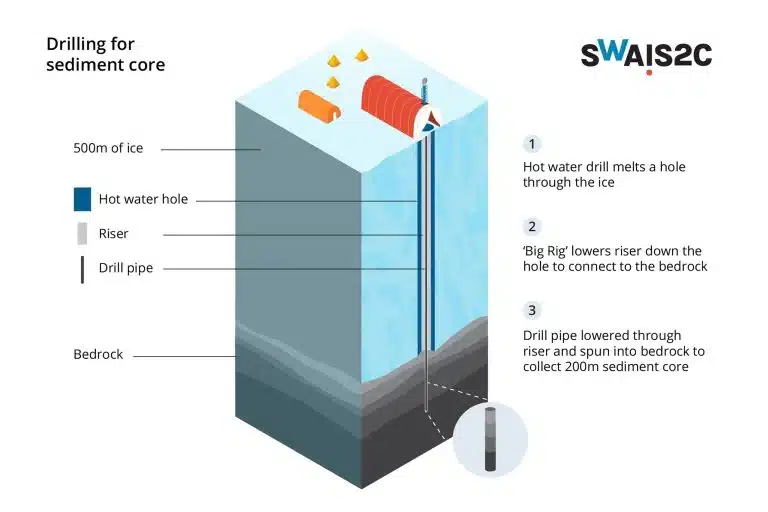
The successful retrieval of the sediment core is a major scientific and engineering milestone. The drilling team, which operated in one of the most remote and inhospitable regions of the planet, faced numerous technical challenges. Previous drilling attempts had failed due to mechanical difficulties, but the team was determined to overcome these obstacles. After months of preparation, they succeeded in drilling through 523 meters of ice using a hot water drill, then lowering a 1300-meter-long riser and drill string to collect the core.
The core was extracted in segments up to three meters long, and each section was meticulously logged and analyzed. The successful operation is a testament to the ingenuity and perseverance of the international team, which included scientists, engineers, and polar specialists from 10 countries.
“With our drilling system having been put to the test under these tough Antarctic conditions and passing with flying colors, we’re looking ahead to plan future drilling to continue our mission to learn more about the sensitivity of the West Antarctic Ice Sheet to global warming,” said Horgan.
First Appeared on
Source link






Leave feedback about this