

March 4, 2026
Sri Lanka says Iranian ship sinks off coast
Sri Lankan officials said Wednesday that 32 injured sailors were rescued from the Iranian frigate IRIS Dena, which sank just 40 kilometers (25 miles) south of Sri Lanka, just outside the island’s territorial waters in the Indian Ocean.
In remarks to Sri Lankan lawmakers, Foreign Minister Vijitha Herath said navy vessels and an aircraft were involved in a rescue operation, but did not specify what caused the Iranian warship to sink.
The 180-crew frigate had issued a distress call at dawn. Sri Lanka’s Defense Ministry said it was still searching for missing sailors.
The Reuters news agency, citing unnamed Sri Lankan Defense Ministry sources, said at least 101 people were missing after a “submarine attack” on an Iranian ship.
A Sri Lankan navy spokesman later said the report of 101 people being missing was not true, and that 32 people injured in the incident had been rescued by the Sri Lankan navy and were under treatment in hospital.
Navy spokesman Buddhika Sampath told the French AFP news agency that Sri Lanka “responded to the distress call under our international obligations, as this is within our search and rescue area in the Indian Ocean.”
Sampath said the sailors were being treated at a hospital in Galle, 115 kilometres (70 miles) south of the capital, Colombo. Sri Lankan officials said they were not releasing footage of the rescue because it involved the military of another country.
https://p.dw.com/p/59m3c
March 4, 2026
Could the son of late Ayatollah Khamenei replace his father?
Following the death of his father Ayatollah Ali Khamenei, 56-year old Mojtaba Khamenei is being touted as a possible successor as Iran’s supreme leader.
Although the younger Khamenei has not been seen in public since the recent strikes began, he is believed to still be alive following the attack that killed both his father and his wife Zahra Haddad Adel.
Before the killings, Khamenei occupied a similar role to that of the eldest son of Iran’s first Supreme Leader Ruhollah Khomeini — “a combination of aide-de-camp, confidant, gatekeeper and power broker,” according to US-based analysts. Internal Iranian documents published by Wikileaks in 2008 paint a similar picture.
Now, with his wife and father considered martyrs, his star has risen amongst the 88-seat Assembly of Experts who will select the next leader.
Born in 1969, Khamenei grew up watching his father agitate for the downfall of Shah Mohammad Reza Pahlavi, whose power was shored up by American and British oil interests.
He fought in the Iran-Iraq war and has worked closely with the Revolutionary Guard, most recently in January to suppress nationwide protests with deadly force, according to the US Treasury.
Khamenei has been accused by opposition politicians of working behind the scenes to ensure that hard-line presidential candidates win elections over reformers.
On Wednesday, a spokesman for the Assembly of Experts said that “the Supreme Leader will be identified in the closest opportunity, we are close to a conclusion.”
https://p.dw.com/p/59lqw
March 4, 2026
Why is Israel striking Lebanon as part of its war against Iran?
Israel has been launching deadly air strikes on Beirut and parts of southern Lebanon since the start of the joint US-Israeli attacks against Iran.
Israel says it has been targeting Hezbollah sites and strongholds in Lebanon.
Here is what you need to know about Hezbollah and its ties to Tehran:
- Hezbollah (Arabic for “Party of God”) emerged in 1982 during the Lebanese Civil War (1975-1990) and the Israeli invasion of southern Lebanon
- It is a political and militant group that is inspired by the Shiite Islamist ideology that underpinned the 1979 Islamic Revolution in Iran
- Since its foundation, it has been supported, trained and equipped by Iran’s powerful Islamic Revolutionary Guard Corps (IRGC)
- The US government estimated in late 2023 that Iran funds Hezbollah to the tune of around $700 million (€661 million) annually
What are Hezbollah’s policies?
-
According to the US-based think tank the Council on Foreign Relations, Hezbollah ‘violently opposes Israel and Western powers operating in the Middle East’
-
It functions as a proxy of Iran, its largest benefactor
-
Part of Hezbollah’s original vision also called for a religious Islamist regime in Lebanon inspired by Iran’s theocratic model
-
Over time, Hezbollah’s local objectives have softened somewhat as the group has grown more involved in mainstream politics
- In 2009, it published a new manifesto acknowledging that an Islamist regime might not be suitable for Lebanon
https://p.dw.com/p/59lwB
March 4, 2026
WATCH — Iran war: A strategic mistake?
Are the US, Israel and Iran repeating the very mistakes history warned us about? Historian Hew Strachan breaks down what Clausewitz and Sun Tzu would say about today’s crisis — and the risk of uncontrolled escalation.
https://p.dw.com/p/59m0S
March 4, 2026
‘You can’t play Russian roulette with destiny of millions,’ Spain’s Sanchez tells Trump
Spain’s Prime Minister Pedro Sanchez on Wednesday repeated his firm opposition to the escalating conflict in the Middle East triggered by the joint US-Israeli attack on Iran last weekend.
Sanchez is the only major European leader to have condemned the US-Israeli attacks on Iran.
His opposition to the large-scale military operation has drawn the ire of US President Donald Trump, who on Tuesday said he would slash trade with Spain over the Spanish government’s position.
In a televised address on Wednesday, the Socialist prime minister said, “This is how humanity’s great disasters start … You cannot play Russian roulette with the destiny of millions.”
“The position of the Spanish government can be summarised in four words: ‘No to the war,'” Sanchez continued, adding that the stance was “consistent and coherent” with its approach to the conflicts in Ukraine and in Gaza.
“We’re not going to be complicit in something that is bad for the world, nor contrary to our values and interests, simply to avoid reprisals from someone,” the prime minister said, in an apparent reference to Trump’s trade threats.
Sanchez pointed to the lessons of the US invasion of Iraq in 2003, which destabilized the region, triggered a rise in Islamist terrorism and caused energy prices to soar.
Sanchez had already previously denounced the US-Israeli bombings of Iran, calling them illegal and reckless. He has also refused to allow the US to use air and naval bases in southern Spain for the campaign against Iran.
Spain was also one of the few European countries to consistently condemn Israel over its war in Gaza.
https://p.dw.com/p/59ljT
March 4, 2026
Iran to hold three-day funeral for Ayatollah Khamenei
Iran will begin a three-day state funeral on Wednesday evening for Supreme Leader Ali Khamenei, who was killed in US-Israeli airstrikes, according to Iranian state media.
The state news agency IRNA said mourners would be able to pay their respects starting at 10:00 p.m. local time (1830 GMT/UTC) in Tehran’s Imam Khomeini Mosque.
Khamenei, 86, was killed Saturday on the first day of the US-Israeli strikes on Iran. He had led the country since 1989.
He is expected to be buried in his birthplace of Mashhad, the country’s second-largest city.
Since the attacks began, Iran has launched strikes against Israel and several US facilities across the Gulf region.
https://p.dw.com/p/59lYv
March 4, 2026
US says nearly 2,000 targets hit in Iran offensive
US forces have hit nearly 2,000 targets in Iran in their offensive against the country since Saturday, the US Central Command (CENTCOM), which oversees US forces in the region, said.
CENTCOM’s Admiral Brad Cooper described the US strikes in the opening hours of the campaign as “nearly double the scale” of the opening attacks of the 2003 US-led invasion of Iraq.
“Our military in the Middle East is undertaking an unprecedented operation to eliminate Iran’s ability to threaten Americans,” Cooper said in an operational video update on X.
“We’ve already struck nearly 2,000 targets with more than 2,000 munitions. We have severely degraded Iran’s air defences and destroyed hundreds of Iran’s ballistic missiles, launchers and drones,” Cooper said.
“In simple terms, we are focused on shooting all the things that can shoot at us,” he added.
The military also destroyed 17 Iranian warships in less than 100 hours, he added. Among the targets attacked was Iran’s “most operational” submarine. The aim was to sink the entire Iranian navy, Cooper said.
https://p.dw.com/p/59lOc
March 4, 2026
Israel warns that any new Iranian leader would be a target
Israel‘s defense minister has warned that any Iranian leader picked to succeed the late supreme leader Ayatollah Ali Khamenei would be targeted for assassination.
“Any leader selected by the Iranian terror regime to continue leading the plan for Israel’s destruction, threatening the United States, the free world and countries in the region, and suppressing the Iranian people, will be a certain target for assassination, no matter his name or where he hides,” Katz said in a post on X.
Katz said Prime Minister Benjamin Netanyahu and he had instructed the Israel Defense Forces to prepare to act by all means as part of the objectives of what Israel has called Operation “Lion’s Roar.”
He added that Israel would continue working with the United States to weaken the Iranian government’s capabilities and create conditions for the Iranian people to replace the regime.
https://p.dw.com/p/59lNZ
March 4, 2026
Israel says new ‘broad wave of strikes’ launched at Iran
Israel says it has launched strikes targeting military sites in Iran, with Iranian state media reporting explosions in the capital, Tehran.
In a message on the Telegram messaging platform, the Israeli Defense Forces (IDF) said it had “begun a broad wave of strikes targeting the Iranian terror regime’s launch sites, aerial defense systems, and additional infrastructure.”
It was reported that a residential building had also been hit.
The IDF said it hit buildings linked to the Basij, the all-volunteer force of Iran’s paramilitary Revolutionary Guard that carried out a brutal crackdown on protesters in January, killing thousands. It said dozens of Basij bases, “used by the Iranian regime to maintain its stability and tighten its control,” had been hit.
The Israeli military also said it struck buildings associated with Iran’s internal security command.
https://p.dw.com/p/59lAZ
US gives permission for non-emergency staff to leave Cyprus
Rana Taha
The US embassy says non-emergency personnel and their families in Cyprus have permission to leave the country amid fears that it will be further targeted by Iran.
The US State Department “authorized non-emergency US government employees and US government employee family members to leave Cyprus due to the safety risks,” the embassy said.
Early on Monday, Iranian-made drones were targeted on the the Mediterranean island, causing limited damage.
https://p.dw.com/p/59lA6
March 4, 2026
Iran stikes back against Gulf countries
Iran continued strikes across the Gulf region overnight from Tuesday to Wednesday.
In Kuwait, an 11-year-old girl was killed by falling debris.
Attempts by emergency services to revive her were unsuccessful, the Kuwaiti Health Ministry said in a statement on Wednesday morning.
The ministry did not provide any details about the type of debris that struck the girl.
Kuwait’s air defense system shot down a number of Iranian drones and missiles, with reports of debris from the enemy targets causing damage and injuries.
Saudi Arabia‘s defense ministry meanwhile said two cruise missiles were intercepted on Wednesday over an area south of the capital Riyadh.
“Two cruise missiles were intercepted and destroyed in Al-Kharj” district, a defence ministry statement said.
It also reported intercepting and destroying nine drones in a separate attack.
https://p.dw.com/p/59l0K
March 4, 2026
Several killed in fresh strikes on Lebanon
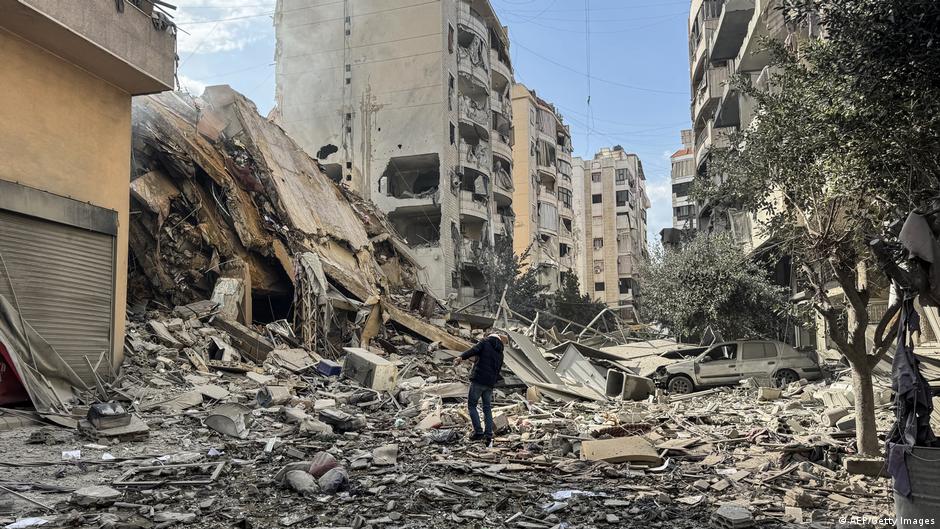
At least 10 people were killed in the latest round of Israeli strikes on Lebanon overnight.
Lebanese state media said an Israeli strike on an residential building in the eastern town of Baalbek killed at least four people and wounded others.
In Aramoun and Saadiyat south of Beirut, the Health Ministry said Israeli strikes killed six people and wounded eight others. It cautioned that this was a “preliminary toll.”
The towns outside the traditional strongholds of Iran-backed militant group Hezbollah.
An Israeli strike also hit a hotel in the Lebanese capital, Beirut.
The latest strikes comer after World Health Organization chief Tedros Ghebreyesus condemned the killing of three paramedics in earlier Israeli strikes.
Another six people were wounded while recovering people who had been hurt by explosions, he said.
The Israeli military earlier announced “broad-scale strikes” against Hezbollah after the militant group fired a barrage of missiles on drones on Israel on Monday.
It also announced on Tuesday that ground troops had seized areas of southern Lebanon close to the border with Israel.
https://p.dw.com/p/59l0I
March 4, 2026
Trump administration may arm Kurdish leaders in Iraq: Reports
US President Donald Trump has talked to several Kurdish leaders in Iraq in the past days to discuss the war against Iran.
Trump talked to Bafel Talabani, the head of the Patriotic Union of Kurdistan (PUK) in Iraq, the party said on Tuesday.
It said Trump told Talabani about his further plans regarding the war with Iran.
Trump spoke on Tuesday with the president of the Democratic Party of Iranian Kurdistan (KDPI), Mustafa Hijri, according to US broadcaster CNN.
The US news website Axios reported that Trump also spoke with Iraqi Kurdish leader Masoud Barzani from the Kurdistan Democratic Party (KDP) on Sunday.
Why is Trump speaking to Kurdish groups in Iraq?
There is much conjecture about why Trump is reaching out to Kurdish leaders in Iraq,
The Wall Street Journal says that Trump is considering supporting them in a fight against Iran’s leadership.
US broadcaster CNN goes a step further. It says that the CIA, the country’s foreign intelligence service, is working to arm Kurdish forces, citing multiple unnamed sources.
Iraq’s autonomous northern Kurdistan region shares a border to Iran. Several Iranian Kurdish opposition groups are also based in Kurdistan.
Kurdish militias, already already an important ally of the US in the fight against the terrorist group Islamic State in Iraq and Syria, have thousands of battle-hardened fighters in the region.
Iran has also been targetting Iraq’s Kurdistan region.
https://p.dw.com/p/59kwG
First Appeared on
Source link






Leave feedback about this