

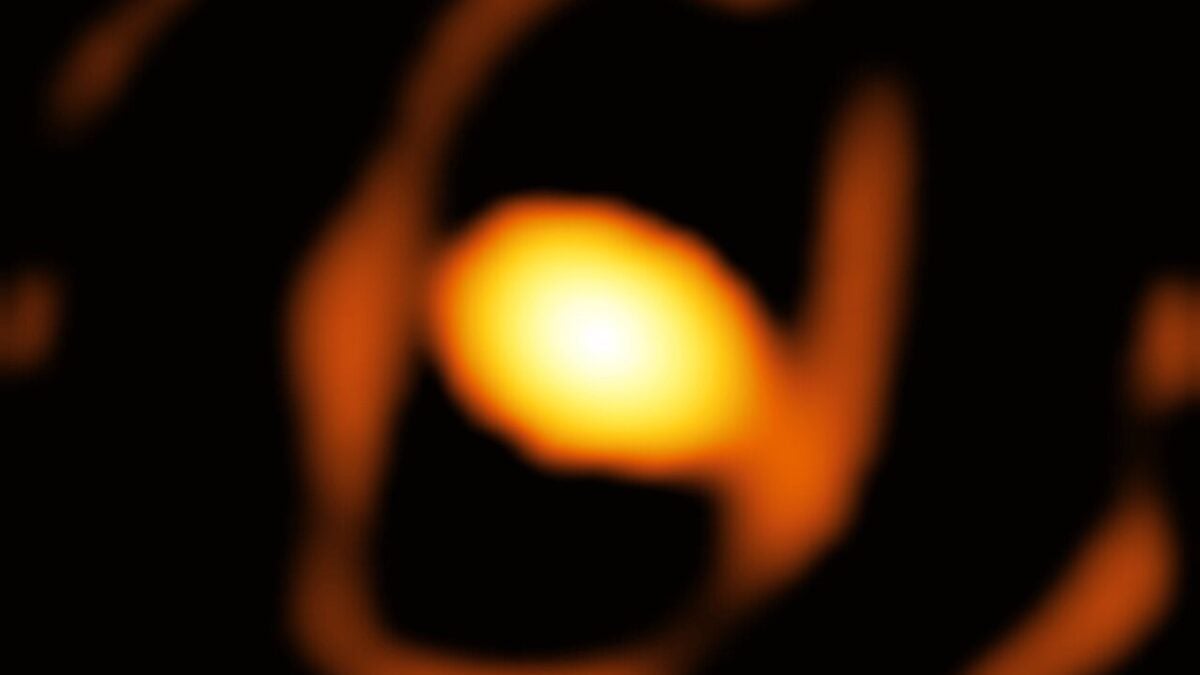
A massive star nearing the end of its life has donned a new face, changing color and becoming hotter in a surprisingly short amount of time. The dramatic transformation may be indicative of its impending doom, giving us a rare opportunity to witness a supernova in the making.
A team of astronomers has been monitoring a red supergiant star in the Large Magellanic Cloud over the past decade, recording an increase in surface temperatures as it evolved to a yellow hypergiant star. The findings, reported in a recent study published in Nature Astronomy, provide new insight into stellar evolution and a unique opportunity to observe the late stages of a star’s life.
Live fast, die young
Red supergiants form when a massive star burns up the hydrogen in its core and is headed toward the final, unstable stage of its life. Astronomers first discovered the red supergiant, named WOH G64, in the 1970s, and it remains one of the largest known stars in the universe.
The star is 28 times the mass of the Sun and has been around for nearly 5 million years. Although it’s relatively young compared to the age of the universe, WOH G64 was born large and is therefore destined to live a short life. The Sun, on the other hand, is around 4.6 billion years old and will likely continue to burn hydrogen for another 5 billion years.
WOH G64 may already be on its way out, shedding its outer layers and shrinking as it heats up. Astronomers began noticing the star’s drastic behavior in 2011, when it started to dim. Two years later, the star had regained its luminosity but looked completely different than it did before.
The star’s surface temperatures had increased by more than 1,000 degrees Celsius (1,800 Fahrenheit), turning its signature red color to yellow. It also shrank as a result of becoming hotter, going from 1,500 times the radius of the Sun to just 800 solar radii, according to the study.
Yellow hypergiant stars are extremely rare, representing a brief, evolutionary phase of a star’s life as it transitions from a red supergiant to its eventual supernova phase.
More life or earlier death?
The dramatic transformation marks the most extreme changes ever witnessed for a star. The evolution of stars typically takes place over billions of years, extending beyond the human timescale. Therefore, astronomers can only theorize over what happens to a star approaching death but have never witnessed it taking place in real time.
The team of astronomers behind the study came up with two possible scenarios to explain the star’s strange behavior. WOH G64 may be bound to a binary system, with its companion star becoming engulfed beneath its expanding surface. The interaction between the two stars could have ejected the outer layers of the supergiant, leading to its transformation.
Another theory is that the star may have undergone an eruptive episode predating the observations, turning it into its red state. Now, the star is returning to its quieter, more docile form and original yellow color.
Since this type of transformation has never been observed before, it’s hard to predict what might happen next for WOH G64. Only time will tell whether the star eventually explodes in a supernova, giving us a rare front-row seat to the cosmic action.
First Appeared on
Source link





Leave feedback about this