

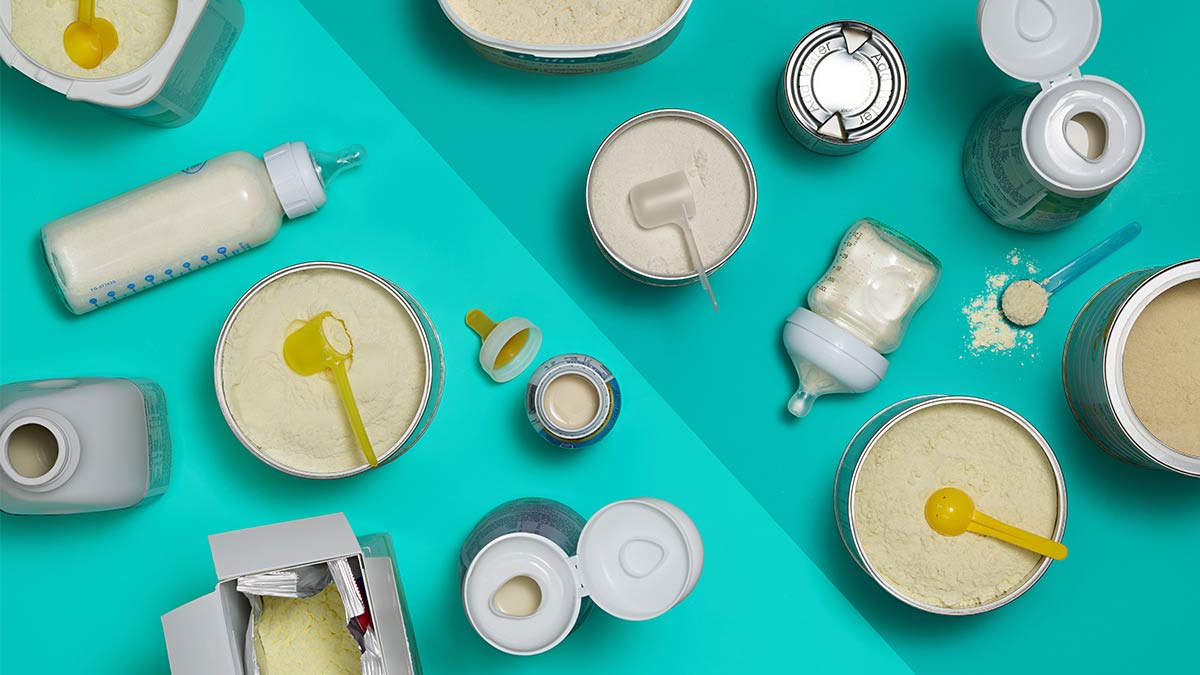
We tested 49 different formulas, but the U.S. market is almost entirely dominated by just a handful of formula manufacturers. About half of all formula bought in the U.S. is bought through the Special Supplemental Nutrition Program for Women, Infants, and Children (WIC), and almost all of that is made by just two companies: Abbott and Mead Johnson. Abbott makes Similac and EleCare, while Mead Johnson makes Enfamil and PurAmino.
A third company, Perrigo, is responsible for making many familiar store brands—including Kirkland Signature (Costco), Member’s Mark (Sam’s Club), Parent’s Choice (Walmart), and Up&Up (Target)—as well as Dr. Brown’s, which we tested last time, and Earth’s Best, which we included in this current round of testing.
Together, the formula made by these three companies—Abbott, Mead Johnson, and Perrigo—makes up 79 percent of the U.S. market, according to 2022 estimates.
CR sent questions to all the companies about the types of contaminants they test their ingredients and products for, their thresholds for allowed contaminants, and what they thought might be the sources of any contaminants we found in our tests. We also reached out to companies producing formulas that didn’t contain contaminants to learn what they were doing to achieve these positive results.
Similac and EleCare manufacturer Abbott Nutrition and Enfamil manufacturer Mead Johnson both sent detailed responses to CR’s test results and questions. These companies, which dominate the infant formula market, have products that appear in every category in our charts; CR’s tests detected contaminants at levels of concern in some of their formulas and didn’t detect them in others.
Both of these companies challenged CR’s results. They argued that trace levels of heavy metals occur naturally in the environment and throughout the food supply, and that this is not an issue that is unique to infant formula.
“Abbott’s infant formulas are safe and parents can use them confidently,” wrote a spokesperson for Abbott. “Today, Abbott’s infant formulas—including those sold in the U.S.—meet existing regulations for heavy metals set by the European Commission and Health Canada. These European Commission limits are the most stringent regulatory limits for heavy metals in infant formula adopted to date by any nation in the world. They also meet FDA’s current limits for heavy metals in (non-formula) baby foods, children’s juices, and drinking water. The test results shared with Abbott by Consumer Reports confirm as much.” Abbott also took issue with CR’s use of California’s extra-protective limits to assess risk.
“We employ stringent testing protocols and are proud of our efforts to date to reduce the levels of unintended materials in our products, which meet all safety and quality standards set by U.S. and global regulatory bodies,” wrote a Mead Johnson spokesperson, adding that “we test ingredients prior to manufacturing our products” and “we employ a stringent testing protocol for all finished products. Only products that meet our rigorous safety standards are released to market.” Mead Johnson also emphasized that heavy metals are never intentionally added to its products.
Perrigo, which makes Dr. Brown’s and Earth’s Best formula, as well as many popular store brands in our tests, including Mama Bear (Amazon), Parent’s Choice (Walmart), and Up&Up (Target), told us that it performs risk assessments for all its raw ingredients and tests for any contaminants of concern, and that it surveys all its finished products for 25 to 30 contaminants.
Danone is the parent company of Happy Baby Organics and Nutricia (which makes Neocate, Pepticate, and Fortini). Happy Baby Organics, which performed well in these tests, told CR, “Every batch of product undergoes more than 1,850 rigorous quality and safety tests, including testing for heavy metals.” Nutricia, whose formulas had more mixed results in our tests, said, “Nutricia infant formula batches undergo more than 1,000 quality tests, including testing heavy metals, to help ensure high quality and product safety before reaching families.” Both Happy Baby Organics and Nutricia also added that they screen their formulas for Clostridium botulinum, the bacteria responsible for infant botulism.
Kendal Nutricare, which makes a ready-to-feed Kendamil milk-based formula and a powdered goat milk formula in our tests, said that it takes “extensive measures to control and reduce” environmental contaminants in its products. “In the case of our goat recipe, inorganic arsenic levels were well below even the most conservative safety limits and within the range naturally expected for milk-based formulas,” wrote a Kendal Nutricare spokesperson.
Nannycare, which produces goat milk formula in New Zealand for the U.K. market, told us, “The trace levels of certain contaminants reported in your testing are consistent with what is commonly observed at very low background levels in agricultural and dairy-based foods and are widely recognised by regulators as unavoidable at trace levels.”
Australian manufacturer Sprout Organic told CR, “Based on the data provided, the results show low-level presence of certain elements that are known to occur naturally in plant-based ingredients” and that “the detected levels fall within internationally recognised health-based benchmarks.”
All the Bobbie formulas we have spot-checked in both rounds of testing have been in the top-choice category, with no or low levels of detected contaminants. In a statement to us, a Bobbie executive wrote, “We have strict standards for contaminants across the board—every ingredient we bring into our process has strict requirements for heavy metals, microbials, and other contaminants.”
A representative from Jovie, which makes a European goat milk formula that performed well in our tests, said, “Our infant formula complies with strict EU requirements and is subject to rigorous testing at every stage, from incoming ingredients and (packaging) materials to the finished product.”
Nestlé’s representative told us, “All findings referenced by Consumer Reports fall within established regulatory limits, and our formulas continue to meet our strict safety and quality standards for infant nutrition,” and also wanted to make it clear that the recent global Néstle recall did not affect any of its formula produced for the U.S.
Our tests detected acrylamide, BPA, or both in three powdered formulas. Mead Johnson, which makes Enfamil Nutramigen, challenged CR’s test results for these contaminants and said that neither contaminant had ever been detected in any of the company’s products in its own tests. Sprout Organic said, “Acrylamide can form in small amounts during heat-processing steps common to many dry food products,” and that the BPA levels we identified in our tests “are extremely low and . . . well below levels considered to pose a health risk.” Nannycare did not comment specifically on CR’s BPA test results of its formula.
HiPP, Holle, and The Pure Goat Company did not respond to CR’s requests for comment.
First Appeared on
Source link





Leave feedback about this