

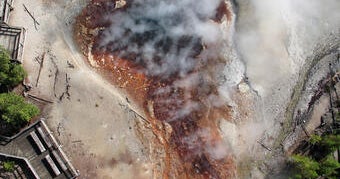
The world’s largest acidic geyser has begun erupting again in Yellowstone after slumbering for over five years, the national park said Monday.
Echinus Geyser, located in the back basin of the Norris Geyser Basin at Yellowstone, is about 66 feet wide and is surrounded by rocks that resemble sea urchins. The geyser was named for those rocks, Yellowstone said, after mineralogist Albert Charles Peale noted the resemblance during a visit to the site in 1878.
Echinus is made acidic because of a mix of acidic gases and neutral waters, Yellowstone said. Many acidic geysers break down the rock that forms a geyser, but the acidity at Echinus is not strong enough to eat away at the surrounding stone. The acid is not concentrated, making it more like “orange juice or vinegar,” according to the park.
Instead, “that somewhat unique water chemistry results in interesting formations and compositions,” Yellowstone said, including the red color around the geyser pool and the spiny rocks.
Yellowstone National Park
Echinus erupted often in the late half of the 20th century, and viewing platforms and benches allowed visitors to get closer to the site than any other geyser in the park, according to Yellowstone. In the 1970s, the geyser erupted every 40 to 80 minutes, and in the 1980s and 1990s, the eruptions could last as long as 90 minutes and reach as high as 75 feet. Sometimes the eruptions were even horizontal, soaking visitors with warm water.
The geyser’s activity started to wane in the early 2000s. In 2010, a temperature monitoring system installed in the geyser’s outflow channel allowed Yellowstone to monitor changes. The system recorded 15 sporadic eruptions between October 2010 and January 2011, and eruptions remained few and far between until October 2017. The eruptions were consistent for several weeks, but then “suddenly stopped,” Yellowstone said. There were a few eruptions over the following years, but the geyser was largely inactive.
In February 2026, the geyser started showing signs of activity. It erupted on Feb. 7, then again throughout the next week. There were regular 20-30 foot eruptions every few hours beginning on February 16.
In recent days, the geyser has had spikes of activity that tend to precede eruptions, but no actual eruptions, according to a temperature graph.
The park said it is unlikely the geyser will continue erupting into the summer, but there is no way to predict what may actually occur.
First Appeared on
Source link





Leave feedback about this