

On February 28, 2026, the United States and Israel launched a joint military operation against Iran, resulting in the killing of Supreme Leader Ali Khamenei. Brookings experts break down what the ensuing war means for Iran and what’s at stake internationally and domestically.
Suzanne Maloney
‘Khamenei raft’
In February 1979, after months of internal unrest, Iranian newspapers announced the departure of Mohammad Reza Pahlavi, the last king of Iran. The massive banner headline declaring “Shah raft” (“the Shah is gone”) quickly became iconic. That concise phrase and the vivid image evoked the magnitude of this historical moment, at the culmination of an unlikely popular revolution that toppled the modernizing monarch of a wealthy, pro-Western state in a strategically and economically vital region.
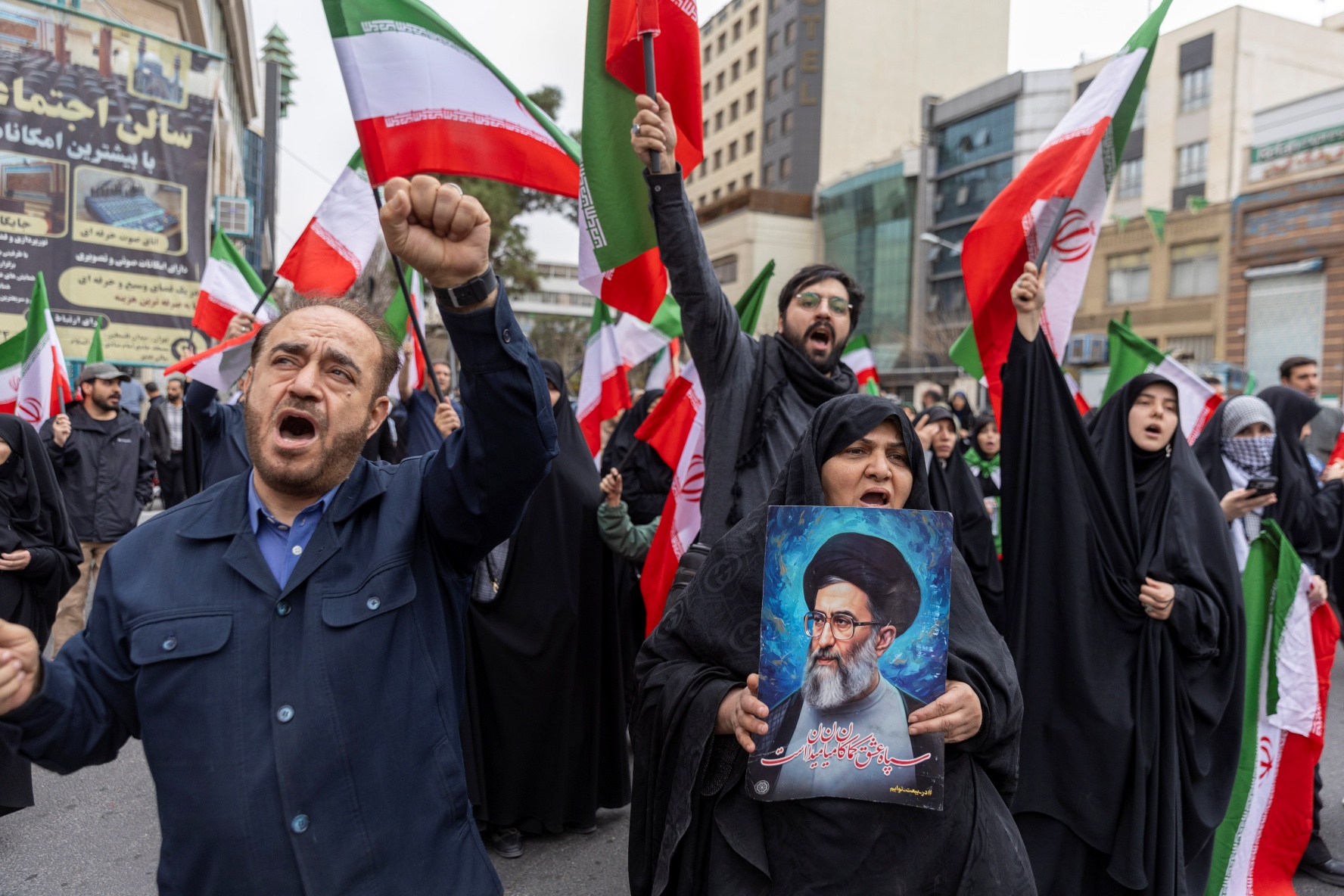
Saturday’s death of Ayatollah Ali Khamenei, the supreme leader of the state that succeeded the monarchy, in an Israeli airstrike on his compound, is no less momentous. Over the course of nearly 37 years in power, Khamenei cemented the unique dominance of his office, thwarted every effort to make meaningful changes to Iran’s approach to the world, and empowered and expanded its influence across the region. For many Iranians and others, Khamenei’s quick elimination elicited celebrations and a rare sense of hope for the future.
Sadly, however, that hope may be short-lived. Just as the shah’s departure failed to usher in the aspirations of the millions who rallied in the streets during the 1979 revolution, it’s highly uncertain that the U.S.-Israeli operation will successfully produce a real transition to a different regime. Over the past few days, airstrikes have powerfully degraded Iran’s military capabilities and decapitated key political and military leadership. Still, the deeply embedded networks and institutions that have underpinned the Islamic Republic for nearly half a century ensure that, at least in the near term, the vestiges of the power structure continue to hold an overwhelming advantage over any challengers.
To regain some leverage even as the country remains under bombardment, Tehran is deploying its time-tested strategy of escalating strikes on its neighbors’ energy and economic infrastructure in the hopes of creating pressure and incentives for diplomacy. After the attrition of its proxies and its nuclear program at the hands of Israel and the United States over the past 18 months, and then the shock of a massive internal uprising in January, the regime saw this conflict coming. For Iran’s battered and bloodied regime, the stakes are existential. Imposing high costs on Washington, their neighbors, and the global economy is their survival strategy.
Itamar Rabinovich
Tehran’s radical turn
The initial air raid, which killed Khamenei and several of his family members and other officials, inflicted a heavy blow on the regime. However, the decapitation strike neither toppled the regime nor produced an immediate wave of popular opposition. The regime’s radical core is taking charge, evidenced by attacks on Arab neighbors, and seems to be entrenching itself rather than seeking an accommodation with the Trump administration. It appears likely that it would take more than the initial phase (five days to several weeks) to bring about a regime change. It is an open question whether Trump will have the patience for a lengthy campaign. At some point, the current U.S.-Israeli harmony could be disrupted by Trump’s potential quest for a swift ending and Netanyahu’s more ambitious war aims.
The Iranian leadership is in a radical mood, manifested by its conduct of the prewar negotiations with Washington and its policy of launching missiles at the Arab Gulf countries (including friendly Oman) and seeking to hit Cyprus. This is clearly an ill-calculated effort to persuade the United States and the international community that the war’s continuation is too costly and too dangerous. It is ill-conceived and is likely to be counterproductive. Should the war end with a weakened version of the current regime in power, its Arab neighbors will have to rethink the policies they pursued in the last few years (treading a fine line between the United States and Iran).
Finally, there is an important domestic Israeli dimension. Netanyahu and his right-wing coalition are trailing in the polls ahead of the elections scheduled later this year. The war’s successful outcome would play into Netanyahu’s hands, while a dubious outcome would enhance the opposition’s prospects.
Mara Karlin
High-end war, low-cost drones
The horrific October 7, 2023, Hamas attacks triggered a series of conflicts across the Middle East, culminating this weekend in sweeping American and Israeli efforts to conduct regime change in Iran. Together, the U.S. and Israeli militaries have apparently hit more than a thousand Iranian targets in two days, demonstrating a historic joint operation against high value political and military people and places, and employing sophisticated conventional capabilities paired with rich intelligence and strategic planning.
In response, the Islamic Republic has operated like there is no tomorrow—which is plausible given the breadth, depth, and efficacy of these attacks on its foundations. In doing so, Iranian missiles and drones have attacked at least nine different countries as of Monday morning, including Gulf bases where the U.S. military operates, likely executed by devolved command and control. Iranian efforts to expand the war have resulted in a number of countries who hoped to avoid engagement in this conflict now being brought into the conflict. While many Iranian missiles have been shot down, relatively low cost Iranian drones appear to have been more effective in evading air defense and hitting targets; further evidence that contemporary wars span the low to high end of the continuum of conflict. This latest chapter in Middle East wars looks like “everything everywhere, all at once.”
Vanda Felbab-Brown
The limits of leadership targeting
In the United States and Israel’s war against Iran, the Trump administration announced as a key goal the end of the theocratic regime that has ruled Iran since 1979. But it’s provided few—and contradictory—details as to what the regime’s end means, and the new political dispensation it would find satisfactory. It merely called on the Iranian people to overthrow the regime, without repeating its earlier promises of protection.
In the first days of airstrikes, the United States and Israel killed the ayatollah as well as several top leaders of the Iranian military and the Islamic Revolutionary Guards Corps (IRGC), adding to those killed in July 2025 during the joint attacks on Iran’s nuclear facilities. But the Iranian regime is vast, with sprawling religious authority, layers of officers across various armed branches and militias, and widespread control of the country’s economic assets. Even if the United States and Israel continue mowing down newly-replaced leaders for weeks, the IRGC and various armed forces and their economic assets will not just melt away, even if they eventually fracture.
Even a future electoral process, should a transitional regime at some point emerge, may not lead to a sustained democratic system. Although many people in Iran crave it, such outcomes require nurturing over many years, including from the external intervener. Iran’s fragmented political opposition may produce unstable governments that struggle to satisfy the immense economic needs of the Iranian people and a clamoring for a strongman. And that’s even if armed struggles and militancy don’t rise, such as from Iran’s oppressed Kurdish and Baluch people or from Islamist groups.
The Trump administration broke a cruel, brutal, and dangerous regime with little clarity, planning, readiness, and accountability for how to foster a new, desirable replacement system. In Venezuela, it remains satisfied with 99% of the Maduro regime staying in power, including those with egregious human rights records, and only cosmetic political liberalization, as long as the “new” regime appears to be doing U.S. oil bidding. President Donald Trump is hinting that such a minimal change of leadership in Iran may be enough for him. It hardly will be for the Iranian people or Israel.
Stephanie T. Williams
Flying blind
We are flying blind, captured by magical thinking. The United States has launched an entirely volitional and illegal war against a country in which it has had no diplomatic presence for nearly 50 years. Against a theocratic dictatorship whose leader the U.S. military has now decapitated, and who will be mourned by few, but who may well be replaced by someone far worse. A country of 92 million people ruthlessly ruled for decades by a corrupt cabal of armed thugs, whose tentacles deeply penetrated what little remained of the state’s institutions.
The Trump administration has no clue and no plan for what comes next. We can, however, draw lessons—none of them good—from the United States’ 21st–century failures in regime change wars in the Middle East and North Africa. The United States must therefore prepare for the likelihood of Iran’s full implosion, fragmentation, and the spread of a chaos that would make the aftermath of our misadventures in Iraq and Libya look like a picnic. Is the Trump administration prepared to stand by while the Middle East region is engulfed in violence? Will it dispatch ground troops? Will it maintain an armada in the Persian Gulf? None of this has been explained to the American people or U.S. congressional representatives. Ironically, the greatest beneficiaries of the United States’ grave violations of international law are the very actors whom, under normal circumstances, Washington would be seeking to restrain: Moscow will be emboldened to continue its barbaric assault on Ukraine, while China will feel empowered to move on Taiwan.
Sharan Grewal
The most likely scenario is still a deal, not regime change
For Trump, the best option in Iran is still a “Venezuela scenario”: striking a deal with whoever comes to replace Khamenei, likely a modified nuclear deal plus some oil concessions. Trump—and especially his MAGA base—has no interest in a long, drawn-out war in the Middle East, which is what is required to truly topple the Iranian regime. Especially as casualties mount—with three U.S. troops already killed over the weekend, followed by a friendly fire downing of three jets Monday morning—Trump is likely to abandon his earlier calls for regime change and attempt to strike a deal. Iran, for its part, appears to be pursuing the same strategy, expanding the war as much as and as quickly as possible in order to create the greatest diplomatic pressure on Trump to end the war, and signaling its interest in negotiations as well.
Inside Iran, while the killing of Khamenei and other top officials has decapitated the regime, the incentives of each element of the regime have not meaningfully shifted. While protesters celebrated Khamenei’s death in the streets, the regime also organized continued nationalist counterprotests in its favor. That suggests the regime’s networks remain resilient, and, at least as of writing, there have still been no major defections.
If so, then for Iran, all Trump’s attacks have really done is to accelerate Khamenei’s already looming death. But the operation may have a meaningful impact on Trump himself: Nicolás Maduro’s capture and now Khamenei’s killing might further embolden him to continue to pursue these reckless, unilateral military operations against heads of state across the globe. Despite his campaign rhetoric, Trump has proven to be even more hawkish than his predecessors, leaving future generations to face the eventual blowback.
Steven Heydemann
The regime change gamble
Wars rarely go according to plan. In launching a war of choice with Iran, the United States and Israel have unleashed a confrontation that is unlikely to succeed and certain to produce unintended effects that they will be unable to manage or contain. There is little question that the United States and Israel can inflict serious damage on Iran’s military capabilities. It is likely that Iran, already severely weakened, will be unable to mount a sustained response to blistering attacks by the United States and Israel, though it will certainly try to inflict as much damage as it can on United States and Israeli targets across the region.
Whether the United States will succeed in its longer-term objectives, however, is doubtful. The Trump administration’s minimal aims can be seen as reversing the unintended effects of the U.S. invasion of Iraq in 2003, the event that paved the way for the expansion of Iran’s influence across the Arab east and reinforced its commitment to its nuclear program. These include giving up its nuclear ambitions; accepting limits on its missile program; abandoning its proxies in Lebanon, Iraq, and Yemen; and conceding its status as a regional power. The Trump administration’s maximalist aims can be seen as reversing the effects of the 1979 Islamic Revolution, restoring Iran’s standing as a status quo power aligned with the West. Neither outcome is possible if the current regime remains in power, and appeals by both Trump and Netanyahu encouraging Iranians to rise up underscore the centrality of regime change to the success of their plans.
Yet regime change is also the war’s central vulnerability and holds out the most dangerous of its potential unintended consequences. Several scenarios are possible, none of which offer any assurance that the war will go according to plan. First, the regime may well survive the war even if its current leadership has been killed off, paving the way for a period of increased repression, renewed determination to restore its deterrent capabilities, and increased use of asymmetric means to impose costs on its enemies. After all, Hamas and Hezbollah have survived far more devastating assaults. Iran’s regime will likely prove to be no less resilient. Second, the regime might collapse yet be replaced by leaders even more repressive and even less inclined to make the concessions demanded by the United States and Israel. Or, third, regime collapse could inaugurate a period of sustained conflict and political instability that will be difficult to contain within Iran’s borders. In going to war to exploit the Iranian regime’s weakness, therefore, Trump and Netanyahu may well have set the stage for a lose-lose outcome that will leave no one, least of all the Iranian people, better off.
Trump’s war of choice is unwise and potentially unlawful. It also misaligns ends and means, like so many of Trump’s other defense and foreign policies. If this war’s objective is to transform the Iranian regime’s nature—rather than merely its leadership—the prioritization and expansion of U.S. civilian tools of influence should be paramount. For decades, the United States and its allies have supported quiet, locally led efforts within Iran to strengthen civil society—journalists, academics, trade unions, environmental advocates, and women’s rights organizations. Congress has consistently funded these activities through the Near East Regional Democracy Program, which, since its establishment in 2009, has invested nearly $600 million in on-the-ground initiatives.
Administrations of both parties have approached this work with appropriate caution, given the recognition that only the Iranian people can legitimately mobilize internal pressure for political change. U.S. involvement in Iran’s domestic politics also carries historical baggage. When major protests emerged—the Green Movement (2009-2010), the Dey protests (2017-2018), and the Women, Life, Freedom movement (2021-2022)—the United States calibrated its endorsement out of concern that its involvement would discredit these local efforts. In retrospect, this caution may have been excessive, and the United States should have provided more public support.
Even so, during the peak of the Women, Life, Freedom protests, roughly one in four Iranians used a U.S.-funded virtual private network (VPN) to bypass heavy government censorship. In the years since, U.S. programs—often involving partnerships with U.S. technology companies—have developed more advanced methods that allow Iranians to circumvent total internet shutdowns—rare events that require technologies more sophisticated than VPNs or even satellite-based systems, such as Starlink.
Over the past five years, U.S. policymakers added new accountability measures and used Global Magnitsky sanctions to target Iranian officials responsible for human rights abuses and corruption.
The United States should now expand every civilian lever of statecraft. Policymakers should restore the State Department’s Bureau of Democracy, Human Rights, and Labor and associated foreign assistance programs, including internet freedom funding. For more than a decade, these capabilities allowed the United States to anticipate and counter authoritarian crackdowns in the information space. They should also rebuild the specialized teams that administer Global Magnitsky and related sanctions so they can hold individual perpetrators of repression and state violence accountable. Most urgently, the administration should set aside its counterproductive tensions with the European Union, the Organization for Economic Cooperation and Development, and other multilateral institutions. Without a U.S. presence on the ground in Iran, Washington will need to rely on its partners to help support opposition actors.
Aslı Aydıntaşbaş
After Iran, Turkey and Israel face a reckoning
With the death of Iran’s supreme leader and the continued U.S.-Israeli strikes on the Iranian regime, the Islamic Republic’s future is suddenly much harder to predict. The regime may decline gradually, and then suddenly. Or a narrower security elite may consolidate power, eventually strike a deal with Washington, and preserve the system through harsher repression at home.
One consequence, however, is already coming into view: this war is sharpening the enmity between Turkey and Israel, pushing them closer to a long-term collision.
That much was clear in Turkish President Recep Tayyip Erdoğan’s initial response. He blamed Netanyahu for triggering the conflict and condemned Israel’s strikes as “provocations,” with no reference to the U.S. military role. Ankara wants to believe Trump was dragged into war by an Israel determined to reshape the Middle East.
Turkey doesn’t want another war at its doorstep and will quietly work with the Trump administration and regime insiders to identify an off-ramp—not out of sympathy for Tehran but because it fears the day after. Iran and Turkey are historic rivals, and Turks have long been nervous about Iran’s nuclear ambitions, missile capabilities, and proxy networks. But Turkish officials also feared that war would bring prolonged instability and produce consequences worse than the status quo—including refugee flows, trade and energy disruption, and the possibility that turmoil inside Iran could create new space for Kurdistan Workers’ Party-linked Kurdish autonomy inside Iran. Turkey does not believe regime change is in the cards.
Ankara’s deeper concern, however, is geopolitical. It prefers the Iran it knows to a postwar order shaped more decisively by Israel. In Turkish eyes, American and Israeli aims diverge. Trump is seen as a transactional actor who may still declare a quick victory and return to nuclear diplomacy. Israel, by contrast, is viewed by Turks as pursuing something broader: an ideological transformation, a fractured Iran, and a Middle East reorganized around Israeli military primacy. That will inevitably clash with Turkey’s own interests and quest for regional influence.
That is why Turkey and Israel are increasingly locked into a security dilemma, each viewing the other’s gains as a direct threat—accusing each other of “neo-Ottomanism” and “Greater Israel” ambitions, respectively. Their rivalry had already intensified over Gaza and Syria. Now, the prospect of an Israel-led regional order will deepen it further. Ankara may stay out of the war itself. But managing the rivalry with Israel—and the diplomacy with Washington over what comes next—will be far harder.
Kemal Kirişci
Turkey is holding its breath
Turkish leaders repeatedly expressed their categorical opposition to a military intervention against Iran. Two concerns would have been at the forefront of their minds: the potential for a mass influx of refugees and the economic consequences.
After the current Iranian regime rose to power in 1979, an estimated 1.5 million Iranians transited Turkey during the 1980s and early 1990s on their way to a then-welcoming Western Europe and the United States. Today, traditional countries of asylum have closed their doors. A case in point is the Syrian refugees, who were overwhelmingly hosted in Turkey, Lebanon, and Jordan. In Turkey, the government initially received them with open arms, expecting a quick regime change in Syria and a quick return home. This did not happen. Instead, for more than a decade, until a slow repatriation process started with the collapse of the Assad regime in Syria late 2024, Turkey housed the largest refugee population in the world. Their presence—still numbering more than 2.3 million—has taxing social, political, and economic consequences in Turkey. This experience has unsurprisingly led the government to build a wall along both the Syrian and Iranian borders and consider receiving refugees on the Iranian side of the border.
The Turkish economy today is not booming, in contrast to when Syrians began to arrive in the spring of 2011. The government is following a painful anti-inflationary policy with limited results, a policy dependent on a highly overvalued and fragile national currency. A hike in energy prices and a slowdown in the world economy would aggravate Turkey’s so far manageable trade deficit. This could jeopardize the government’s economic policies and weaken its capacity to resist the opposition’s persistent calls for early national elections.
Hady Amr
After the attack on Iran, questions at home
As a result of the United States and Israel’s attack on Iran, two things are certain. First, many people—civilians and military—have been killed. Second, these attacks will precipitate change. The question is: What will that change be? Well, it depends.
Will Iran’s leadership dissipate and go underground, as Hezbollah did after Israel’s 2024 campaign in Lebanon? Or will Iran’s new leaders become even more hardline and conclude that only nuclear weapons—à la North Korea—can deter future attacks? Could Iran descend into internal conflict, as Iraq and Syria did over the past decade? Or will a battered but intact status quo reconstitute itself?
If Iran is weakened or destabilized, does Israel emerge as the undisputed hegemon, which would likely bolster Israeli Prime Minister Benjamin Netanyahu politically? Would this make Arab states more or less leery of engaging Israel? And finally, will Trump leverage the U.S. attacks to press Netanyahu and Israel to finally allow Palestinians to live freely in a safe and secure homeland?
Beyond foreign policy, serious domestic questions loom. In the absence of an imminent threat, will Americans see this U.S. war of choice as constitutional or just an attempt by U.S. President Donald Trump to distract from his domestic woes? How will Americans feel if the war causes crude oil prices to double? Can a president who pledged to end Middle East wars persuade Republican voters to support a war of choice? How will Democratic voters react to the fact that their own leadership complacently let the war proceed without even calling for a vote on war powers resolutions that had been put forward in the House and Senate? Will Americans view this war as advancing U.S. interests, or those of Netanyahu? And if Congress votes against the war, will Trump even respect it?
The outcome depends not only on Trump, Netanyahu, and the remains of Iran’s leadership, but also on how Americans, Iranians, and Israelis themselves respond in the weeks and months ahead—with their voices and with their votes.
Constanze Stelzenmüller
Will Europe enter the fray?
The Iranian regime has played a nefarious role in European security for a long time: it has supported terrorist networks, fed wars and civil strife in the Middle East that swept streams of refugees to Europe, and helped Russia pursue its brutal invasion of Ukraine with Shahed drones. For Tehran, Europe was an enemy as much as Israel and the United States.
But the U.S.-Israeli strikes on Iran present European governments with a highly uncomfortable dilemma. Relief at the overthrow of a dictatorial regime that butchered its own citizens and exported terror is mixed with apprehension at the potential destabilizing consequences, including in Europe—and a sharp sense of limited agency and options. Most European governments initially responded to the aerial bombings with calls for restraint or the respect of civilian lives and international law.
Yet, following Iranian drone hits on British and French military bases, as well as bases in Jordan and Iraq that station German soldiers, the “E-3” (France, Germany, and the United Kingdom) declared on Sunday night: “We will take steps to defend our interests and those of our allies in the region, potentially through enabling necessary and proportionate defensive action to destroy Iran’s capability to fire missiles and drones at their source. We have agreed to work together with the US and allies in the region on this matter.” The U.K. has agreed to let the United States use British bases; France says it will boost its military presence in the region. German Chancellor Friedrich Merz, who arrives in Washington on Monday, will no doubt be asked what his repeated vow to build “the strongest army in Europe” means in this context.
Meanwhile, Europeans and Americans might do well to remember that there is one country with four years of expertise in downing Iranian drones: Ukraine.
Pavel K. Baev
For Russia, a major geopolitical setback with a sharp personal twist
The high probability of a U.S. attack on Iran was obvious in Moscow, but it still came as a shock. Russia sought to discourage this escalation by staging naval exercises with Iran, both on its own and together with China, but Trump’s “beautiful armada“ was too expensive to assemble to be deterred. From the narrow focus of the U.S.-Iranian talks in Geneva, Russian experts deduced a limited scope of air assault targeting primarily nuclear assets. They did not expect the first strike to be so massive, let alone effectively eliminate Iran’s top leadership.
During the previous escalation of hostilities in June 2025, President Vladimir Putin firmly refused to discuss the possibility of Israel or the United States targeting Iran’s supreme leader. Last Saturday, he held an emergency meeting of the Security Council, but not a word on the proceedings was published. His message of condolences decried Khamenei’s “assassination” as a “cynical violation of all norms of human morality and international law,” which rings hollow for any researcher of the Russian way of war, but betrays his angst. Putin has been obsessed with personal safety since the death of Libyan dictator Moammar Gadhafi, and Putin’s long self-isolation during the COVID-19 pandemic turned it into paranoia. How this fear would play in the U.S.-Russian-Ukrainian talks on a peace deal, no rational analysis can tell, but it is not impossible that Putin may discover new incentives for a compromise.
Steven Pifer
A limited response from Moscow
The Russian Foreign Ministry was quick to condemn the U.S. and Israeli strikes as an “unprovoked act of armed aggression” and demanded “an immediate return to the path of political and diplomatic resolution.” Moscow will take heart that few countries support the attack and will welcome the spike in oil prices that could add to Russian coffers, important for financing its war against Ukraine. Some Kremlin cynics may hope the United States will get drawn into a lengthy war, even at the expense of their Iranian partner.
However, Moscow cannot be happy about yet another display of Kremlin impotence. The Russian response will almost certainly remain words, despite the Treaty on Comprehensive Strategic Partnership between Russia and Iran that entered into force in October 2025. That fits the recent pattern:
- In December 2024, Moscow stood meekly by as Bashar al-Assad fell in Syria. Russian military forces in the country did not act.
- In June 2025, Russia called the U.S. strike on Iranian nuclear facilities “an unprovoked act of aggression” but took no action.
- In January, when U.S. forces seized Maduro in Venezuela, Foreign Minister Sergey Lavrov expressed “strong solidarity,” but Russia did nothing meaningful.
- In February, Putin told the Cuban foreign minister that U.S. economic pressure on the island was “unacceptable,” but a Russian tanker carrying oil to Cuba halted in the Atlantic well short of the island.
The Kremlin has limited response options. The Russian military, bogged down for more than four years in Ukraine, has little appetite and limited ability to project force to support Moscow’s partners, especially those far from Russia’s borders. Moreover, Putin still hopes he can continue stringing along President Trump to keep the United States from supporting Kyiv while Putin presses to achieve his goals on the battlefield.
Ryan Hass
The view from China and Taiwan
During their first face-to-face meeting in 2017, Trump informed Chinese leader Xi Jinping over dessert that U.S. forces had just launched a military strike on Syria. So began the relationship between the leaders of the world’s two most powerful countries. In the years since, Trump has launched numerous military strikes. The common denominator of all of America’s strikes has been that they were against targets incapable of shooting back at the American homeland.
China is in a different category. With formidable nuclear, long-range strike, space, and cyber capabilities, China wants America to believe it would punch back if America ever struck it. Indeed, that has been the pattern of behavior in recent U.S.-China trade wars.
America’s recent strikes on Iran are a setback for Chinese interests. Even so, Beijing has been preparing for such a scenario, e.g., building up its strategic petroleum reserves and diversifying its relationships across the region. China did not have ideological or personal affinities to Iran’s leadership. As Allie Matthias and I wrote, Iran is a mid-tier partner for China. Beijing will respond to instability in Iran by aiming to restore oil flows, limiting external spillover of domestic instability, and working to prevent any new Iranian government from realigning toward the United States.
Meanwhile, Taiwan’s leaders will be rooting for America to successfully complete its military mission against Iran quickly and with the lowest possible expenditure of munitions. The sooner American forces can refocus on deterring Chinese aggression against Taiwan, the better from Taiwan’s perspective.
Tanvi Madan
A consequential crisis for India
India finds itself in a situation that it cannot control, but whose consequences have deep implications. For New Delhi, this is not an extra-regional crisis; it considers what it labels West Asia a part of its extended neighborhood. And India’s interests there are significant. The region is home to almost 9 million Indian citizens (the size of a small Middle Eastern country), and it is the source for nearly half of India’s oil imports, over two-thirds of its liquified natural gas imports, and over one-third of the $135 billion remittances it receives. Moreover, it is the destination for 15% of India’s merchandise exports, a growing source of investment, and home to one of India’s top arms suppliers. Geography, the direction of its maritime trade, the number of Indian seafarers (among the top three globally), and one of the largest Shia populations in the world only increase the stakes.
New Delhi’s concern, particularly about the safety of its citizens, has been clear in the Indian foreign minister’s calls with every one of his Middle Eastern counterparts.
But an Indian tilt is also evident: the government has thus far not criticized the United States or Israel and not condemned the killing of Khamenei. Meanwhile, though not naming Iran, Indian Prime Minister Narendra Modi has condemned the strikes against Bahrain, Saudi Arabia, and particularly the UAE, and expressed solidarity with them. It is not yet clear whether this tilt stems from India’s greater equities with the other countries involved, Iran’s—and Khamenei’s—attitude toward India in recent years, Tehran’s decision to target the Gulf Arab states where millions of Indians reside, or New Delhi’s assessment of the likely outcome.
The Indian hope will be for a cessation of hostilities—as Modi noted to Netanyahu—and de-escalation. In the meantime, New Delhi will be focused on dealing with its diaspora, mitigating energy and economic disruptions, and preventing or planning for any spillover impact on India’s security interests (both internal and external).
Lynn Kuok
Normalizing the use of force: Legal precedents and fallout for Southeast Asia
Few will mourn the decapitation of the Iranian regime. But hard cases make bad law. The joint U.S.-Israel strikes on Iran threaten the United Nations Charter, which prohibits the use of force except in self-defense against an armed attack or with U.N. Security Council authorization. Coming less than two months after the U.S. intervention in Venezuela, these actions—and the muted international responses to them—risk normalizing unilateral military force as a standard tool of statecraft.
Responses in Southeast Asia have ranged from outright condemnation to careful calibration; the Association of Southeast Asian Nations, to date, has not issued a statement. Malaysia delivered the region’s strongest rebuke, condemning the attacks against Iran and subsequent retaliatory attacks as violations of sovereignty, territorial integrity, and the prohibition against the use of force under the U.N. Charter, and warning of further destabilization in an already fragile region. Indonesia’s response focused on diplomacy: it called for dialogue and expressed its readiness to facilitate a resolution.
The Philippines, a U.S. ally, focused on the safety of Filipinos in Iran and called for all parties to return to negotiations. Singapore, despite the premium it places on international law, avoided directly criticizing the United States or Israel, both close security partners, instead regretting the failure of negotiations and urging a peaceful resolution “in accordance with international law and the principles of the U.N. Charter.” While U.S. allies and security partners have avoided direct finger-pointing so as not to risk straining U.S. security commitments, the erosion of the rule of law narrows their strategic space.
Beyond the damaging legal precedent, which erodes constraints on the use of force that protect the region against coercion by stronger states, the strikes carry material risks. Disruptions in the Strait of Hormuz are spiking energy prices and insurance premiums, threatening export-oriented Southeast Asian economies. The threat of Iranian proxies targeting Western interests in the region, with spillover effects, also cannot be ruled out. Iran’s Islamic Revolutionary Guard Corps has already claimed to have targeted a U.S. fuel support vessel in the Indian Ocean. This makes the South China Sea, which accounts for up to one-third of global maritime commerce and which carries over 30% of global maritime crude oil trade, a realistic target for disruption. A “Ghost Fleet” of around 60 dark fleet tankers carrying Iranian oil operates in the region just off Malaysia’s coast. These ageing, often uninsured vessels could be used to disrupt the Malacca Strait, one of the world’s busiest waterways. Iranian nationals were implicated in coordinated attacks on Israeli diplomatic targets in Thailand, India, and Georgia in 2012, including explosions in Bangkok and New Delhi that injured several people.
Diplomatically, the latest strikes will harden regional perceptions of the United States and Israel. In a region with significant Muslim Sunni populations, there is limited solidarity with the Iranian Shia regime. But this will not prevent public regard for Washington or Tel Aviv from further plummeting, complicating U.S. efforts to secure regional alignment with its objectives.
Domestic and economic implications
Michael E. O’Hanlon and Caitlin Talmadge
Airpower’s track record in attempting regime change
Trump has unleashed American airpower as part of a combined U.S.-Israeli operation, not only to further damage Iran’s nuclear program after last June’s successful attacks, but also with the aspiration of overthrowing the Iranian regime. That is an understandable goal—but a very high bar. Consider the recent track record of similar missions:
In Kosovo in 1999, NATO wasn’t seeking regime change; it wanted to protect the ethnic Albanian population of the Kosovo region of Serbia against the militias of Serb strongman Slobodan Milošević. It achieved that goal, but it had to bomb with roughly 10 times as many planes as initially forecast for roughly 10 times longer than expected.
In Afghanistan in 2001, where the United States overthrew the Taliban, U.S. airpower did not act alone, but in conjunction with American special forces and CIA operators, together with an Afghan resistance group, the Northern Alliance.
In Iraq in 2003, the United States and its allies tried to kill Saddam Hussein on the opening night of the war with a “shock and awe” attack, followed by a rapid ground invasion. These attempts at a quick victory did lead to Saddam’s overthrow, but created a chaotic environment that bogged down the United States for more than half a decade. Could the same kind of thing, heaven forbid, happen in Iran? The Trump administration says no—but George W. Bush was not looking for a multiyear ground presence in Iraq, either.
In Libya in 2011, NATO airpower supported resistance forces trying to protect civilians against Moammar Gadhafi’s depredations. NATO eventually succeeded, and within a few months, Gadhafi was dead at the hands of internal foes. But 14 years later, Libya remains anarchic. Moreover, our allies on the ground in Libya were much stronger than any Iranian internal opposition is today.
From 2014 through 2019, the United States and allies used airpower and advisors to help local allies defeat ISIS in Iraq and Syria. But it took half a decade, and it required strong partners on the ground.
To defeat Hamas in Gaza, Israel bombed for more than two years and used lots of troops on the ground as well. Hamas is much weaker but still not dead.
The impulse to overthrow the Iranian regime is understandable. The historical track record suggests the path ahead will be very difficult and slow. And even if the U.S. achieves its stated objectives, peace and stability are far from guaranteed.
Joshua Rovner
An unsubtle warning to global rivals
On February 18, 1976, President Gerald Ford signed an executive order prohibiting assassination as a tool of U.S. foreign policy. Almost exactly 50 years later, the United States reportedly provided Israel with intelligence that it used to kill Ayatollah Ali Khamenei and other Iranian leaders.
U.S. officials made no attempt to deny responsibility, as was the case in the era of Cold War covert action. Instead, they reveled in it. Trump took to social media to describe the attack as a historical milestone. Killing the ayatollah, he declared, was “the single greatest chance for the Iranian people to take back their Country.” The norm against political assassination, for all practical purposes, is defunct.
Airstrikes appeal to Trump because they spare him from having to commit to a land war, especially now that military technology enables very accurate attacks from very long range. Trump specifically noted the “Intelligence and Highly Sophisticated Tracking Systems” used to locate the Iranian leadership.
Trump views global politics as coercive bargaining among strongmen. Leaders who resist coercion are subject to removal, as in the case of Venezuela’s Maduro, or death. Making this threat credible requires convincing foreign leaders that the United States is omniscient when it wants to be. When the president openly brags about secret intelligence, he reinforces beliefs about U.S. technological supremacy. Killing the ayatollah was not just an attack on the Iranian regime, but an unsubtle warning to rivals elsewhere.
Samantha Gross
Oil markets are nonchalant so far about Iran risk
Only four years ago, oil prices dramatically rose after Russia invaded Ukraine: benchmark Brent crude oil price increased by more than 7% in the hours after the invasion and increased 40% in the first two weeks. The attack on Iran was less than two days ago, as I’m writing, but the response in oil markets has been muted so far. In Asian markets on March 2, the Brent crude price increased by only 4.5%. Nonetheless, the amount of oil and liquified natural gas (LNG) supply at risk from the conflict in Iran is more than was at stake in the Russian conflict.
The Strait of Hormuz, between Iran and Oman, is the most important energy shipping chokepoint in the world, with shipments from Iran, Iraq, Kuwait, Saudi Arabia, and the United Arab Emirates (UAE) passing through it. About 20% of the world’s oil supply and LNG supply pass through the strait. Limited capacity exists to circumvent it—Saudi Arabia and the UAE have excess pipeline capacity of about 2.6 million barrels per day (mbd) that they can use divert oil around the strait in a disruption, compared to around 20 mbd that normally flows through it. LNG has no circumvention option. Blocking the strait would be very difficult for Iran militarily, but if tanker operators and their insurers curtail operations there out of concern, it would have much the same effect on markets.
Loss of Iran’s crude oil exports is more likely but would have a much smaller effect on global supply. Iran exports about 2 mbd of crude oil. Crude oil production is geographically dispersed and not a great military target, but the processing and export facilities are more concentrated and thus much easier to take out militarily.
The crude oil market is not pricing in a major disruption in the Strait of Hormuz. Events over the coming days and weeks will tell us whether their relaxed response to risk is the right one.
William A. Galston
War without Congress
The rise of executive power at the expense of Congress, which threatens to upend the system of checks and balances, is the central constitutional issue of our time. Trump’s decision to attack Iran without congressional authorization is the latest step down this dangerous road.
Granted, the president enjoys greater freedom of action in foreign affairs than in the domestic sphere. Granted, also, the constitutionality of the War Powers Resolution has been under constant attack since its passage more than half a century ago.
Still, previous presidents have understood the rationale for seeking congressional backing before embarking on major military ventures. Before initiating military action in 1991 to expel Iraqi invaders from Kuwait, President George H.W. Bush obtained both a supportive U.N. Security Council resolution and explicit authorization from Congress. Prior to the invasions of Afghanistan (2001) and Iraq (2003), President George W. Bush sought and received congressional resolutions authorizing the use of military force. The extensive debates in Congress before these votes helped inform Americans about the competing considerations and stakes in these ventures and put members of the House and Senate on record.
By contrast, Trump’s decision to go it alone in Iran without a vote or even debate in Congress creates both constitutional problems and political challenges. The president chose not to offer a full discussion of this choice in his 2026 State of the Union address, when he enjoyed the attention of the American people, and he provided only a cursory public justification of his decision once the bombs started dropping.
In the days prior to the war, Americans were divided about the merits of attacking Iran, but they were united on the need for obtaining congressional approval before acting. It was unwise for Trump to ignore this sentiment. If the bombing of Iran fails to achieve its stated objective of regime change or worse, expands into a regional war, the American people will know where the blame lies.
Scott R. Anderson
The need to constrain presidential war powers
The Trump administration’s decision to attack Iran without seeking authorization from Congress shows just how broad the president’s authority over the use of force has become—and the problematic places that may lead.
The executive branch maintains that the president may use military force without seeking congressional authorization—and without regard for compliance with international law—so long as it supports U.S. interests and is not expected to result in “prolonged and substantial military engagements.” At times, this latter test incorporated the U.S. infliction of casualties and impact on third parties. But recent presidential administrations have viewed it instead through the narrow lens of threats to U.S. troops, and pinned the relevant threshold at casualty levels equivalent to past major U.S. armed conflicts.
The result is that air and other campaigns against weaker states involving limited risks to small numbers of U.S. personnel are almost always permissible, even where the result is regime change or something else highly destabilizing. Indeed, in its legal opinion justifying the operation that captured Maduro, the Trump administration cited a lack of military plans to respond to a destabilized Venezuela as a factor supporting the president’s authority to act without Congress, as it suggested a significant number of U.S. troops would not be put in harm’s way even if things went poorly—regardless of the broader consequences.
There are good reasons for Congress to want (and to believe the Framers intended it to have) a say in such consequential military actions. But as federal courts have proven reluctant to patrol the limits of presidential war powers on their own, Congress needs to set limits—and provide for their judicial enforcement—if it wants to have such a role in the future.
The Brookings Institution is committed to quality, independence, and impact.
We are supported by a diverse array of funders. In line with our values and policies, each Brookings publication represents the sole views of its author(s).
First Appeared on
Source link




Leave feedback about this