

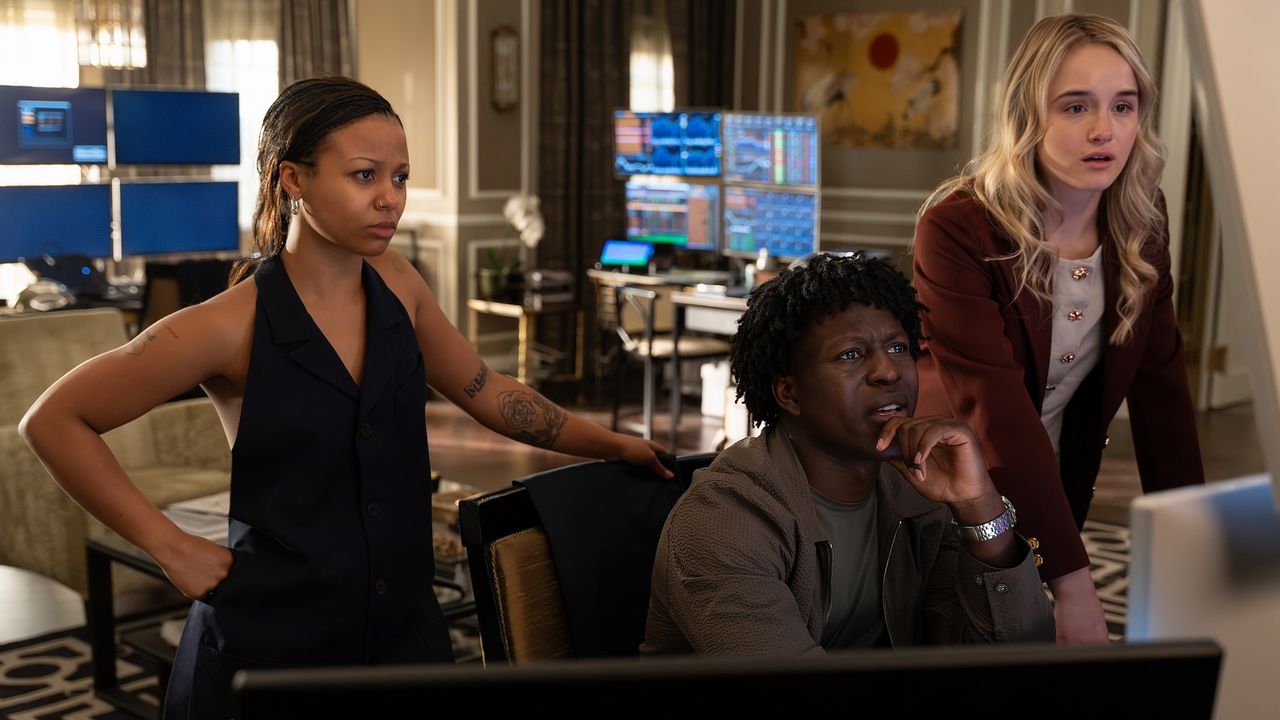
Kay: I didn’t either.
Down: They’re so wildly different from us, I felt like I’ve never really thought about them being reflections of where we are in our lives. I dunno, they kind of want different things than me and Konrad. [laughs]
Kay: Well, him being our peer is actually quite important in framing this question, when we think about it, because he’s obviously a sort of composite of all the things you just mentioned—and of the stuff he would’ve been reading. In a way, he’s a metatextual character, because his reference points for constructing himself would’ve been identical to what me and Mickey were drawing on in writing him. So you could look at him as a sort of a cipher or an avatar—but to us it was interesting to have a genuinely compelling villain at the heart of the show for the first time. There’s a conspicuous literary-ness to the way he talks and the way he moves through the world, and writing that letter and stuff, that allowed us to play into a different kind of mode for the show.
I mean, when Max [Minghella] first read the character, he was like, I think he stands outside of what you’ve created thus far on the show. He stands kind of above it, and I need to find an access point to him so he doesn’t feel like he belongs in another TV show. But I think his felicity with language was part of Whitney’s con, part of his artistry. It was not only knowing what to say all the time and, like, equivocating and talking around things. But it was also psychologically knowing how to use exactly the right words to unlock exactly what he wanted in various people at various stages.
One of my favorite scenes in the season is when Henry and Whitney are on the bank of the canal after their night out, and Whitney starts going into that mode of rhetoric—but it’s sort of lazy, he’s exhausted after the club, and Henry calls him out on it: “Yeah, I dunno if I believe that.” And you see it kind of jolt the Whitney machine a little bit. I just love the way that plays, because it does feel, again, like a Ripley reference. You have this Dickie-Tom dynamic playing out between them, where the outsider, the con man, is seducing the high-born mark who he’s manipulating and whose life he covets, but also eliciting repulsion and rejection from him.
Another example is when Whitney and Henry are at the Pierpoint meeting in the next episode, and Henry says to Whitney, “Do that thing you do.” Meaning, use that facility with language, do the magic trick. And Whitney kind of half-heartedly stands up, and he’s unconvincing, but then the engine turns over and it starts to work and you guys drop “Heroes” over it. I just love the way that that language is the manifestation of Whitney’s power. Even though, as it turns out, absolutely everything he says is bullshit.
Down: We had more references to his sort of constructed background that we cut because we felt like actually we were playing a bit too hard into [Whitney being] an enigma, with this checkered and hard-to-authenticate background. There was a scene—actually it was a line in episode four, when him and Yasmin have worked together to kind of bury Jim Dycker and also to launch the app, after he goes, “We ride together, we die together.” That was intentionally meant to feel like it was an empty kind of statement and it ended up in loads of trailers for the show. Because it’s a line that belongs in the trailer! Yasmin has this look where she looks at him and she’s just trying to get to the core of him. And we actually had a line of dialogue after that where Marisa says, “Everything that comes out of your mouth feels very insincere.” And it felt like a moment where Yasmin actually saw through him.
Cracked it a little bit.
Down: Cracked it a little bit. I like it without that, because it feels like we’re showing it rather than saying. But Yasmin can see through him because she’s no longer incentivized, in that moment, to believe him. Whereas Henry, who is to the manor born and can tell where you’re from exactly from your accent, and can see through him in episode two when they’re talking next to the Turner painting—after that, for want of a better word, Whitney starts glazing Henry, and telling him everything he wants to hear, and Henry’s incentive structure is: Don’t see any of the red flags anymore. Cause actually this guy’s making me feel good in a way that I haven’t felt for years and he’s actually making me feel the way I feel I should feel, which is important and at the center of something. And yeah, it was a small bit of dialogue that we cut, but probably should have kept it.
Down: We write quite long scripts and we shoot long episodes, so there’s usually quite a lot of cutting. And actually that is usually to the benefit of the show because all the fat is chopped away and you end up with a very kind of fast-paced, lean product. I will say that because the show is so plot-heavy this season, some of the choices we had to make in terms of getting it down to length were to—I mean, maybe “sacrifice” is a big word, but we had to pick and choose what sort of intimate character-driven moments we had, because sometimes just cutting scenes would mean that the plot just didn’t make sense, which is a terrible thing to do when you get into the edit. So we had to make some really quite difficult decisions. It’s interesting because in the moment you are like: God, this is really killing our darlings. But then, in the totality of the episode, you look back and think: Actually that was slowing it down or That was actually a little bit too languorous or a bit too pretentious. And you kind of convince yourself that actually it’s fine by the time it airs.
When you talk about the length of an episode and writing and shooting long, are we talking about 10 extra minutes coming down, or is it a 90-minute script that needs to fit into an hour?
Down: When we direct—and when anyone directs, I’m sure—there’s a lot of air in the scene. So there’s usually a top and tail of the scene which gets chopped out unless it’s really important. So those initial cuts are 85 minutes sometimes, and when you watch them, you’d be tearing your eyes out because they’re very slow and they don’t feel like the show whatsoever. But they have to give you a sense of whether the story actually works or not. And then the process is getting the air out and then making it feel like the show, with the cutting style, and then actually just having a quite difficult conversation with ourselves about what we can lose. We had to get episode eight, for example, down to 64 minutes, which after [the finale of] season three, which is a 72-minute episode, felt like a real cut. And there were moments where we were like, Fuck, how are we going to do this? It’s to the detriment of this show and maybe we won’t get a season five, so this is going to be the last episode and it’s compromised….But then you kind of convince yourself that it will work. And then you look back on those scenes and you’re like, Actually, you know what? They didn’t suit the story, they didn’t actually drive it. And putting them in there would’ve been, I dunno, maybe sort of an own goal? It would’ve been us in the moment loving our material. I mean Jane Tranter, for example, who produces the show with us for Bad Wolf—in episode two, “The Commander and the Grey Lady,” she was like, You have to fall out of love with your material. [laughs]
First Appeared on
Source link

Leave feedback about this