

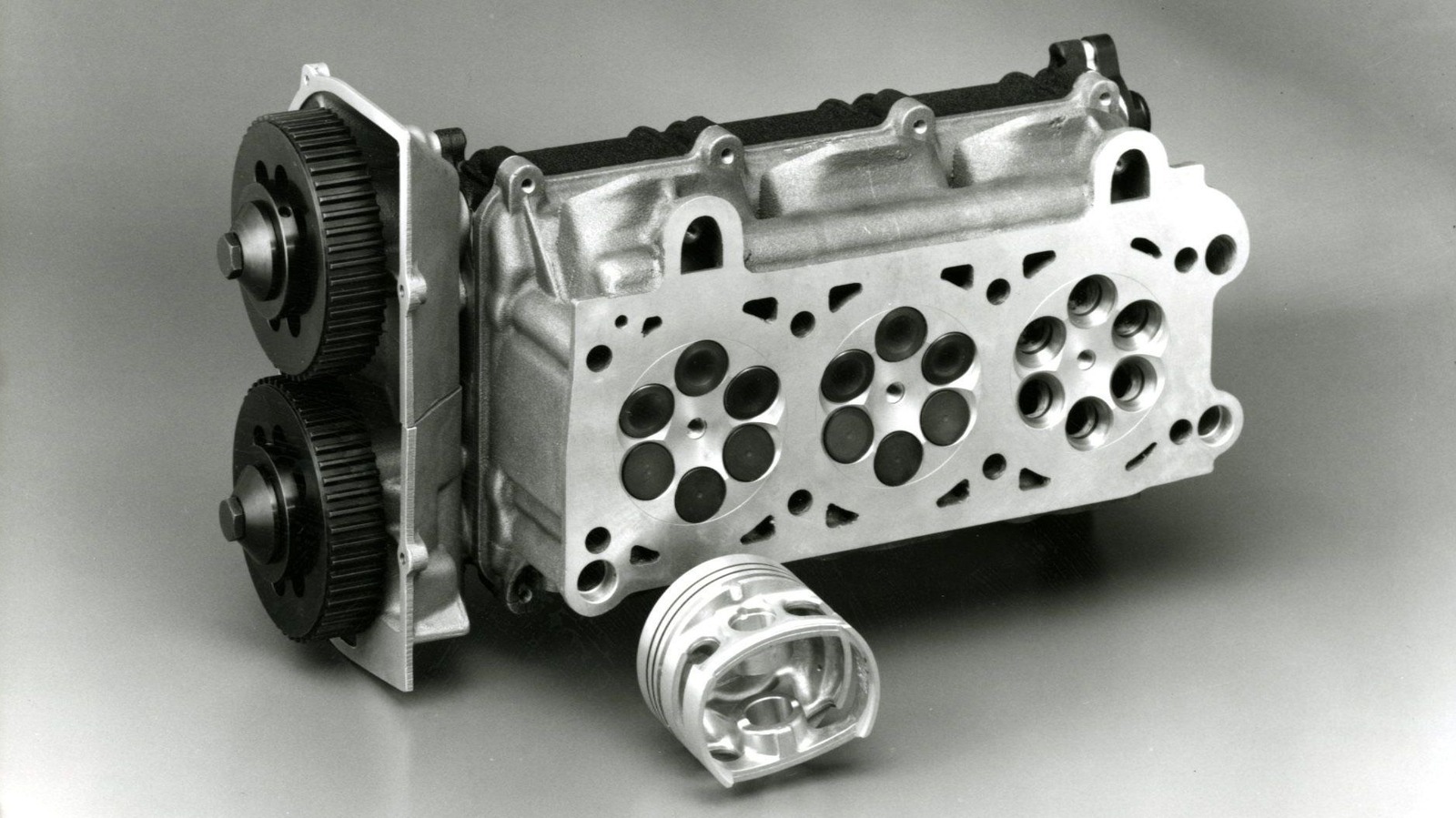
What’s scarier than a Maserati engine from the ’80s? A more sophisticated one from the same timeline. Admittedly, we can’t really comment on its reliability, as Maserati’s prototype six-valve engine never reached production, so it’d be unfair to slap the “unreliable” title earned by the 2.0-liter V6 in the Biturbo. That’s partly why Maserati Biturbos are dirt cheap.
The 6.36 engine, as it was called, was fairly innovative for its time. The 6.36 name basically meant a V6 with 36 valves, translating to six valves per cylinder, which was pretty revolutionary as far as automotive engines were concerned. And the claims were big too. Maserati reckoned the prototype 2.0-liter twin-turbo engine was good for 257 horsepower at 7,200 RPM, a decent increment over the 180 horses the early three-valve version managed to pump out.
Adding to the engine’s sophistication was a patented cam-rocker arrangement, which translated to three of the six valves being operated using a single rocker and cam lobe, reducing the engine’s overall complexity. Not only that, but the unique valve setup allowed the twin-turbo V6 to run an ideal air-fuel mixture. Maserati’s six-valve arrangement brought along a 34% improvement in the gas circulation area when compared to an engine with four valves per cylinder. Or so the company claimed.
Although the engine had potential, Maserati’s enthusiasm fizzled out after a while, and the 6.36 got shelved. But we can’t help but wonder why Maserati would drop an industry-first idea when they managed to make it work, produce decent power, all while claiming less complexity and better durability? Maybe Yamaha had something to do with it.
More is not always better
Turns out, Maserati wasn’t the only one toying with the idea of stuffing more valves in an engine. Apparently, Yamaha ran experiments using six and seven valves per cylinder while developing the radical FZ750. If you didn’t know, the 750 cc four-pot had five valves per cylinder, three on the intake side and two for the exhaust.
During the FZ’s development, Yamaha tested a 28-valve V4 (that’s seven valves per cylinder) with two spark plugs capable of a 20,000 RPM ceiling. Engineers eventually realized that more was not necessarily better when it came to valves. The engine ran into detonation issues, especially near the closely spaced exhaust valves, of which the experimental V4 had three. Not only that, but the engine was stupidly expensive to develop.
Apparently, you enter an area of diminishing returns once you’re past five valves per cylinder. Using five instead of four valves per cylinder saw a tangible improvement in volumetric efficiency, through increased intake area, as the three intake valves (though smaller in diameter) have more total circumference than the two-valved setup. Beyond five, however, the total valve opening area saw a noticeable decrease, which in turn reduced overall engine performance.
Five was a decent compromise, as it did bring about a 10% improvement in power and torque figures (as opposed to four), in addition to broadening the torque curve, which proved helpful in a 750 cc high-revving four-cylinder engine. That’s perhaps why Ferrari employed five valves per cylinder in the 355’s achingly beautiful engine, as did Mitsubishi, Audi, and Volkswagen in some of their engines from the ’90s and early 2000s. Although the Biturbo saved Maserati, the six-valve exercise was perhaps too ambitious for the small Italian carmaker to pursue.
First Appeared on
Source link






Leave feedback about this