

A tiny marine invertebrate spotted in photos posted by scuba divers has been identified as a new species off the coast of Japan. Nicknamed the “skeleton panda,” the creature’s markings resemble a panda’s face set against a bony frame.
The species, formally named Clavelina ossipandae, was described in 2024 after researchers analyzed specimens collected near Kumejima, Japan. Images of the animal had circulated online for years before scientists confirmed it had never been documented.
A Discovery Sparked by Online Photos
Photos of the small, translucent organisms first appeared online around 2017, shared by a local diving center. According to Live Science, researchers who saw the images suspected the animals might represent an undocumented species and began examining collected samples.
The formal description was published in the journal Species Diversity in 2024. The research team included Naohiro Hasegawa of Hokkaido University, who helped analyze the morphology of the specimens gathered by divers.
The Japanese nickname given to the species, “gaikotsu-panda-hoya,” translates to “skeleton panda ascidian,” a reference to the animal’s visual pattern.
Explaining the Panda-Like Design
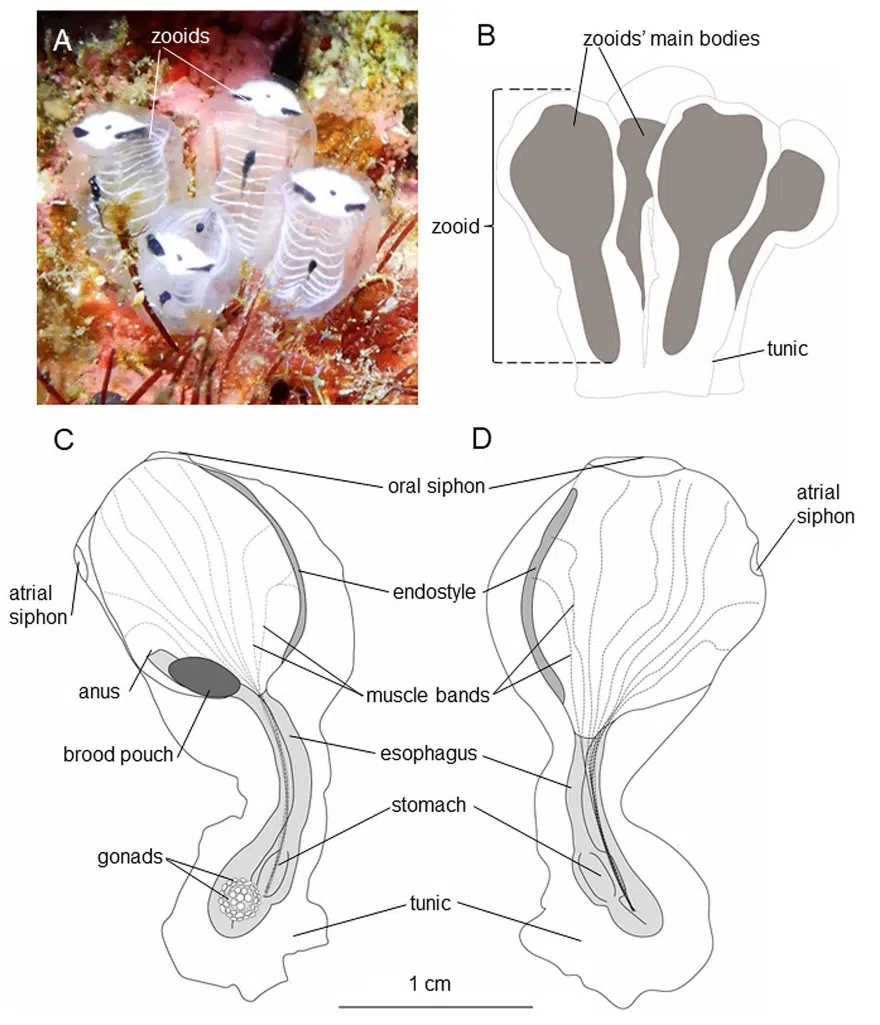
The sea squirt’s resemblance to a panda is striking but coincidental. The white structures that appear to form a skeleton are actually blood vessels running horizontally through the gills. As Naohiro Hasegawa noted:
“The white parts that look like bones are the blood vessels that run horizontally through the sea squirts’ gills. The black parts on the head that look like a panda’s eyes and nose are just a pattern, and we don’t really know why the pattern is there.”
The dark markings that resemble eyes and a nose are simply pigmentation patterns. As reported by a video published by Reuters, researchers do not yet know why this pattern exists.
The scientific name reflects these features. Clavelina means “little bottle” in Latin, describing the animal’s shape, while ossipandae combines os, meaning bone, with panda, directly referencing its unusual appearance.
A Tiny Filter Feeder in Shallow Waters
Like other members of the Clavelina genus, Clavelina ossipandae is a filter-feeding marine invertebrate. It attaches itself to hard substrates and pumps water through siphons to extract plankton and other small organic materials.
The species grows to less than an inch in length, measuring under 20 millimeters, and inhabits shallow waters up to 66 feet (20 meters) deep off the coast of Kumejima. Other sea squirts in the same genus, such as Clavelina moluccensis and Clavelina picta, also display striped or spotted patterns, though none mimic a panda as convincingly.
First Appeared on
Source link






Leave feedback about this