

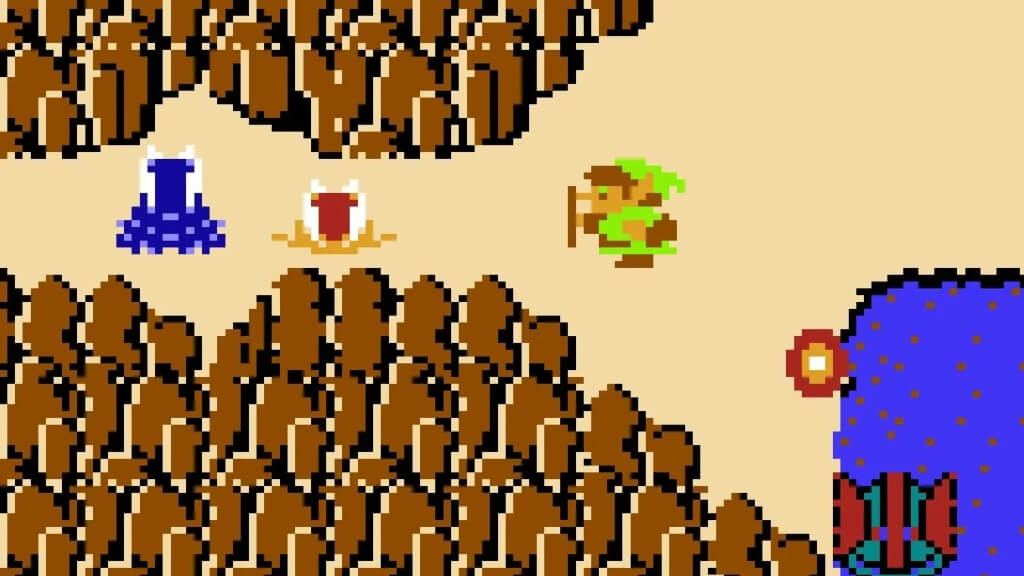
The Legend Of Zelda, originally released in Japan 40 years ago this week, was a significant hit for Nintendo. To this day it remains one of the few Zelda titles that has sold at least one million copies in Japan alone, and is the third best-selling title on Nintendo’s original home console among those that weren’t at one time pack-in games for the system, with over 6.5 million sold. (No offense to various Super Mario Bros. titles or Duck Hunt, of course, but Zelda did it on hard mode.) The Legend Of Zelda inspired a wave of games that would be known as “Zelda clones” for years after, the kind of designation that occurs for only the most important, genre-defining titles like Tetris and DOOM. 40 years later the series is as strong as it’s ever been thanks to the success of mainline entries such as Breath Of The Wild and Tears Of The Kingdom, as well as spin-offs like the Musou Hyrule Warriors: Age Of Imprisonment and the Zelda-starring Echoes Of Wisdom. There’s even going to be a Zelda live-action movie now, and rumors of a theme park persist. Everything in the series that has come after The Legend Of Zelda has overshadowed it in some ways, and 40 years on, that’s one long shadow.
And yet, it’s still a joy to play four decades on, especially if you know the context in which it was released. It might look simple today—again, overshadowed by what followed it—but it was a technological achievement, with superior and smooth screen-to-screen scrolling, as well as a soundtrack that showed off the hardware improvements of the day, and techniques to get past the hardware limitations that still existed.
The most important thing that The Legend Of Zelda did, however, was to bring the depth, gameplay, and challenge of computer role-playing games to the masses in a brilliant, albeit streamlined version, through consoles. It’s the same trick that Enix’s Dragon Quest pulled off in the same year; whereas Dragon Quest achieved this feat for turn-based RPGs based off of the likes of the Wizardry and Ultima series, The Legend Of Zelda had its influences in the works of more action-oriented RPGs created by Namco, Falcom, T&E Soft, and Cosmos Computer. Dragon Quest was such a massive shift in the kinds of RPGs that could be developed that the game—and ones it helped inspire simply by existing—ended up sold internationally on the Japanese-made consoles that were available worldwide. (Nintendo famously retitled it Dragon Warrior for its American release, in an early example of a Japanese game getting a more aggressive makeover for the States.) That worldwide distribution in turn created a Western conception of a Japanese video game development reality that didn’t actually exist: a specific, well-defined genre known as the JRPG, or Japanese role-playing game. Computer RPGs had a significant audience in Japan, but since those games were not localized nor spread internationally in the same way as their console cousins, being developed for Japanese PCs like the X68000, PC-98, MSX2, and plenty of others, only half the story was told in the moment—and that half continues to shape Western ideas of Japanese role-playing games.
A similar result occurred for The Legend Of Zelda, which we now think of as an “action-adventure” game but was—and still is, in some camps—thought of as an action RPG. Zelda, like its influences, married arcade-style game design with the rules and breadth of computer role-playing games to create something entirely new. Namco’s seminal hit, 1984’s The Tower Of Druaga, had a massive influence on Nintendo, and especially Zelda creator Shigeru Miyamoto. Miyamoto had Nintendo put a Druaga arcade cabinet in the office, and the original design of The Legend of Zelda borrowed more than just a little bit from it, going so far as to reverse the titular tower setup to instead have a many-floored descending dungeon to traverse—there was no open-world surface in the original plan for the game, but rather a “series of dungeons underneath Death Mountain” instead. What Zelda kept in later versions, though, were Druaga’s hidden secrets and need for context-specific items and tools; if the original Zelda seems difficult to play without a guide in 2026, well, it was a cinch compared to Namco’s arcade smash hit.
First Appeared on
Source link





Leave feedback about this