


As NASA prepares to launch the Artemis II crew around the Moon in the very near future, the Aerospace Safety Advisory Panel (ASAP) is raising warning flags about the next flight in the queue, Artemis III. That’s the mission designed to land astronauts on the surface of the Moon for the first time since 1972, but ASAP warns the current plan is too risky. NASA will hold a press conference tomorrow morning, February 27, to discuss “Next Steps for the Artemis Campaign” that presumably will focus not only on the upcoming launch of Artemis II, but ASAP’s report as well.
Created by Congress after the fatal Apollo 1 fire in 1967, ASAP reports to both Congress and the NASA Administrator on all safety issues at the agency. Former NASA astronaut Lt. Gen. Susan Helms (Ret.) is the current chair.
In its annual report issued yesterday, ASAP left no doubt about the level of their concerns, many expressed in previous reports. Chief among them is the “ambitious timeline” for developing lunar spacesuits and the Human Landing System (HLS) to get astronauts down to and back from the Moon’s surface.
“Over the past year, programmatic and technical risks with these systems have continued to emerge and affect the overall Artemis III schedule and risk management. This is especially evident with the HLS, given its intricate operational design, complex concept of operations, and challenges during their ongoing flight test program. Taken together, these difficulties cast doubt on the current Artemis III timeline and the feasibility of the Artemis III mission goals.”
Among other things, ASAP is concerned about the number of “firsts” needed for the mission to succeed. That includes the first operational use of the HLS version of SpaceX’s Starship, which requires in-space refueling, another first; first use of Axiom Space’s spacesuits; first lunar landing since 1972 and the first ever at the lunar South Pole; first lunar ascent since 1972 and the first on SpaceX’s HLS; first docking of the Orion spacecraft and SpaceX’s HLS in lunar orbit; and more.
ASAP found this “stacking of firsts” a problem because it “elevates mission risk and reduces margin.” It wants to ensure “schedule pressure does not override prudent risk reduction—particularly for the HLS development, spacesuit readiness, and cryogenic propellant transfer capabilities.” But it doesn’t see that in the existing architecture.
As planned today, the Panel deems Artemis III a high risk, and rebalancing objectives is thus essential to the safe achievement of the national objective — returning the United States to the Moon.
On top of that, ASAP points out the Trump Administration has proposed ending use of the Space Launch System (SLS) rocket and Orion spacecraft after Artemis III, opening questions about the flights to follow as NASA pursues plans to build a lunar outpost for sustained operations on the Moon leading to human exploration of Mars. The panel advises NASA to urgently act on this recommendation:
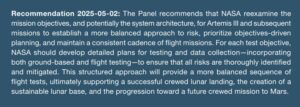
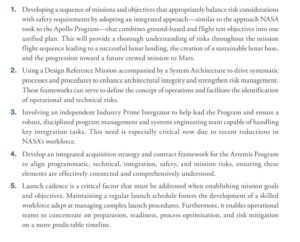
Specifically, NASA should consider these steps as it “works to revise mission flight plans, objectives, and sequences.”
The “daunting” challenge of getting SpaceX’s Starship HLS ready for Artemis III is a specific concern. NASA contracted with SpaceX to build the HLS for Artemis III in 2021. At the time, the goal was to launch Artemis III in 2024. While few considered that realistic and the date has slipped year by year to 2028, ASAP considers launching “within the next few years” as “probably not achievable.”
It is early 2026 and Starship has yet to reach earth orbit. The 11 test flights to date have had mixed success and even though the last two did well, SpaceX is about to introduce a new version, V3, which may have its own growing pains. The company’s main goal is using Starship for launching thousands of a new, more capable generation of Starlink broadband Internet satellites.
ASAP acknowledges those launches will enhance the reliability of Starship overall, but do not contribute to developing an HLS version of Starship which requires human-rating and in-space refueling to travel beyond earth orbit. Not to mention that Starship by itself, without the Super Heavy booster, is 171 feet (52 meters) tall and 29.5 feet (9 meters) in diameter, a large vehicle to land on the cratered surface of the Moon’s South Pole.
“The development and test progress necessary for a version of Starship that has not yet flown in time to support a human lunar landing mission within the next few years appears daunting and, to the Panel, probably not achievable. Beyond this, the physics of landing a six-to-one height-to-width ratio vehicle on the uneven, poorly lit polar lunar surface seems questionable at best.”
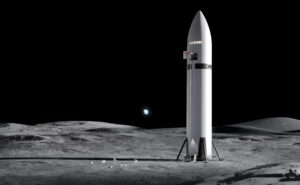
Concerned that Starship delays might lead to China putting taikonauts on the Moon before American astronauts return, last summer NASA reopened the HLS contract to incentivize Blue Origin, which won a second HLS contract two years after SpaceX, to try and accelerate development. ASAP is skeptical that will help, though. “At this time it is difficult to imagine another NASA contractor capable of meeting a challenge of this scale and pace as SpaceX.”
ASAP is more sanguine about Artemis II. NASA was hoping to launch the four Artemis II astronauts — NASA’s Reid Wiseman, Victor Glover and Christina Koch and Canadian Space Agency’s Jeremy Hansen — around the Moon on March 6, but a helium flow problem on the Space Launch System rocket’s upper stage required them to roll it back to the Vehicle Assembly Building for repairs. NASA said this evening they are getting ready to make those repairs. April is the earliest the launch could take place. More information could be forthcoming at tomorrow’s press conference.
ASAP said it’s been monitoring Artemis II preparations and has “confidence in NASA’s disciplined handling of known technical risks.” The panel’s only recommendation is to make sure the readiness of the Artemis Mission Management Team is a special topic at the Flight Readiness Review.
Last Updated: Feb 26, 2026 11:04 pm ET
First Appeared on
Source link





Leave feedback about this