

Asteroids and meteorites contain the raw materials needed for future space infrastructure, including rare and high-value metals. The challenge has always been finding efficient ways to extract those resources beyond Earth. Now, an experiment aboard the International Space Station suggests that tiny living organisms could help solve that problem.
In a study published in npj Microgravity, researchers found that microbes can continue extracting metals from meteorite fragments even in microgravity. The findings point to a future where biology plays a role in building self-sufficient space habitats.
Why Scientists are Turning to Microbes
As space missions travel farther from Earth, resupplying materials becomes increasingly difficult. Future outposts on the Moon, Mars, or beyond will likely depend on local resources. Many asteroids and rocky bodies contain abundant metals that could support infrastructure, manufacturing, and life support systems.
Instead of relying solely on heavy mechanical equipment, researchers are studying biomining. This process uses microorganisms to chemically leach metals from rock. By producing organic acids, microbes gradually dissolve minerals and release valuable elements.
The Bioasteroid Experiment in Orbit
To investigate, scientists from Cornell University and the University of Edinburgh launched the BioAsteroid experiment to the space station in 2020.
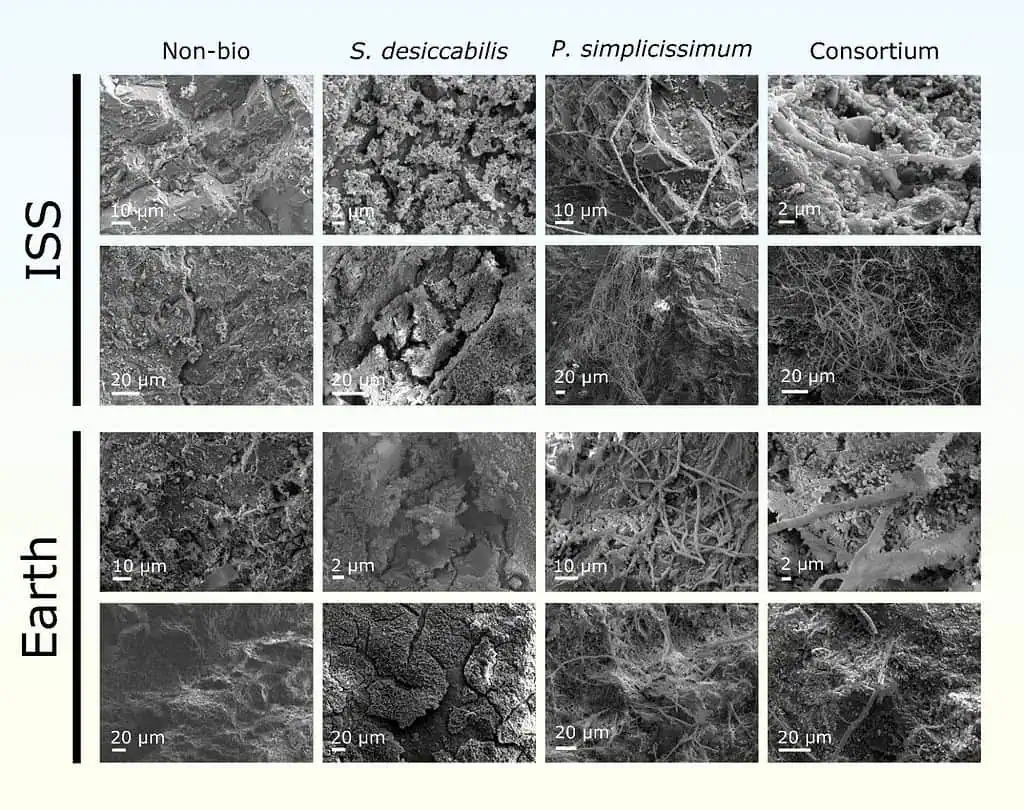
Based on the study published in npj Microgravity, fragments of an L-chondrite meteorite were placed inside sealed reactors along with two microbes: the bacterium Sphingomonas desiccabilis and the fungus Penicillium simplicissimum. Over 19 days, the organisms grew on the rock while astronauts monitored the hardware.
“This is probably the first experiment of its kind on the International Space Station on meteorite,” said Rosa Santomartino, a biological engineer at Cornell and lead author of the study, in a statement.
A parallel experiment was conducted on Earth under normal gravity so researchers could directly compare the results.
What Bacteria Pulled From Space Rocks
After the samples returned to Earth, scientists analyzed 44 elements that had dissolved from the rock. Microbial activity contributed to the extraction of 18 of those elements.
The fungus showed notable changes in orbit. In microgravity, its metabolism shifted and it produced larger amounts of molecules, including carboxylic acids, which help dissolve minerals. These changes influenced the release of metals such as palladium and platinum, both critical for advanced technologies.
“In these cases, the microbe doesn’t improve the extraction itself, but it’s kind of keeping the extraction at a steady level, regardless of the gravity condition,” Santomartino said.
Chemical extraction without microbes often performed worse in microgravity than it did on Earth. Microbial processes, by contrast, remained relatively stable. Researchers also observed that the fungus formed filaments and microscopic communities directly on the meteorite surface.
How Asteroid Biomining Could Work In Reality
The microbes were not exposed to the vacuum of space but were grown inside sealed “Experiment Units” filled with sterilized, crushed meteorite fragments. The chambers included a semipermeable silicone rubber membrane for gas exchange, and scientists injected a liquid nutrient medium to sustain growth.
Beyond metal extraction, microbial interaction with regolith may release nutrients such as potassium, phosphorus, and iron, supporting life support systems. The leftover slurry from bioleaching could even contribute to soil formation for space habitats.
The study builds on earlier research showing bacteria can extract rare earth elements in orbit. According to Alessandro Stirpe, differences between Earth and space were limited, while Rosa Santomartino emphasized that:
“Bacteria and fungi are all so diverse, one to each other, and the space condition is so complex that, at present, you cannot give a single answer,” she noted. “I don’t mean to be too poetic, but to me, this is a little bit the beauty of that. It’s very complex. And I like it.”
First Appeared on
Source link






Leave feedback about this