

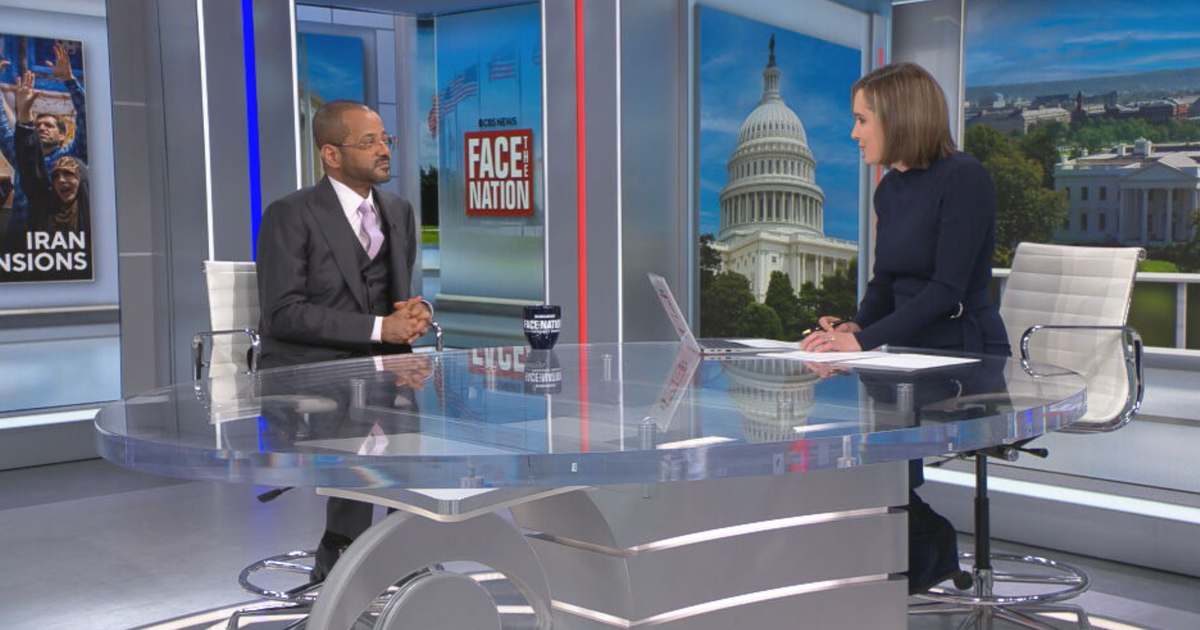
Omani foreign minister Badr bin Hamad Al Busaidi, a key mediator in the US-Iran nuclear talks, tells “Face the Nation” moderator Margaret Brennan that he’s confident “a peace deal is within our reach” between the U.S. and Iran as negotiators meet over Tehran’s nuclear program. He also said, “I don’t think any alternative to diplomacy is going to solve this problem.”
Read the full transcript below:
MARGARET BRENNAN: And joining me now is the foreign minister of Oman Badr Albusaidi, who is the mediator negotiating a nuclear deal between the United States and Iran. Welcome to ‘Face the Nation.’
OMANI FOREIGN MINISTER BADR ALBUSAIDI: Thank you.
MARGARET BRENNAN: So President Trump said Friday he’s not happy with the way talks are going, and not happy that they’re “not willing to give us what we have to have.” From your point of view, is diplomacy failing?
MINISTER ALBUSAIDI: I am confident, and in my assessment of the way the talks are going, I think there is, really I can see that the peace deal is within our reach.
MARGARET BRENNAN: A peace deal?
MINISTER ALBUSAIDI: Yes, is within our reach, if we just allow diplomacy the space it needs to get there. Because I don’t think any alternative to diplomacy is going to solve this problem.
MARGARET BRENNAN: When you say space, does that mean you are asking for more time to continue negotiations?
MINISTER ALBUSAIDI: I’m asking to continue this process because we have already achieved quite a substantial progress in the direction of a deal. And the heart of this deal is very important, and I think we have captured that heart.
MARGARET BRENNAN: When you say the heart of the deal, Iran has said this has to be nuclear only. What have you actually agreed upon? Can you give us any sense of why there should be more time?
MINISTER ALBUSAIDI: Because if the ultimate objective is to ensure forever that Iran cannot have a nuclear bomb, I think we have cracked that problem through these negotiations by agreeing a very important breakthrough that has never been achieved any time before. And I think if we can capture that and build on it, I think a deal is within our reach.
MARGARET BRENNAN: What has Iran agreed to, to you, that they have never done before? Can you give us any sense?
MINISTER ALBUSAIDI: The single most important achievement, I believe, is the agreement that Iran will never, ever have a nuclear material that will create a bomb. This is, I think, a big achievement. This is something that is not in the old deal that was negotiated during President Obama’s time. This is something completely new. It really makes the enrichment argument less relevant, because now we are talking about zero stockpiling. And that is very, very important, because if you cannot stockpile material that is enriched then there is no way you can actually create a bomb, whether you enrich or don’t enrich. And I think this is really something that has been missed a lot by the media, and I want to clarify that from the standpoint of a mediator.
MARGARET BRENNAN: So explain that. So the enriched material, things that could be used as nuclear fuel for a bomb, you’re saying Iran would not keep on their own soil?
MINISTER ALBUSAIDI: They would give it up.
MARGARET BRENNAN: They would give it up?
MINISTER ALBUSAIDI: They will not be able to actually accumulate that material that will enable them to create a bomb–
MARGARET BRENNAN: –Where would that–
BADR ALBUSAIDI: There is no accumulation, so there would be zero accumulation, zero stockpiling, and full verification. That is also equally important achievement, I think. Full and comprehensive verification by the IAEA, which is the agency in charge of this, this file.
MARGARET BRENNAN: The UN nuclear watchdog. So you’re saying all enriched material would be shipped someplace else, not Russia but–
MINISTER ALBUSAIDI: No, no, the current stockpiles that are- still exist–
MARGARET BRENNAN: The things that are still in Iran–
MINISTER ALBUSAIDI: I think that there is agreement now that this will be down blended to the lowest level possible, to a neutral level, a natural level, which means- and converted into fuel, and that fuel will be irreversible.
MARGARET BRENNAN: That would be significant.
MINISTER ALBUSAIDI: It is very significant. And I think we have agreement on that, in my view.
MARGARET BRENNAN: In your view.
MINISTER ALBUSAIDI: Yes.
MARGARET BRENNAN: Because today, CBS confirmed a confidential report from the IAEA says inspectors report seeing Iran conducting nuclear- or conducting regular activity at bombed uranium enrichment sites. But Iran has refused to tell us what has happened to their stockpile, they have refused to allow UN inspectors in to look at it. Are you telling me that inspectors would be given access to these sites like at Isfahan?
MINISTER ALBUSAIDI: If there is a deal, an agreed deal, there will be full access.
MARGARET BRENNAN: Iran has offered that?
MINISTER ALBUSAIDI: Yes.
MARGARET BRENNAN: So who would these inspectors be? It would be UN? IAEA?
MINISTER ALBUSAIDI: IAEA, IAEA. But I think you know, there is room also, if there is a deal in place, I am quite confident, from my point of view, that even United States inspectors will have access at some point in the process. If we have a deal that is respected and fair and endurable, I see no reason why there is no access to be given, even to the United States itself.
MARGARET BRENNAN: Iran has never allowed American weapons inspectors on their soil. They wouldn’t let President Obama do that. You think Iran will let President Trump send American inspectors into Iran?
MINISTER ALBUSAIDI: This is why I think this is a much, much better deal, because I think Iran is open to the idea in a way that- that- that never had been the case in the past.
MARGARET BRENNAN: You met with Vice President JD Vance, does he understand the details like you have laid out here? What did he say?
MINISTER ALBUSAIDI: I have explained to Vice President, and I really want to express my thanks and appreciation for the time and for his engagement and attention, and I have explained as much as possible and to the best possible of my ability, how I see the situation going, what is the assessment, what is our view as an independent mediator and observer and facilitator for these talks.
MARGARET BRENNAN: Did you get a sense that enough has been accomplished in these talks to convince America to hold off on strikes?
MINISTER ALBUSAIDI: I hope so. I think, I think we have, we have, we have really advanced substantially. And I think obviously there remains to be various details to be ironed out, and this is why we need a little bit more time to really try and accomplish the ultimate goal of having a comprehensive package of the deal that will, will have different components to it. And I’m not really in a position to go into the details of this, but the big picture is that a deal is in our hand, if we are only allowed the negotiators, and I believe both sides have been dead serious, very creative, very imaginative, to really to reach where we have reached so far.
MARGARET BRENNAN: Did you get the sense that the vice president wants this deal to succeed?
MINISTER ALBUSAIDI: Yes, I think even the president wants this deal to succeed.
MARGARET BRENNAN: But the president has said that not enough is being done.
MINISTER ALBUSAIDI: Well, I don’t know what he meant by that. I mean, I would love to respond to any specific areas that, that he’s not happy about, of course. I mean, I sincerely think the President really is passionate, and he is really sincere about preferring the choice of diplomacy and have a diplomatic deal, a negotiated deal, than the alternative.
MARGARET BRENNAN: There are technical talks scheduled for Vienna next week with the head of the IAEA.
MINISTER ALBUSAIDI: Yes.
MARGARET BRENNAN: How much time are you talking about? How much time do you need?
MINISTER ALBUSAIDI: I think on Monday, they have agreed to talk technicalities in Vienna on Monday, and then a few days following that, within a week, really from now, we are working on another round of talks at the level of the negotiators.
MARGARET BRENNAN: So Steve Witkoff and Jared Kushner are going to sit down with you?
MINISTER ALBUSAIDI: That’s the idea.
MARGARET BRENNAN: Well, let me ask you this, because we are hearing concern that time is of the essence. Why is there an emergency right now? Do you get the sense of why President Trump feels this has to happen right now, or there could be strikes?
MINISTER ALBUSAIDI: I don’t know. I just think you know there is really, really, a real chance here, a very historic opportunity to really crack this issue diplomatically.
MARGARET BRENNAN: If– Are you concerned that Israel is planning to take a first strike, even though the U.S. and Iran are agreeing to talk?
MINISTER ALBUSAIDI: I hope that is not the case.
MARGARET BRENNAN: If Israel strikes first, will that end the diplomacy that you are trying to conduct here on the nuclear program?
MINISTER ALBUSAIDI: Well, we saw what happened last year. We don’t want the repetition of that.
MARGARET BRENNAN: To be clear, you were helping with the diplomacy last summer, and in the middle of that diplomacy is when the United States and Israel carried out the bombing of the nuclear sites. The U.S. hit those three nuclear sites. Are you concerned that that’s what’s happening now?
MINISTER ALBUSAIDI: I’m very concerned, like you and like everyone else, the whole world is concerned about this, and I think the whole world really wants a negotiated deal out of this, and, and not to go the route of what we saw last year.
MARGARET BRENNAN: So President Trump carried out those strikes on Iran’s nuclear program, and he said it was obliterated. What does Iran have right now? Do you believe you have a good sense of what their nuclear program still entails? Do you consider it an emergency?
MINISTER ALBUSAIDI: I don’t know exactly the right answer for that question, but what I do know is that if we can agree tomorrow on this deal, and it can be agreed very fast, then there will be the access given to all the experts to go and assess what we have there. We will have the access diplomatically without having to go to war.
MARGARET BRENNAN: How quickly do you think you could get UN inspectors on the ground in Iran?
MINISTER ALBUSAIDI: That to be- that has to be agreed. But I think according to these negotiations that I have witnessed and facilitated. I believe a lot of these questions can be addressed amicably and comprehensively inside a three months kind of cycle.
MARGARET BRENNAN: Three months?
MINISTER ALBUSAIDI: Maximum, I think from what I heard by both sides, this is actually doable. And what I heard from the experts involved in these talks, that within 90 days, we can really address completely the question of the stockpiles that exists at the moment, and we can address and agree on the verification and the controls that are necessary to be put in place, access to these sites, assessment of exactly the state of affairs inside- in this program, and not only that, even determine really what are the exact and real needs. And that needs to be done to, to ensure that this program remains peaceful, remains acceptable to the United States and to the Iranians.
MARGARET BRENNAN: So a nuclear only deal is what we are talking about here. But Secretary of State Rubio said just a few days ago that if Iran refuses to talk about ballistic missiles with the United States or anyone, he said, that is a big problem. Will Iran negotiate about its ballistic missiles?
MINISTER ALBUSAIDI: I believe Iran is open to discuss everything.
MARGARET BRENNAN: Including its ballistic missiles, because they’ve said this has to be nuclear only.
MINISTER ALBUSAIDI: Everything, but that has to take its proper context, proper course, proper framework. Now, the priority number one is to get this nuclear issue resolved in a proper deal that is clear, that- that exactly specifies obligations of each side. I believe we have discussed and potentially agreed on the approach that all these other non-nuclear issues of concern can be discussed in the context of a regional dialogue between Iran and its neighbors.
MARGARET BRENNAN: So just to be clear, Iran has told you they will discuss their nu- their ballistic missile program with some of the Arab neighbors?
MINISTER ALBUSAIDI: We have not gone to that extent of specifics, but we have agreed, in general, to discuss economic and security cooperation between Iran and its neighbors, and set up a process of dialogue that will really start the elements of building confidence, building a rapport, building a process that can really lead us to reach an understanding on all these various areas of concern, areas of concern on the Iranian side, and areas of concern on the GCC side.
MARGARET BRENNAN: And the Gulf countries. So Secretary Rubio also said Iran is not enriching nuclear material right now.
MINISTER ALBUSAIDI: That’s correct.
MARGARET BRENNAN: In your view, in your country’s view, they are not.
MINISTER ALBUSAIDI: They are not.
MARGARET BRENNAN: Because Envoy Witkoff told Fox News last week that Iran is probably a week away from having industrial grade bomb making material.
MINISTER ALBUSAIDI: I am not an expert to judge that, but I have asked experts who know about the subject, and I think that could have been misinterpreted, since they are not enriching, and the only really facility that is operational, to some extent, is what- what is called the Tehran research reactor, which is research related. It’s a- it’s a reactor that produces isotopes, for example, for- for hospitals and medical, medical needs. But other than that, I am assured by the IAEA that there are no enrichment activities going on at the moment.
MARGARET BRENNAN: The last time that we saw a diplomatic deal, there were years of talks. There were nuclear scientists, intelligence officials and diplomats at the table. There was international pressure that was coordinated, from Russia to China to the United States to Europe. The talks you had on Thursday were just six hours with Steve Witkoff and Jared Kushner. Can you get this complicated of a deal done quickly? You said you need three months. What do you need to accomplish this in three months?
MINISTER ALBUSAIDI: No, I said that a deal actually can be agreed tomorrow.
MARGARET BRENNAN: Broad terms of a deal.
MINISTER ALBUSAIDI: Broad terms. It’s- politics, the big main issues, components, that really are the main areas of concern, I think that can be agreed tomorrow. The technicalities will take some time to work it out with the agency, the IAEA. And then once those are accomplished, and I believe that can be done also quickly, relatively quickly, because a lot of this work, this groundwork, was done years ago, and it’s- it’s there in place. The three months period is really the implementation of what will be agreed, whether, whether it’s to- related to the stockpiling and the stockpiles issues, whether it’s related to the verification, I think within three months, that will be all in place.
MARGARET BRENNAN: And Iran wants the United States to lift sanctions. If the United States does that, that helps the regime, a regime with a terrible human rights record, stay in power. Are human rights in any way, a part of this conversation? Is the United States raising them?
MINISTER ALBUSAIDI: This conversation is completely focused on the job at hand, which is the nuclear file. I think other areas of concern are not really- we have not been mandated to discuss this, and so I think I would rather focus on this, because that is the most critical element at the moment.
MARGARET BRENNAN: You didn’t get to meet with President Trump. He may see this interview. Do I understand that your main ask is give me more time, because you think you can close this and prevent Iran from ever getting a nuclear weapon?
MINISTER ALBUSAIDI: I think both sides of the equation, the American negotiators and the Iranians, are very, very serious to reach a deal, and they think they can reach a deal in my assessment. And knowing and assessing the various components of this deal, and what I have already explained to you, the great progress that we have made, the substantial progress that we have made, which is far, far more than any time before, we just need that bit of extra time to close the deal. And if I was President Trump, my only advice is just to give those negotiators enough room and enough space to really close these remaining areas that we need to discuss and agree upon.
MARGARET BRENNAN: And if Israel carries out a strike, or if the U.S. carries out even a limited strike on the ballistic missiles, do you think that you could still get a nuclear deal done?
MINISTER ALBUSAIDI: Well, diplomacy can reach a deal. I don’t think any other acts can solve this problem, really. I don’t think that will be- it will only complicate resolving this problem and delay it.
MARGARET BRENNAN: Mr. Foreign Minister, thank you for your time.
MINISTER ALBUSAIDI: Thank you.
First Appeared on
Source link


Leave feedback about this