

Sign up for the Slatest to get the most insightful analysis, criticism, and advice out there, delivered to your inbox daily.
If President Donald Trump rejects the deal that Iranians offered at their talks in Geneva, it can be for only one of two reasons: Either he doesn’t want a deal—or he doesn’t want a deal that resembles President Barack Obama’s 2014 accord, which Trump tore up in 2018 after calling it “the worst deal ever.”
In Tuesday’s State of the Union address, Trump said he would prefer to settle the current crisis through diplomacy, but only if Tehran’s leaders said they “will never have a nuclear weapon”—words, Trump claimed, that “we haven’t heard.”
Actually, they have spoken those words, many times, though of course it’s another matter whether we should trust them. Iran is also a signatory to the Nuclear Non-Proliferation Treaty, which makes the same pledge.
What Iranians do refuse to say is that they will never enrich any uranium. This is one of the stumbling blocks in the negotiations, though it shouldn’t be.
In the latest round of talks through an Omani intermediary, Iran now says it is willing to suspend enrichment for the next three years—that is, for as long as Trump is president. After then, it would limit enrichment to purity levels of 1.5 percent and allow international inspectors to verify the pledge.
The thing is this: The NPT allows signatories to enrich uranium for “peaceful” purposes, such as electricity or medical research. In fact, Article IV of the treaty enshrines enrichment as an “inalienable right.” The nuclear deal that Iran signed with the United States and five other countries in 2014 limited this enrichment to purity levels of 3.5 percent. (It takes 90 percent enrichment for uranium to be “weapons-grade.”) By the time Trump tore up the deal, Iran was abiding by it, according to inspectors with the International Atomic Energy Agency. Iran had also dismantled much of its stockpile of “highly enriched” uranium.
Now, after eight years of unconstrained activity, Iran has a large quantity of uranium enriched to 60 percent, meaning that, if its leaders wanted, they could have enough for an atom bomb in a matter of months.
And yet, in the ongoing Geneva talks, Iran is offering to slash that down to the barest minimum—to an even lower level than Obama allowed. Will Trump take the deal, or will he stick to his requirement that enrichment be banned, even though 190 other countries are permitted to enrich a little bit? (The only countries that have not signed the NPT, or that once signed it but later pulled out, are India, Pakistan, Israel, South Sudan, and North Korea.)
In the early stages of the talks that led to the 2014 deal, Obama and others pressed Iran for an enrichment ban, but then realized that it was impractical, given the NPT’s talk of an “inalienable right” to enrich—and unnecessary, as long as inspectors could verify that Iran’s enrichment levels stayed low.
Trump’s negotiators in the current talks—his son-in-law Jared Kushner and his real-estate friend Steve Witkoff—have hit an impasse over three other issues. Trump wants Iran to dismantle its arsenal of ballistic missiles, which have the range to hit allied territory and U.S. military bases throughout the Middle East. He wants Iran to stop supplying the region’s terrorist groups, such as Hezbollah, Hamas, and the Houthis. Finally, he wants any deal struck to be permanent.
Iran resists the first two demands as violations of its sovereignty. It is true that its missiles pose a threat; hundreds were fired in the Iran–Israel conflict last summer, inflicting considerable damage. However, Iran regards the missiles as a deterrent to an attack on its own land—and notes that no other country has been barred from building a conventional arsenal. They make the same argument in defending its right to supply allies.
Obama too tried to limit or outlaw ballistic missiles and aid to terrorist groups as part of the deal a decade ago, but after Iran’s resistance seemed clearly implacable, he decided that, whatever else Iran did with its armaments, it would be more dangerous with nuclear weapons than without.
The demand for a permanent deal is a rebuke to the Obama-era deal, which set “sunset clauses”—expiration dates ranging from 10 to 25 years after the deal’s signing—on some of its restrictions. Critics charged that, therefore, the deal only postponed the day when the Islamic Republic would get its hands on some A-bombs.
There was some validity to this charge, but nearly all treaties have expiration dates or clauses allowing one country or another to withdraw from the deal. (President George W. Bush did that with the 1972 Anti–Ballistic Missile Treaty, and of course Trump did that with the Iran nuclear deal.)
Also, it works both ways. In exchange for Iran’s dismantling its nuclear infrastructure, the 2014 deal required the United States and other nations to lift economic sanctions against Iran. So far, Trump has not offered Iran any rewards for giving up its nuclear potential in this round of talks—except the reward of avoiding the onslaught of U.S. and Israeli air strikes, and Trump hasn’t yet said that restraint would be permanent either.
So these are some of the questions that Trump needs to address. How does he weigh the relative risks that Iran poses? Can he accept the persistent presence of its ballistic missiles and its continued supply to proxy militias (such as they are) in exchange for the decimation of its nuclear capabilities? And can he accept agreeing to a deal for many years, as opposed to forever (which treaties alone can’t guarantee in any case)?
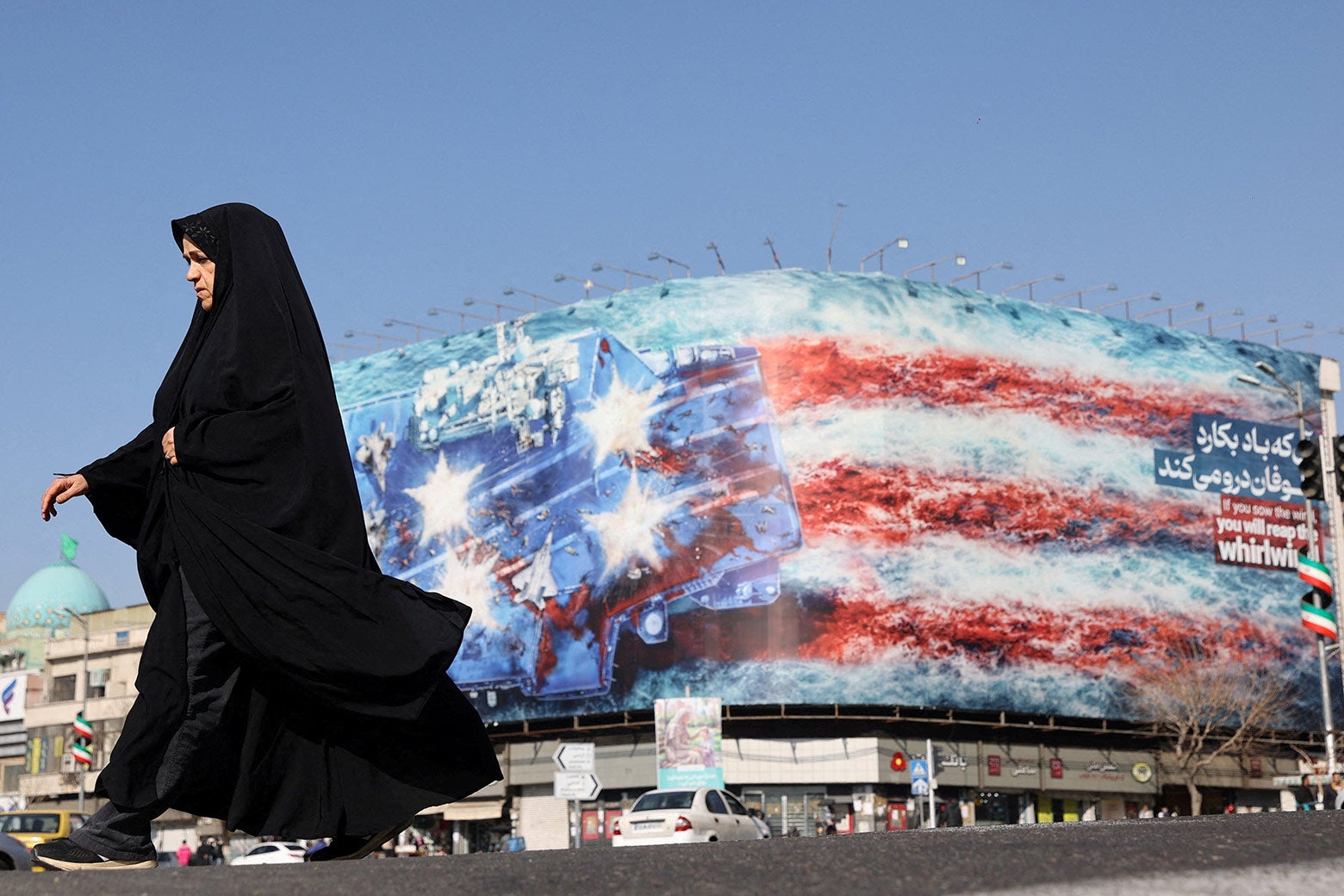
He also has not yet addressed, at least not publicly, a bigger question: What’s the rush? Why has he mobilized two aircraft carriers, their full fleet of escort warships, and dozens of fighter jets to Iran’s flanks now? Just last June, he said that he “obliterated” Iran’s nuclear materials in the bomber raid called Midnight Hammer. But in his State of the Union address, he said he might need to attack Iran in order to keep the world’s largest supporter of terrorism from going nuclear. Clearly, Trump’s claim that Midnight Hammer “obliterated” Iran’s enrichment sites was exaggerated (if his State of the Union address is to be believed, he was admitting as much), but intelligence analysts say the attack was devastating, perhaps setting the program back by years.
So, again, what’s the rush? And if other issues justify U.S. military action, the question remains: Why now? Iran has deployed missiles and supported terrorists for many years, though no American president—including Trump—has ever cited those facts as causes for war. This should be especially true now, as Iran’s arsenal is smaller and its allies weaker than they have been for many years.
Finally, how much is Trump willing to risk to achieve whatever aims he hopes this attack might accomplish?
Vice President J.D. Vance said this week, in an interview with the Washington Post, that there is “no chance” the U.S. would get embroiled in a long, drawn-out war with Iran. Good to hear, except for two things. First, Vance doesn’t necessarily know what Trump is thinking. (It’s worth recalling that in the administration’s early days, Vance said “obviously” the most violent protesters in the Jan. 6 riots shouldn’t be pardoned—right before Trump did just that.)
Second, as the old saying has it, the enemy gets a vote in shaping how a war unfolds. If Iran’s leaders think the attack could undermine their regime (and Trump has spoken in favor of regime change), they might unleash a massive attack against Israel and U.S. military bases, which could spur Trump to step up his attack, and onward and upward the violence spirals. Uncontrolled escalation is a particular danger when the leader starting a war hasn’t thought through what he wants to gain from it.
The latest round of talks in Geneva ended on Thursday, with negotiators reporting “significant progress” and hoping they might resume next week, though they revealed few details and no suggestion that their differences had been resolved.
Still, just as war is unpredictable once the first shots are fired, it’s not inevitable before that line is crossed. Trump still has a chance to set priorities and make choices. We have no way of knowing what they might be; it’s possible that he doesn’t know either. That’s the cause of worry and, perhaps just a little bit, hope.

First Appeared on
Source link



Leave feedback about this