

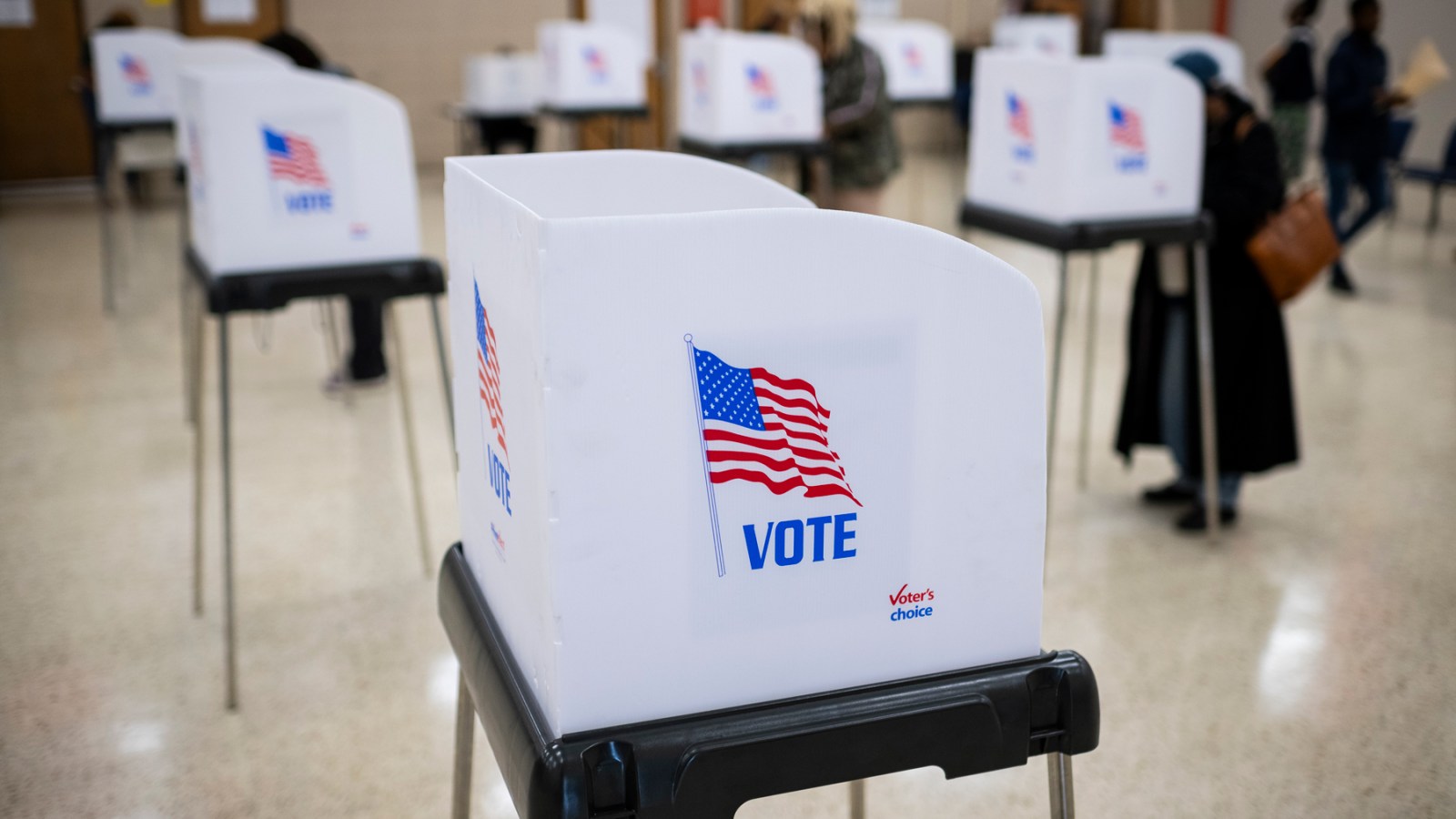
During his State of the Union address on Tuesday, Donald Trump demanded that lawmakers gathered in the joint session of Congress “approve the SAVE America Act to stop illegal aliens [from] voting in our sacred American elections.” Republicans stood and cheered. “The cheating is rampant in our elections,” the president continued. “It’s rampant.”
The directive was built on years of Republican bloviating about a problem that doesn’t exist: the notion that scores of noncitizens are voting in American elections and influencing results. This, of course, includes the 2020 presidential election, which Trump has falsely claimed was rigged against him. Now, ahead of the 2026 midterms, the president and the GOP are literally trying to legislate elections in their own favor.
Trump cited many of the common arguments leveled by Republicans supporting the SAVE Act in his speech to lawmakers. The party has argued that voter identity verification (voter ID) is generally popular with the American public and ID is required to do many other things in the United States, so opposing the law means you actually want voter fraud. “All voters must show proof of citizenship in order to vote,” the president said of the legislation on Tuesday, to more applause from Republicans.
The reality is not that simple.
The Safeguard American Voter Eligibility (SAVE America) Act proposes a radical transformation of the way Americans interact with their electoral system. At its core, the legislation shifts the burden of verifying voter eligibility away from states and onto individual voters, requiring them to present proof of citizenship when they register to vote and an approved ID at the ballot box, while implementing a slew of other changes to voting processes.
If passed, the legislation would be a “cataclysmic” blow to the “way that voting and registration take place in the country,” Eliza Sweren-Becker, deputy director at the Brennan Center’s Voting Rights and Elections Program, tells Rolling Stone.
The new requirements would “completely disrupt online voter registration, mail voter registration, and also [the types of] voter registration drives that so many civically engaged organizations do across the country,” Sweren-Becker says. “It would also entirely undermine election administration. It would create election administration chaos.”
For example, Real ID — the post-9/11 law that sought to standardize the requirements for issuing a driver’s license or ID card across all 50 states — passed in 2005. Over 25 years later, its rollout is still a year away from being totally finalized. The legislation went through years of court challenges, implementation planning, and pushback from states. Conservative groups like the Heritage Foundation supported Real ID as a counter to undocumented immigration, but it faced widespread, often bipartisan opposition from lawmakers and civil society groups who worried it was unconstitutional, contained provisions that violated privacy laws, and granted the federal government too much power over state bureaucratic processes.
Many of those same criticisms are being leveled against the SAVE Act, which is far more expansive and, if passed, would trigger an immediate implementation — in an election year. Ironically, Real ID would not qualify as a valid document to prove citizenship under the SAVE Act.
As it stands now, the biggest repository of identity verification information is in the hands of states. Individuals wishing to register to vote submit their registration to their state election authorities — often at the same time they’re applying for a driver’s license — and the state consults its existing records to ensure the person is actually eligible to vote. It’s a system that has worked incredibly well for decades.
Where before a potential voter could rely on the state to verify internal records and confirm their eligibility (again, voting illegally is a federal crime), Americans will now be forced to present physical proof of citizenship, in person, in order to register to vote. This would overhaul the voter registration process, placing needless barriers on Americans who don’t have immediate access to documents like a passport or birth certificate, or who live in rural areas removed from physical administrative offices where they would need to present their documents. Experts are emphatic that no demographic group would escape potential disenfranchisement under the law. Concerns have been raised about married women, for example, who may have chosen to change their names to match their spouses, and who might struggle to meet the strict document requirements outlined in the legislation.
“The concept of ‘No Kings’ is rooted in the reality that every individual who has citizenship should be allowed to vote without any interruption or vote suppression factors,” says Derrick Johnson, national president and CEO of the NAACP. “This is nothing more than a means to suppress [voting] under the concept of protecting elections. There’s nothing about this bill that will protect elections. It would only further voter suppression tactics across the country.”
Sweren-Becker, who has been tracking and researching the potential impact of the bill, explains that if passed, with only months left before the November midterms, “it would place an enormous burden on election officials to create new systems and processes to implement this entirely new method of registration.” She adds that the new system would also open up election officials to new legal liabilities.
Trump, aggrieved from his defeat in 2020, has spent the past several years sowing the idea that the nation’s elections are rigged, that fraud is rampant, and that he actually defeated Joe Biden by millions of votes. In reality, the United States had some of the most secure elections in the world, with a report from the Brennan Center finding that the incidence rate of voter fraud in America was between 0.0003 percent and 0.0025 percent, which means it’s less common than getting struck by lightning, and is certainly not swinging elections.
“Investigation after investigation, scholarly reports, federal data, state data that only U.S. citizens vote with vanishingly rare exceptions — there has been an enormous amount of money and energy trying to prove otherwise,” Sweren-Becker says. “Historically, it’s been up to Congress to protect the freedom to vote, and to protect the freedom to vote against actions by states that have in the past tried to make it harder for certain groups to be able to cast their ballots.
“If Congress were to enact a policy like the SAVE Act, it would really be turning its back on its historical role of protecting that freedom to vote,” she adds.
The legislation faces significant hurdles in the Senate, where it needs 60 votes to pass in order to overcome the filibuster. It is unlikely that Republicans manage to pull the required seven Democrats they would need to send the bill to Trump’s desk. Senate Majority Leader John Thune (R-S.D.) plans to move ahead with a vote as early as this week. They’re even considering messing with Senate rules in order to find a workaround to pass the law with only 51 votes. As Trump made clear in his State of the Union address, he is prepared to up the public pressure in order to get what he wants. Civil rights groups are standing at the ready to throw a wrench in his plans.
“We are monitoring it step by step,” Johnson, the NAACP president, says, “but we will take all the appropriate means to try to prevent this from being implemented. We see this as a direct attack on the ability of citizens in this country from casting an effective ballot.”
First Appeared on
Source link



Leave feedback about this