

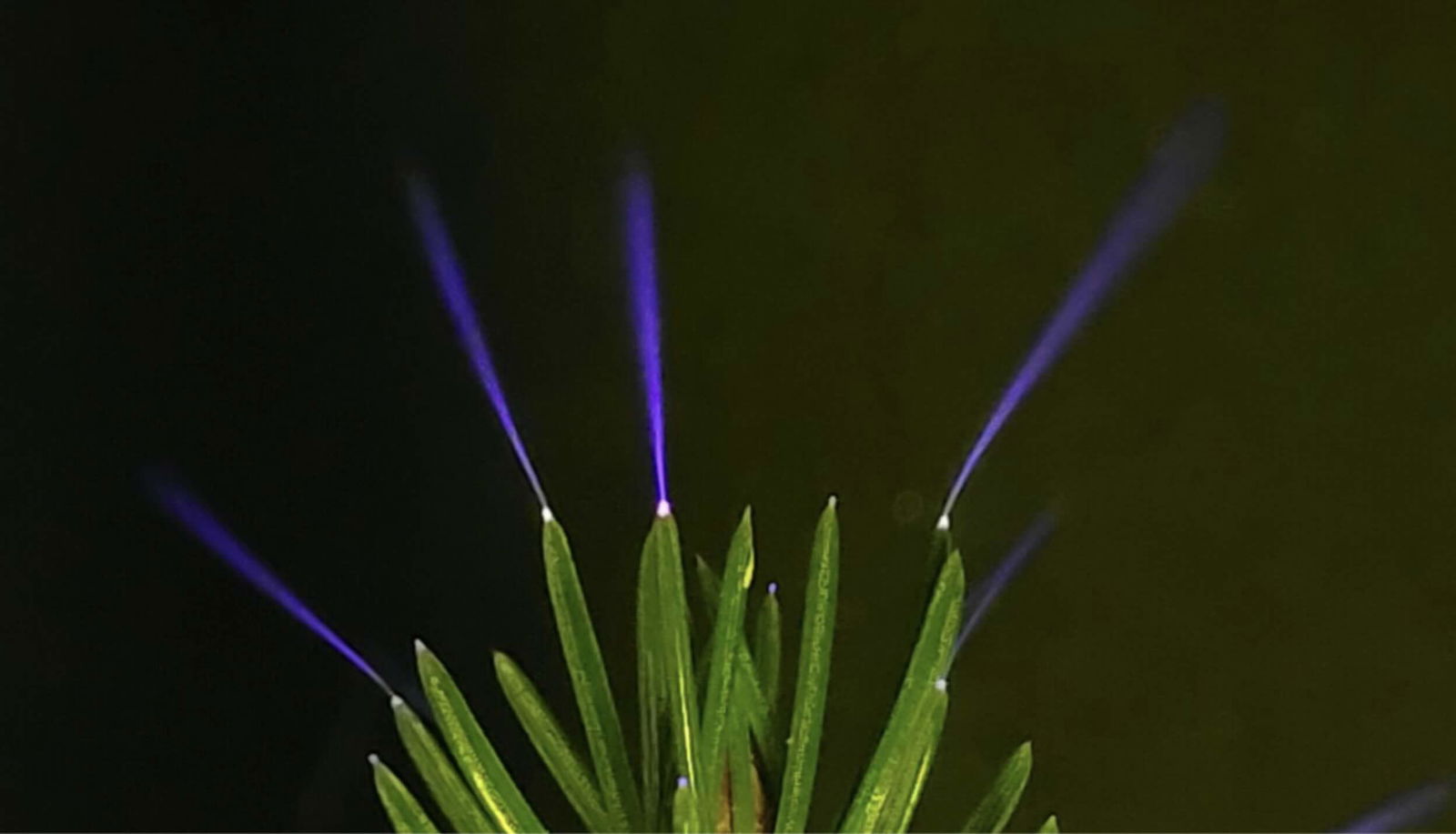
Scientists report the first confirmed field observation of a rare class of electrical phenomena associated with vegetation that has eluded scientific confirmation for nearly a century.
For many decades, observers have logged reports of unusual glows emitted by vegetation, with a leading theory of their cause being faint electrical discharges triggered by atmospheric activity associated with thunderstorms.
Now, a team of researchers who report their findings in Geophysical Research Letters says they have made the first known confirmed observations of this rare effect in the wild.
The team’s study argues that tiny electrical sparks, known as corona discharges, can produce flickering emissions that emanate from leaf tips. The unusual phenomenon was reportedly documented across several tree species in the Eastern United States.
Confirmation of a Century-Old Phenomenon
“These things actually happen; we’ve seen them; we know they exist now,” said Patrick McFarland, a Pennsylvania State University meteorologist who led the research behind the recent study.
Past studies had already confirmed the existence of the discharges in question, albeit only through indirect inference from anomalous electrical field measurements collected during storm activity near forests.
At the heart of the mystery are corona discharges, which occur when electrical energy associated with thunderstorms builds an electrical charge—and sometimes a very strong one—in the atmosphere. The result of this accumulation of charge is an opposite charge forming in the ground below, which travels upward to the highest points available—essentially the same phenomenon behind lightning strikes.
However, the highest points the opposite charge can reach are often the very tips of leaves or needles on trees high in the canopy. From there, the accumulated electricity can escape into the air as a weak discharge.
Experiments in the Lab
Past laboratory experiments involving leaves placed beneath electrically-charged metallic plates had already demonstrated the feasibility of this process, although direct field observations remained elusive.
To overcome this, McFarland and his team decided to go mobile by modifying a 2013 Toyota Sienna minivan into a field-deployable mobile laboratory featuring a weather station, electric field sensors, a laser rangefinder, and a roof-mounted periscope that feeds light to an ultraviolet-sensitive camera capable of detecting coronae through their UV emissions.
Carrying their weather-monitoring mobile lab into the field, the team monitored thunderstorm activity occurring in Pembroke, North Carolina, where they trained their cameras on the branches of a sweetgum tree while examining a video feed from within the vehicle.
“We sit there and stare at this video while the thunderstorm’s raging overhead,” McFarland recalled of their initial experiment. “You’re looking for the faintest signals on a video feed of nothing…It’s really difficult to tell in real time if you’re seeing anything.”
Observations in the Field
Although real-time monitoring revealed little activity, later analysis of their footage revealed clusters of ultraviolet flashes emitted from the leaves, the movement of which appeared to coincide with the branches as they swayed in the storm’s winds.
Over 90 minutes, the team recorded 41 separate corona discharges from the tips of leaves, with some lasting up to 3 seconds. In some instances, the peculiar electrical phenomenon was even observed “hopping” from one leaf to the next.

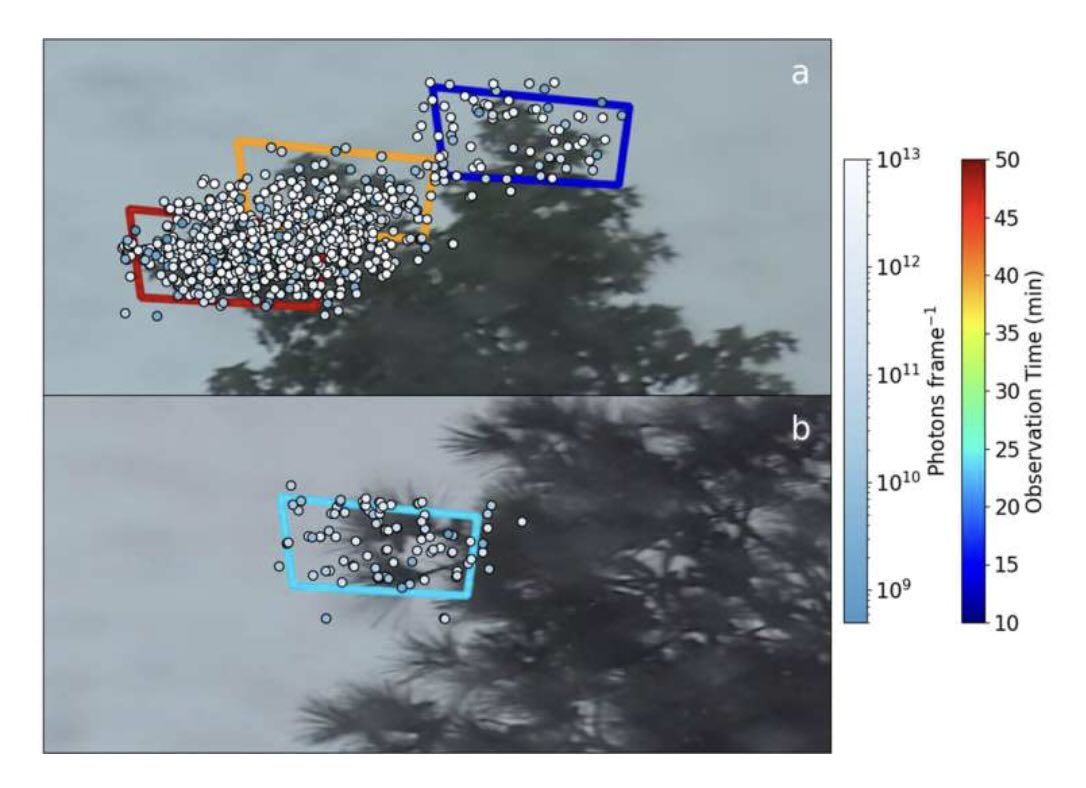
Additional observations revealed that similar activity occurred on a loblolly pine, and, by carrying their observations to other states, the team also observed it between Florida and Pennsylvania during storms, suggesting the phenomenon is widespread rather than unique to certain species of vegetation.
Intriguingly, McFarland said that under the right conditions, thunderstorm activity might electrify many thousands of leaves all at once, although it’s unlikely that normal human vision would reveal this.
“It’d probably look like a pretty cool light show,” McFarland said in a statement, likening the observation of such phenomena to “thousands of UV-flashing fireflies” if they all descended onto a forested area’s treetops at once.
Broader Implications
While a single discharge is unlikely to cause significant damage, McFarland says he wonders whether repeated exposure—particularly during exceptionally stormy seasons—might affect overall canopy health over time.
“That’s really where I’d like to go next,” McFarland says. “To figure out what impact this has on the tree itself and on the forest as a whole.”
The recent study, “Corona Discharges Glow on Trees Under Thunderstorms,” appeared in Geophysical Research Letters.
Micah Hanks is the Editor-in-Chief and Co-Founder of The Debrief. A longtime reporter on science, defense, and technology with a focus on space and astronomy, he can be reached at [email protected]. Follow him on X @MicahHanks, and at micahhanks.com.
First Appeared on
Source link






Leave feedback about this