

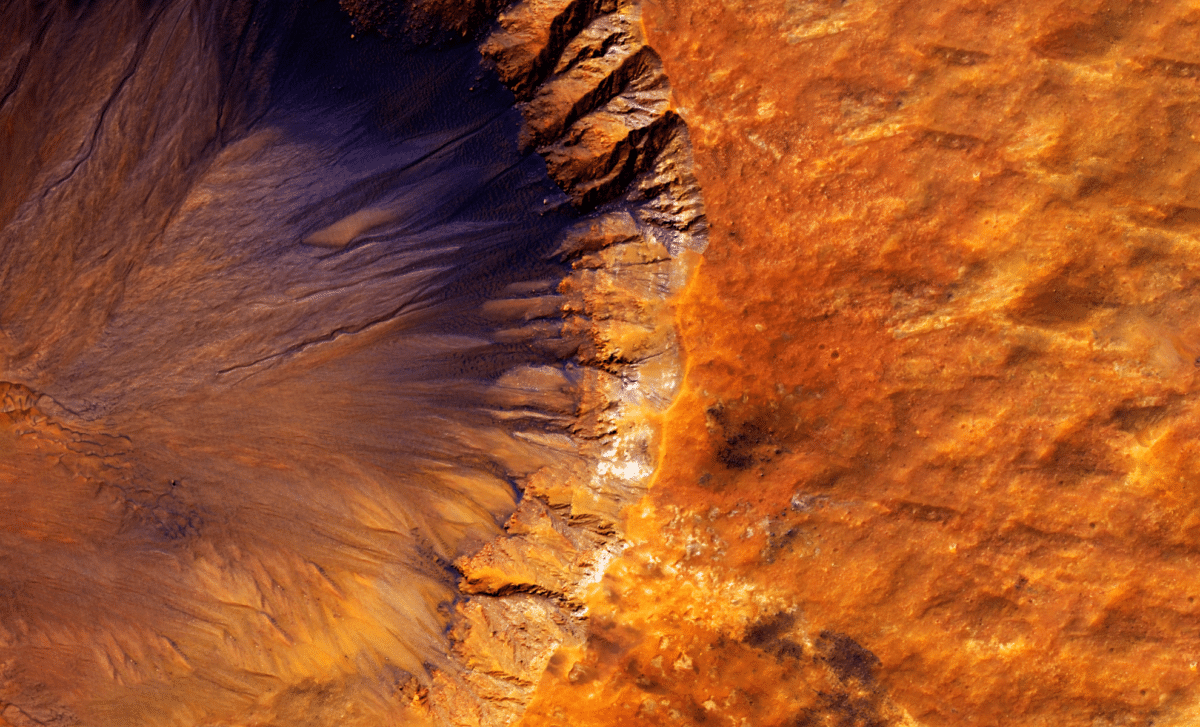
For decades, Mars has been seen as a cold, radiation-blasted desert where any trace of life would have long since vanished. Yet beneath its frozen surface, vast reservoirs of ice may be quietly preserving a biological record stretching back millions of years. Locked within these ancient ice deposits, the chemical building blocks of life could have endured far longer than scientists once believed.
Mars Ice as a Perfect Time Capsule for Life
One of the most exciting revelations from this study, published in in the journal Astrobiology, is the astonishing longevity of organic materials trapped in pure Martian ice. The research team, led by NASA Goddard Space Flight Center’s Alexander Pavlov and Penn State’s Christopher House, conducted a series of lab experiments simulating Martian conditions. They found that amino acids, which are the building blocks of proteins, could survive in pure water ice for over 50 million years, even under intense cosmic radiation. This discovery significantly shifts our search for life on Mars.
“Fifty million years is far greater than the expected age for some current surface ice deposits on Mars, which are often less than two million years old, meaning any organic life present within the ice would be preserved,” said co-author Christopher House. He further emphasized, “That means if there are bacteria near the surface of Mars, future missions can find it.”
These findings suggest that future explorations should focus more on ice deposits rather than rocks or soil, which have historically been the primary targets for extraterrestrial life searches.
The Role of Cosmic Radiation in Preserving Martian Life
Cosmic radiation, which bombards Mars constantly, is one of the harshest environmental factors the planet offers. However, the study shows that in pure water ice, radiation may not be as damaging as once thought. In fact, the team found that the ice effectively protects organic compounds from the radiation that would typically break them down.
“While in solid ice, harmful particles created by radiation get frozen in place and may not be able to reach organic compounds,” said Pavlov.
This insight challenges earlier assumptions about the destructive power of Mars’ harsh environment.
In their experiments, the researchers exposed samples of E. coli bacteria trapped in pure ice to radiation levels equivalent to 20 million years of cosmic bombardment. To their surprise, the bacteria’s amino acids survived significantly longer than when mixed with Martian-like soil, where radiation can penetrate more easily. This discovery adds a new layer of complexity to our understanding of Mars’ surface and highlights ice as a potential refuge for life.
Understanding the Unique Properties of Martian Ice
The study also delves into the specific properties of ice on Mars that make it such an effective preserver of organic material. Unlike mixtures of ice and soil, which are prone to faster degradation, pure water ice seems to “trap” harmful radiation in place. “Based on the 2022 study findings, it was thought that organic material in ice or water alone would be destroyed even more rapidly than the 10% water mixture,” said Pavlov. “So, it was surprising to find that the organic materials placed in water ice alone are destroyed at a much slower rate than the samples containing water and soil.”
This result was unexpected, as researchers initially believed that the presence of water would expedite the breakdown of organic compounds. However, the findings suggest that Martian ice may be far more resilient than previously anticipated, making it a prime candidate for exploring traces of ancient life.
First Appeared on
Source link




Leave feedback about this