

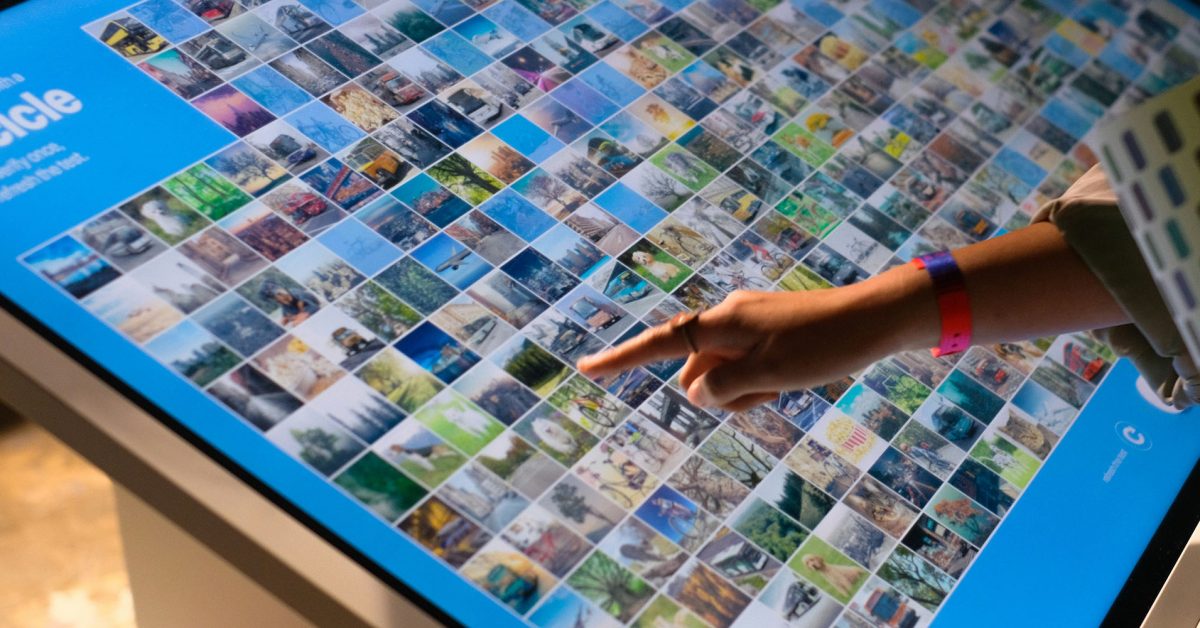
We know from Steve Jobs that Apple’s experiments with touchscreen Macs date back to at least 2008. At the time he said it was a “terrible” idea.
A lot has changed since then, and reports that we are finally going to see a touchscreen Mac have grown in credibility to the point where it now seems more likely than not. I’ve so far been a little concerned about the idea, but the latest report gives me confidence …
Prototype touchscreen Macs ‘terrible’
Steve said at a 2010 event that Apple had done tons of user testing over years. Years plural in 2010 means that the company has been experimenting with touchscreen Macs since at least 2008, and likely very much earlier.
At the time he described it as a terrible idea.
It turns out it doesn’t work. Touch surfaces don’t want to be vertical. It gives great demo, but after a short period of time you start to fatigue, and after an extended period of time your arm wants to fall off. It doesn’t work. It’s ergonomically terrible. Touch surfaces want to be horizontal.
But the iPad changed things
Of course, a lot has changed since 2010, most notably the iPad evolving from a purely touch device into something that can be used as a laptop.
When attached to a keyboard, people can choose between trackpad and touch use, and it appears that most people opt for some mix of the two. I hardly ever use an iPad these days, but when I did use it as a laptop, I found that I used the trackpad for most interactions, but touch for scrolling.
My two provisos
I said a few years ago that I had two conditions for being okay with a touchscreen Mac.
First, I didn’t want to pay a premium for a feature I’d hardly ever use. Either Apple needs to offer a choice of touchscreen and non-touchscreen models, or find a way to make it no more expensive than existing non-touchscreen models.
Second, and even more importantly, I don’t want to see macOS compromised by a touchscreen.
Sure, if people want to do some things on a Mac touchscreen, let ’em. But don’t, whatever you do, Apple, turn macOS into iPadOS. Leave us with our pleasingly compact menus; the option of an almost equally compact dock; our ability to position and size windows with pixel-level precision; and so on. Not the inflexible, space-wasting UI that is iPadOS.
This was the reason that the idea did scare me a little at the time: I wasn’t sure how much Apple might be prepared to compromise in the name of touch support.
I’m no longer scared of a touchscreen Mac
The latest Bloomberg report lends me confidence that Apple does seem to have found a solid workaround when it comes to supporting touch without making UI elements childishly large.
If users touch a button or control, the interface will bring up a new type of menu surrounding their finger that provides more relevant options for touch commands. The software will also display the most appropriate set of controls based on users’ prior interaction. And if a person taps an item in the menu bar at the top of the screen, the set of controls will enlarge to be more easily selectable with a finger.
That sounds to me like the default appearance of macOS will be the same as it is today – unless and until we touch the screen. Only if we do so will the UI adapt to a more touch-friendly scale.
With that approach, assuming it’s done well, I’m going to have no complaints. How about you? Please share your thoughts in the comments.
Photo by Karen Grigorean on Unsplash


FTC: We use income earning auto affiliate links. More.
First Appeared on
Source link




Leave feedback about this