Researchers have finally determined the shape of the heliosphere, the magnetic bubble that protects our Solar System from galactic radiation. Unlike previous models, this zone, generated by solar wind, is neither perfectly spherical nor oval, but adopts an unprecedented shape that resembles a “deflated crescent.”
The heliosphere, an invisible shield that stretches far beyond the Solar System’s outermost planets, plays a crucial role in protecting Earth and the other planets from interstellar radiation. This breakthrough comes from a team at Los Alamos National Laboratory, who used innovative techniques to measure and map the boundaries of this protective zone.
The Heliosphere: A Magnetic Shield Protecting Our Solar System
The heliosphere is a vast, magnetic zone created by the solar wind, a stream of protons, electrons, and alpha particles emitted by the Sun. It extends far beyond Earth, forming an invisible boundary between our Solar System and interstellar space. Its role is crucial: it protects us from cosmic radiation and energetic particles from the far reaches of the galaxy. While its importance is well recognized, the exact shape of this bubble has been a subject of debate among scientists.
In the past a 2020 study relied on computer models using data from the Voyager probes to predict the structure of the heliosphere. These initial simulations suggested that the heliosphere was mostly spherical or slightly elongated. However, recent work byDan Reisenfeld and his team, published with observations from the IBEX satellite, revealed a much more complex shape.
A New 3D Mapping Method
The key to this discovery lies in the method the researchers used to observe the bubble’s boundaries. By relying on data collected by IBEX, which detects particles from the solar wind at the boundary of the heliosphere, the team employed an echolocation technique similar to that used by bats. According to Reisenfeld:
“Just as bats send out sonar pulses in every direction and use the return signal to create a mental map of their surroundings, we used the Sun’s solar wind, which goes out in all directions, to create a map of the heliosphere.”
Illustration of the heliosphere, showing the Sun, Bow Wave, Helopause, and Termination Shock, marking the solar wind’s reach. Credit: NASA / IBEX / Adler Planetarium
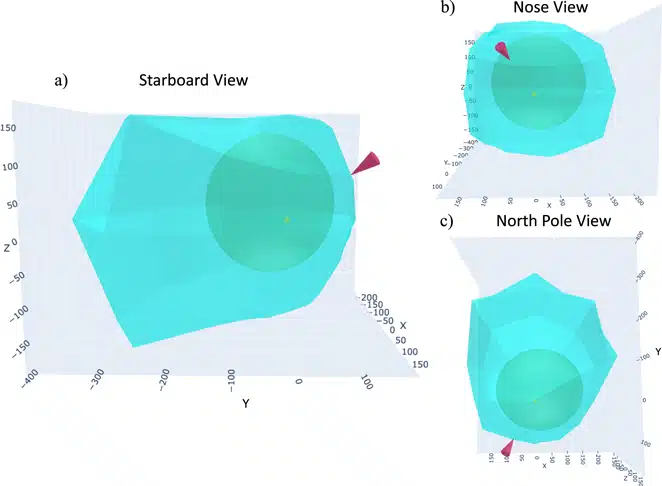
The team observed energetic neutral atoms (ENAs) created from collisions between solar wind particles and those from interstellar wind. This approach allowed them to create a 3D map of the heliosphere, revealing that the minimum distance between the Sun and the heliopause (the outer boundary of the heliosphere) is about 120 astronomical units, while in the opposite direction, the boundary extends at least 350 astronomical units.
A “Deflated Crescent” Shape
The shape of the heliosphere, which sharply contrasts with traditional models, resembles a “deflated crescent.” According to new data from the Los Alamos team, the Solar System‘s protective bubble is neither spherical nor ovalbut takes on an asymmetrical and stretched form.
“Physics models have theorized this boundary for years,” Dr. Reisenfeld noted.“But this is the first time we’ve actually been able to measure it and make a 3D map of it.”
3D views of the heliosphere from different angles: (a) Starboard, (b) Nose, and (c) North Pole. Credit: The Astrophysical Journal
This configuration may be influenced by the combined forces of the solar wind and the interstellar wind, creating a kind of “distortion” of the bubble on a galactic scale.







Leave feedback about this