

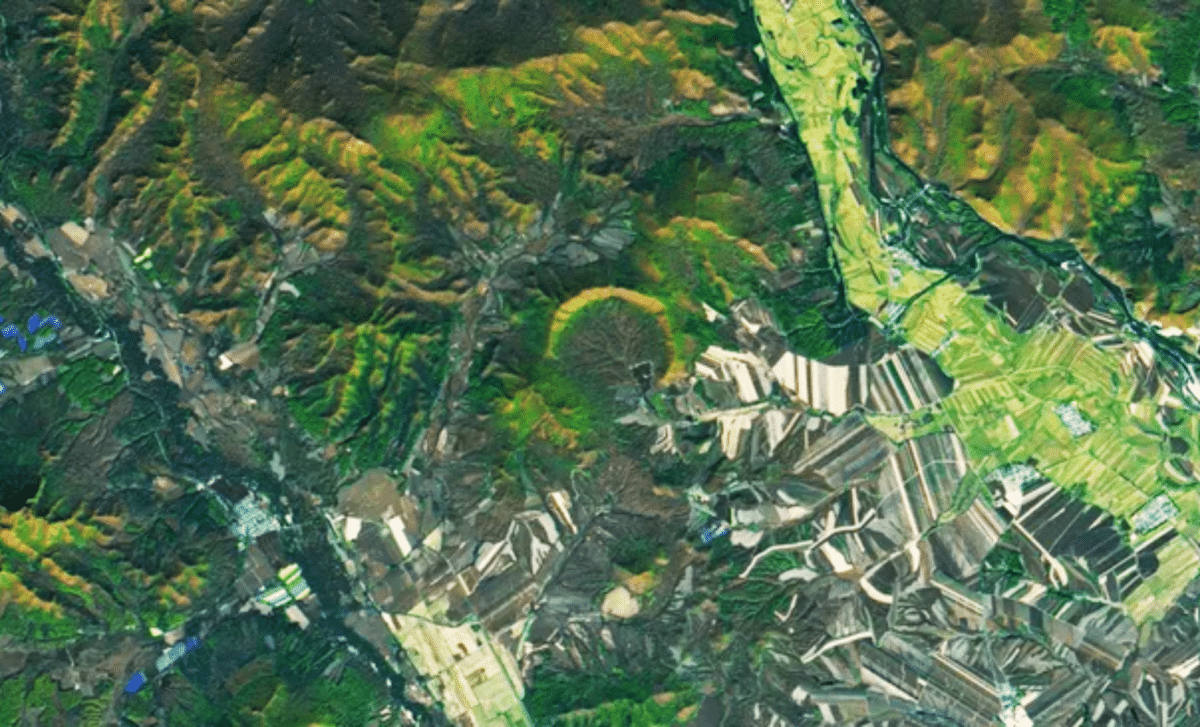
Hidden deep within the dense forests of Heilongjiang province, China, lies an ancient secret—an incomplete meteor impact crater that may rewrite Earth’s history. The Yilan crater, believed to be the youngest known impact site on our planet, was unearthed after centuries of being obscured by thick foliage. Thought to have formed between 46,000 and 53,000 years ago, this remarkable structure could provide key insights into the forces that have shaped our world. Discovered in mid-2021, this crater challenges previous assumptions about meteor collisions on Earth, offering new clues about our planet’s cosmic interactions. With its location in a remote part of China, the Yilan crater remained hidden from scientists until a series of meticulous investigations unveiled its significance.
A Hidden Gem in China’s Lesser Xing’an Mountains
The Yilan crater, measuring 1.15 miles (1.85 km) in diameter, is located in the Lesser Xing’an mountain range in northeastern China. The crater remained largely unnoticed by scientists for centuries, primarily because it was buried deep within the dense forests of the region. However, local residents had long been familiar with the structure, calling it “Quanshan” or “circular mountain ridge.” It wasn’t until 2021 that researchers, through satellite images, began to suspect that the feature was an impact crater. Despite its remote location, the team was able to confirm its extraterrestrial origins using a variety of geological techniques. These included analyzing materials found deep beneath the crater’s surface, such as shocked quartz and glass containing holes formed by gas bubbles, clear signs of a major meteor collision.
NASA’s Earth Observatory Contribution to the Discovery
The discovery of the Yilan crater’s true nature was a result of collaboration between local scientists and NASA’s Earth Observatory. The satellite images from NASA’s Landsat 8, captured on October 8, 2021, were pivotal in revealing the outline of the impact crater. According to NASA’s Earth Observatory, this image was crucial for recognizing the incomplete horseshoe shape of the crater, which is a key characteristic of impact structures. The study noted that such discoveries often come from satellite observations that allow researchers to identify features on Earth that are otherwise difficult to spot due to natural obstructions like forests, mountains, or other terrain. Through their observations, researchers were able to correlate the crater’s features with typical signs of a space rock collision, further solidifying the hypothesis.
Understanding the Age of the Yilan Crater
Carbon dating of the materials found within the crater has revealed that the Yilan crater formed around 46,000 to 53,000 years ago. This makes it a contender for the title of the youngest major impact crater on Earth. Prior to this discovery, the Barringer Crater, or Meteor Crater, in Arizona was considered the youngest significant impact structure, with an age of around 50,000 years. However, because the Yilan crater’s exact age still carries some uncertainty, researchers remain cautious in declaring it definitively younger than Barringer Crater. The precise dating process involved a variety of techniques, including studying the crater’s floor sediments and the specific types of rocks and minerals that were altered by the meteor’s impact.
Blast from the past ☄️
In 2021, geologists in China discovered the second-ever impact crater to be found in the country. Named the Yilan crater, it spans about 1.15 miles and is the largest known crater under 100,000 years old on Earth. pic.twitter.com/5ABvDFFBDE
— NASA Goddard (@NASAGoddard) August 4, 2025
The Mysterious Missing Section of the Crater
One of the most intriguing aspects of the Yilan crater is the missing portion of its rim. Satellite images clearly show that the southern third of the crater’s rim is incomplete, which has sparked curiosity among scientists. While the exact cause of this missing section remains unclear, there are a few theories. One possibility is that erosion over time may have worn away part of the rim, while another suggests that some sort of geological event, such as a large flood or a tectonic shift, could have contributed to the loss. Interestingly, researchers have also found evidence suggesting that the crater may have once contained a lake, further implying that the structure was once more intact.
First Appeared on
Source link




Leave feedback about this