

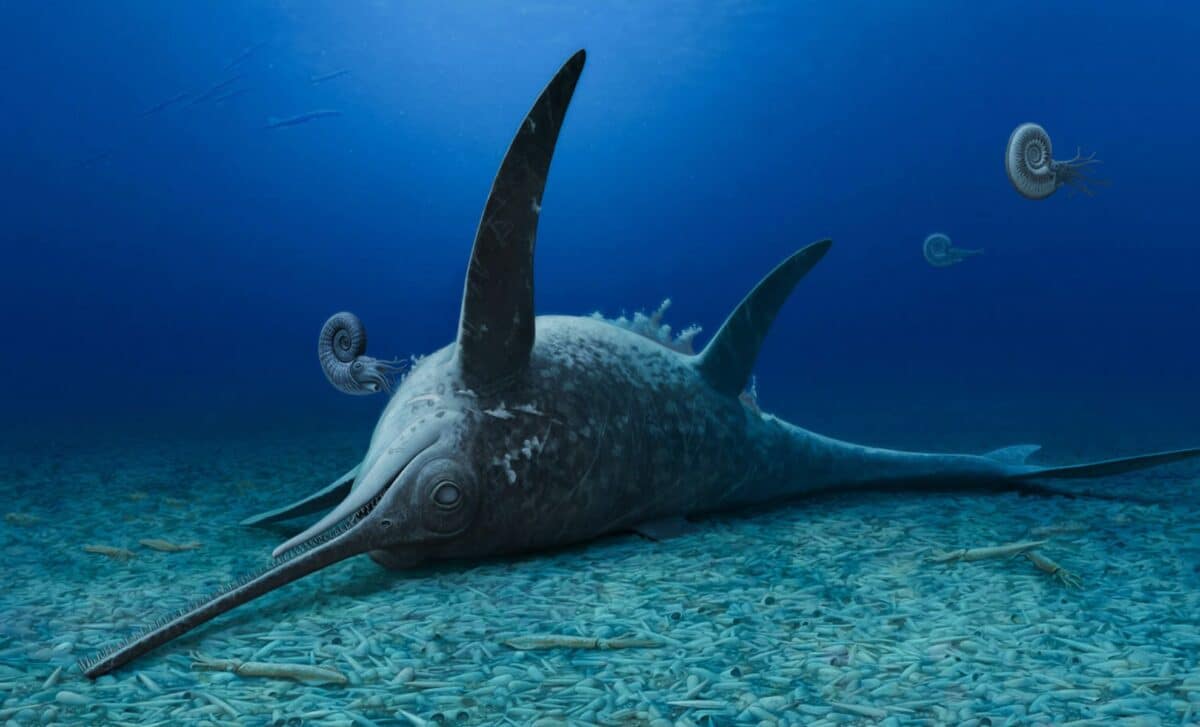
The 190-million-year-old newly discovered ichthyosaur fossil, nicknamed the “Sword Dragon of Dorset,” features a remarkably well-preserved skeleton. Its nearly complete remains have opened a window into a transformative period in prehistoric life when major species shifts were occurring in the world’s oceans.
This rare specimen, Xiphodracon goldencapensis, marks the first new genus of Early Jurassic ichthyosaur described in over a century. The dolphin-sized creature’s fossil was discovered in 2001, but it has only now been thoroughly studied. According to Dr. Dean Lomax, a leading paleontologist involved in the research, the discovery provides a missing piece to the ichthyosaur puzzle, helping pinpoint when significant changes in ichthyosaur families occurred.
An Unusual Find on the Jurassic Coast
The Jurassic Coast of southern England is famed for its wealth of prehistoric fossils, thanks to the area’s rich geological history. Since the 19th century, this coastline has produced some of the most important discoveries in paleontology, starting with the pioneering work of fossil hunter Mary Anning. The latest discovery, however, offers something uniquely valuable: a completely new genus of ichthyosaur from the Early Jurassic period.
The skeleton was found by local collector Chris Moore near Golden Cap in 2001. Preserved in extraordinary detail, the fossil includes a skull with a huge eye socket and an elongated, sword-like snout. The creature, estimated to have been around three meters long, likely preyed on fish and squid, and researchers speculate that traces of its last meal may even be preserved in the fossil. According to Dr. Lomax:
“I remember seeing the skeleton for the first time in 2016. Back then, I knew it was unusual, but I did not expect it to play such a pivotal role in helping to fill a gap in our understanding of a complex faunal turnover during the Pliensbachian.” He explained, “this time is pretty crucial for ichthyosaurs as several families went extinct and new families emerged, yet Xiphodracon is something you might call a “missing piece of the ichthyosaur puzzle.”
The Missing Links of Evolution: Solved!
The discovery, published in Papers in Palaeontology, is particularly significant because ichthyosaurs from the Pliensbachian period (around 193 to 184 million years ago) are exceedingly rare. The fossil helps scientists pinpoint a major evolutionary turnover that occurred during this time, when several ichthyosaur families went extinct and new groups began to emerge.
“Thousands of complete or nearly complete ichthyosaur skeletons are known from strata before and after the Pliensbachian,” said Professor Judy Massare, a co-author of the study. ” The two faunas are quite distinct, with no species in common, even though the overall ecology is similar. Xiphodracon helps to determine when the change occurred, but we still don’t know why.”
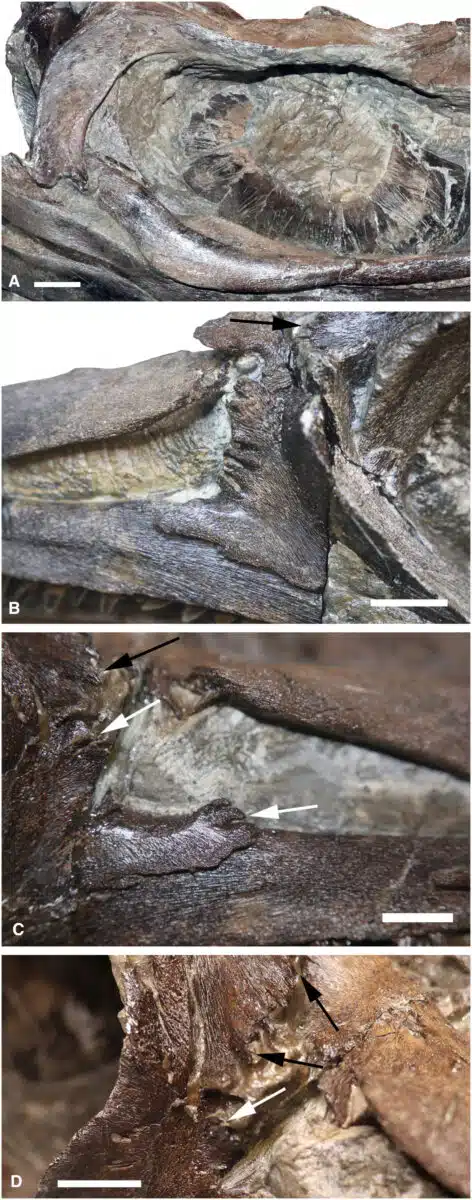
As Dr. Lomax explained, Xiphodracon is “more closely related to species in the later Early Jurassic,” and its discovery suggests that the faunal turnover in marine reptiles occurred much earlier than scientists previously expected.
A Skeleton That Tells Its Story
The skeleton also provides valuable information about the challenges faced by marine reptiles during the Jurassic period. Co-author Dr. Erin Maxwell, from the State Museum of Natural History Stuttgart, noted that the skeleton shows signs of significant injury or disease, with malformed limb bones and teeth.
“The limb bones and teeth are malformed in such a way that points to serious injury or disease while the animal was still alive, and the skull appears to have been bitten by a large predator — likely another much larger species of ichthyosaur,” he said.
The name Xiphodracon is a fitting tribute to the creature’s distinct features. “Xipho” refers to its sword-like snout, while “dracon” is a reference to the long-standing moniker of “sea dragons” for ichthyosaurs. Dr. Lomax expressed his excitement about naming the new species. He said that:
One of the coolest things about identifying a new species is that you get to name it!
The discovery of Xiphodracon will now be part of the Royal Ontario Museum’s collection, where it is set to go on public display, allowing more people to marvel at this extraordinary find.
First Appeared on
Source link






Leave feedback about this