

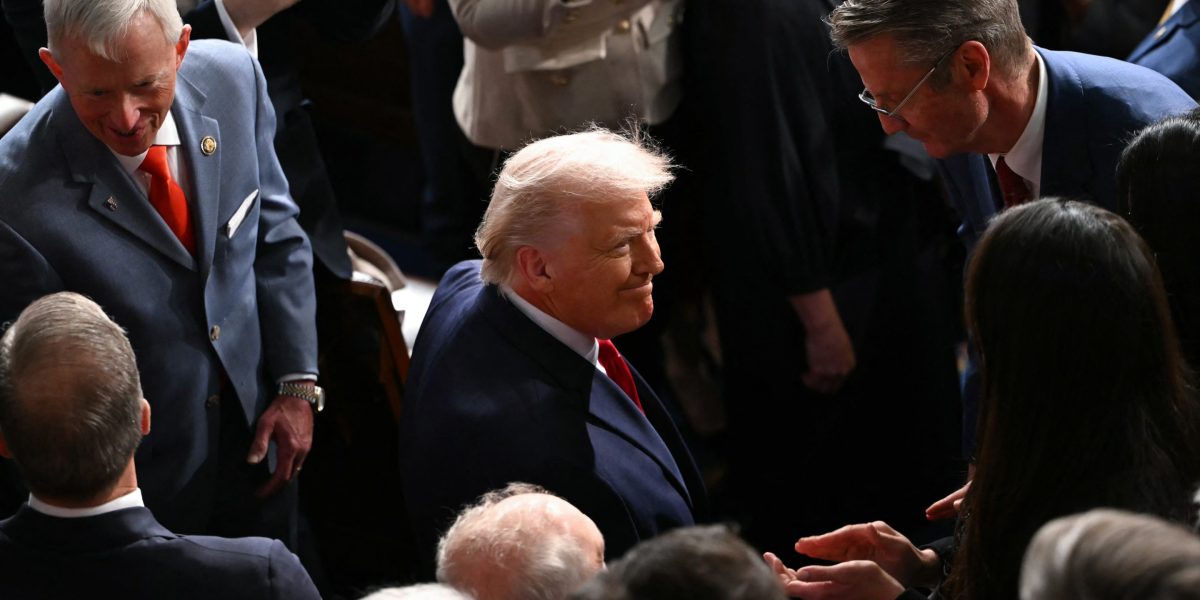
President Donald Trump used his State of the Union address to champion his signature “Trump Accounts,” highlighting the massive influx of private wealth from billionaires who are heavily funding the child investment program. During a speech focused heavily on projecting an era of American economic triumph, with data that was seemingly disconnected at times from current federal statistics, the president pointed to historic corporate philanthropy as key validation of his administration’s financial policies.
“Millions will be pre-funded courtesy of the U.S. Treasury and private individuals like Michael and Susan Dell who have donated $6.25 billion to fund the Trump Accounts to 25 million American children,” Trump declared to the gathered lawmakers, praising the couple as “great people.”
The president used the primetime moment to single out Michael Dell’s path to a $148 billion fortune as a testament to capitalism. “When I asked Michael, ‘How do you make all that money?’ He said, ‘Well, I just sat in my dorm in school, and I made computers, and I’d sell them,’” Trump recounted. “That’s called the American Dream.” Trump also recognized venture capitalist Brad Gerstner in the audience as another Trump Accounts backer, thanking him for being “behind it right from the beginning.”
What are Trump Accounts, and who is eligible?
The newly enacted program, passed as part of a multitrillion-dollar tax and spending package in July, establishes investment vehicles designed to connect young Americans to the financial markets. The federal government will contribute $1,000 to accounts for babies born between 2025 and 2028, with the program officially launching on July 4, 2026, to coincide with the 250th anniversary of U.S. independence. The funds must be invested in low-fee index funds that primarily hold U.S. stocks.
Because the federal baseline only applies to newborns in that specific window, private donors have stepped in to expand the program’s reach. The Dells’ unprecedented $6.25 billion commitment will seed accounts with $250 each for 25 million children ages 10 and under who reside in zip codes with median family incomes of $150,000 or less. Other financial titans have followed suit. Bridgewater Associates founder Ray Dalio pledged $75 million to fund accounts for 300,000 children in Connecticut, while BlackRock announced it will match the $1,000 federal contribution for the children of its employees.
They are designed to give children a long-term financial head start, with the goal of expanding stock market ownership to all Americans—what Treasury Secretary Scott Bessent has called “the greatest merger in history between Wall Street and Main Street.”
Advocates like Gerstner believe this public-private framework will “unlock major giving” and ensure that more Americans benefit from the upside of the U.S. economy. However, despite the enthusiastic Oval Office backing and the influx of billionaire dollars, the Trump Accounts face notable skepticism from policy experts.
Medicare, food stamps, and childcare cut
Economist Darrick Hamilton, who originally pioneered the concept of government-funded “baby bonds,” has dismissed the current iteration of the accounts as an attempt to “address wealth inequality on the cheap.” Furthermore, critics argue, while the long-term investment accounts might help young adults decades down the line, they do nothing to address immediate child poverty—a concern heightened by the fact that the exact same legislative package that created the accounts also enacted significant cuts to Medicaid, food stamps, and childcare.
Additionally, lawmakers scaled back the tax benefits of the accounts before passing the law. Unlike 529 college savings plans, any market gains or tax-free contributions originating from the government, employers, or philanthropists like the Dells will ultimately be taxed as ordinary income upon withdrawal.
The accounts remain locked until the beneficiary turns 18, after which they function similarly to traditional IRAs, allowing penalty-free withdrawals for higher education, first-time home purchases, and birth or adoption expenses.
For Trump, however, the massive private buy-in served as a prime State of the Union talking point. By heavily spotlighting the Dell family’s multibillion-dollar contribution on national television, Trump framed his namesake accounts not just as a government initiative, but as a historic partnership with the champions of American free enterprise.
For this story, Fortune journalists used generative AI as a research tool. An editor verified the accuracy of the information before publishing.
First Appeared on
Source link





Leave feedback about this