

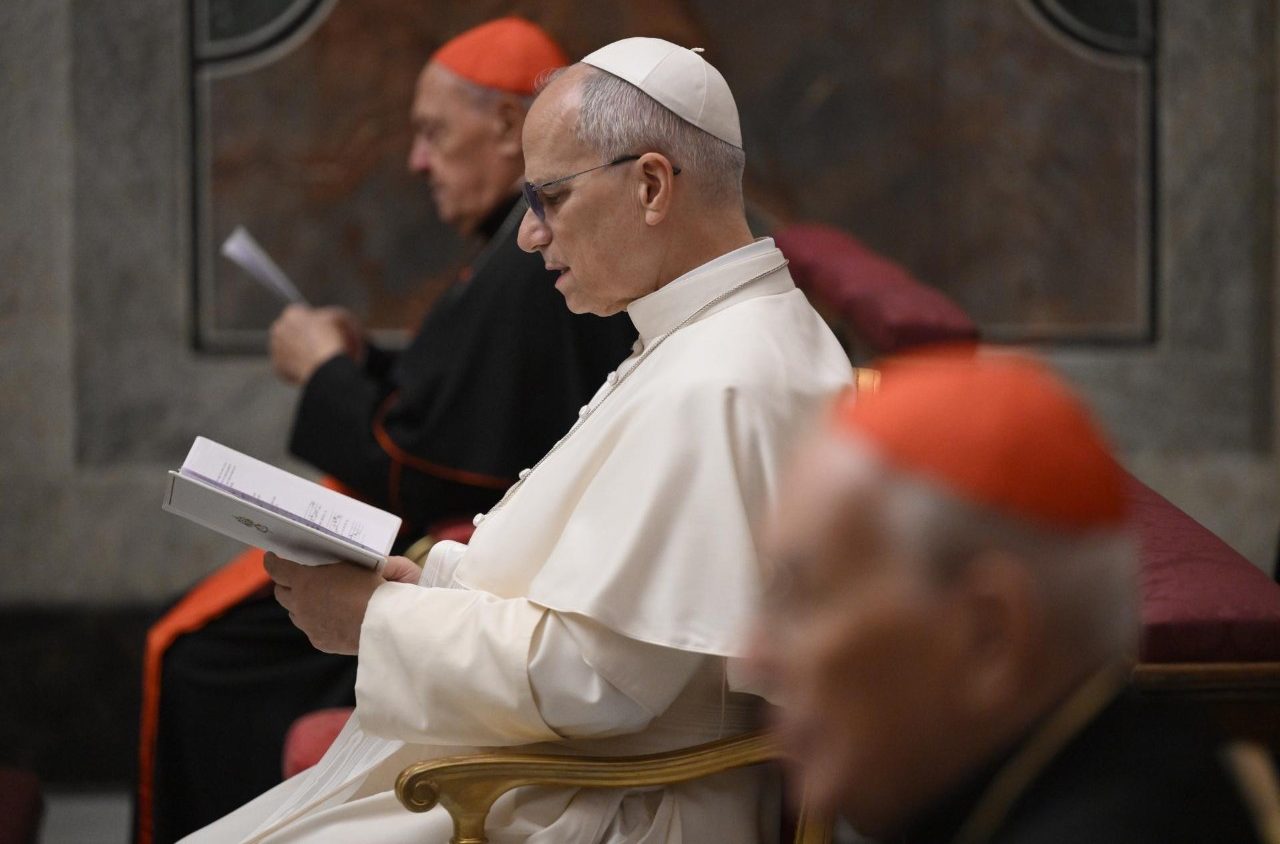
Bishop Erik Varden delivers his sixth reflection at the Spiritual Exercises in the Vatican for Pope Leo XIV, Cardinals residing in Rome, and heads of Dicasteries, focusing on the theme: “The Fall of Thousands.” The following is a summary of his reflection.
By Bishop Erik Varden, OCSO*
Falls can humble us when we are puffed up, showing God’s power to save. They can become milestones on a personal journey of salvation, to be recalled gratefully.
Yet we cannot afford to be gullible. Not every fall ends in exhilaration. There are falls that reek hellishly, bringing destruction to the guilty and carrying ruin in their wake. That wake is often broad and long, pulling in many innocents. We shall need fortitude to approach, with Bernard, the verse of Psalm 90 which begins: ‘A thousand shall fall at your side, ten thousand at your right.’
Nothing has done the Church more tragic harm, and compromised our witness more, than corruption arisen within our own house. The worst crisis of the Church has been brought on, not by secular opposition, but by ecclesiastical corruption. The wounds inflicted will take time to heal. They call out for justice and for tears.
It is tempting, face to face with corruption, especially when we confront abuse, to look for a diseased root. We expect to find early warning signs that were ignored: some failure in screening, an original pattern of deviancy. Sometimes these trails exist and we are right to blame ourselves for not having spotted them in time. We do not, however, find them always.
We can recognise the great and joyful good often manifest in the beginnings of communities now linked with scandal. We cannot presuppose that there was structural hypocrisy from the start, that founders set out as white-washed sepulchres. Sometimes we do find signs of inspiration, even traces of holiness. How can we simultaneously account for these and for warped developments?
A secular mindset will simplify: when it meets calamity, it designates monsters and victims.
Happily the Church possesses, when she remembers to use them, more delicate and more effective tools.
Bernard reminds us that where people pursue noble endeavours, enemy attacks will be fierce. He notes ‘that the spiritual men of the Church are attacked much more terribly than those who are carnal’. He thinks this is what the Psalm Qui habitat intends with its language of ‘left’ and ‘right’: the left stands for our carnal, the right for our spiritual nature. Casualties are more numerous on the right for that is where, on the spiritual battlefield, the most lethal weapons are used.
While he took the demonic realm seriously, this is not to say that he ascribes all spiritual disease to villains with horns and pitchforks. He holds men and women responsible for the way in which they use their sovereign freedom. His point is that human nature is one. If we begin to go deep into our spiritual nature, other depths are perforce laid bare. We shall face existential hunger, vulnerability, a yearning for comfort. Such experiences may arise by way of assault.
Progress in the spiritual life requires a configuring of our physical and affective self attuned to contemplative maturing, else there is danger that spiritual exposure will seek physical or affective release; and that such instances of release are rationalised as if they were, somehow, ‘spiritual’ themselves, more elevated than the misdemeanours of ordinary mortals. The integrity of a spiritual teacher will be attested by his conversation, but not only; it will be evidenced as much by his online habits, his comportment at table or at the bar, his freedom with regard to others’ adulation.
The spiritual life is not adjunct to the remainder of existence. It is its soul. We must beware of all dualism, always remembering that the Word became flesh so that our flesh might be imbued with Logos. We must keep a look-out both to the left and to the right while taking care, Bernard insists on this point, not to mistake the left for the right or the right for the left. We must learn to be equally at ease in our carnal and spiritual nature so that Christ our Master may govern peacefully in both.
* Bishop Erik Varden, Bishop of Trondheim, Norway, was asked to preach the 2026 Spiritual Exercises for Pope Leo XIV, Cardinals residing in Rome, and the heads of Dicasteries of the Roman Curia, which runs from Sunday, February 22, to Friday, February 27. Here is the link to his website.
First Appeared on
Source link




Leave feedback about this