


Using supercomputers, researchers have discovered how the rotation of these stars plays a crucial role in mixing materials between their cores and outer layers.
For years, scientists have been trying to understand how the chemical changes in a star’s core affect its surface as it evolves into a red giant. This new discovery offers an answer to this puzzle, which has eluded astronomers for decades, and opens up new possibilities for studying the life cycle of stars.
How Stellar Rotation Drives Elemental Mixing in Stars
At the heart of the discovery is the role of stellar rotation. According to Simon Blouin, the lead researcher and postdoctoral fellow at the University of Victoria’s Astronomy Research Centre (ARC):
“Stellar rotation is crucial and provides a natural explanation for the observed chemical signatures in typical red giants.”
A release from the University of Victoria reveals that researchers used high-resolution 3D simulations to study how the rotation impacts the mixing of elements between their core and surface.These simulations revealed that rotating celestial bodies mix materials far more efficiently than non-rotating stars.
The mixing rates in rotating red giants were found to exceed those in non-rotating stars by over 100 times, a finding that directly matches the chemical changes observed on the surface of these cosmic objects. This breakthrough demonstrates that the rotation of stars is a key factor in the transport of material from the nuclear-burning interior to the surface, which was previously a mystery.
Supercomputers Make the Discovery Possible
The simulations required to model the complex processes inside a red giant star are immense in scale, demanding powerful computing power. The researchers relied on the Trillium supercomputing cluster at the University of Toronto’s SciNet and the Texas Advanced Computing Centre to run the large-scale simulations necessary for their research.
Falk Herwig, director of ARC and principal investigator on the project, explained that:
“We were able to discover a new stellar mixing process only because of the immense computing power of the new Trillium machine. These are the computationally most intensive stellar convection and internal gravity wave simulations performed to date.”
Without the computing capabilities of these new supercomputers, testing the hypothesis of stellar rotation’s impact on stellar mixing would not have been possible.
How Rotation Affects Stellar Evolution
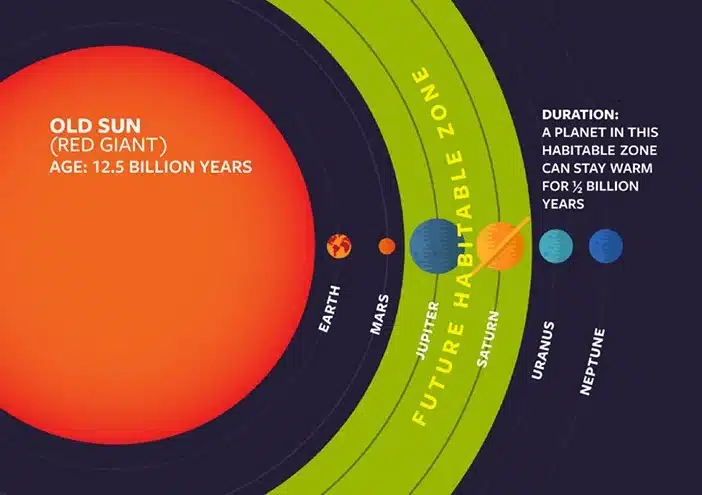
Red giants represent a later phase in the life cycle of stars, a phase the Sun will eventually enter as it exhausts its core hydrogen. As red giants expand, their surface composition changes, a process that has been observed for decades but never fully understood.
Blouin and his team’s work could help predict how our Sun will evolve in the distant future. As he noted, the study opens up new avenues for exploring how other celestial bodies, with varying rotation profiles, might behave as they progress through different evolutionary stages.
First Appeared on
Source link






Leave feedback about this