

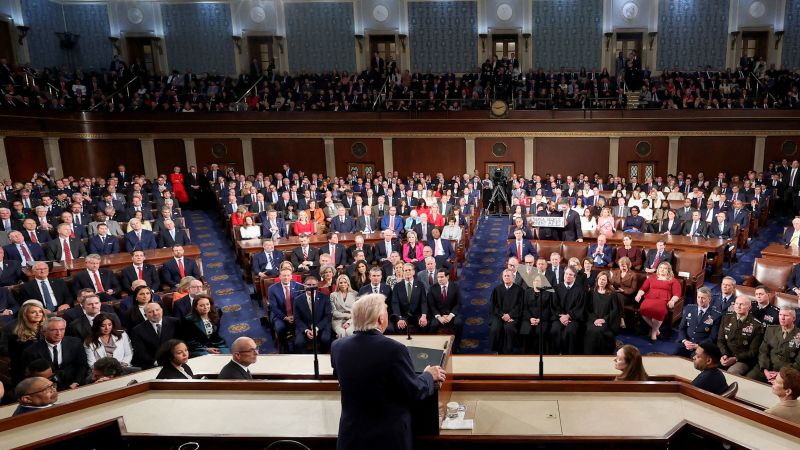
President Donald Trump made false claims in his State of the Union address on Tuesday.
Here is a fact check of some of Trump’s remarks so far:
Trump repeated his regular false claim that he has secured $18 trillion in investments in the US since returning to office, saying, “In 12 months, I secured commitments for more than $18 trillion pouring in from all over the globe.”
The $18 trillion figure is fiction. As of the night of Trump’s address, the White House’s own website said the figure for “major investment announcements” during this Trump term was “$9.7 trillion,” and even that is a major exaggeration; a detailed CNN review in October found the White House was counting trillions of dollars in vague investment pledges, pledges that were about “bilateral trade” or “economic exchange” rather than investment in the US and vague statements that didn’t even rise to the level of pledges.
From CNN’s Daniel Dale
Trump claimed gas prices are “now below $2.30 a gallon in most states, and in some places, $1.99 a gallon.” But no state had an average gas price on Tuesday below $2.37 per gallon, according to AAA; only two states had an average below $2.50 per gallon. And while there are some individual gas stations selling gas for below $2 per gallon, they are scarce; Patrick De Haan, head of petroleum analysis for the firm GasBuddy, said during the speech that the firm found just four stations across the country below $2 (aside from special discounts) out of the roughly 150,000 stations the firm tracks, so about 0.00003% of the total.
Trump could fairly say gas prices have fallen during this presidency. They have declined from a national average of $3.12 per gallon on his inauguration day in January 2025, according to AAA, to a national average of $2.95 per gallon on Tuesday.
In addition, Trump claimed, “And when I visited the great state of Iowa just a few weeks ago, I even saw $1.85 a gallon for gasoline.” We don’t know what Trump saw, but the average price for a gallon of regular gas in Iowa on the day of the January 27 speech was $2.57, according to data published that day by AAA – and Patrick De Haan, head of petroleum analysis for GasBuddy, told CNN at the time that GasBuddy found just four stations in the state selling for $1.97 per gallon (aside from special discounts) out of 2,036 total stations the firm tracks, so 0.19% of the total.
Trump was fact-checked on this subject by an attendee at the Iowa speech he was referring to. When he spoke of gas in Iowa being $1.95 or $1.85 per gallon, someone in the crowd shouted, “No, $2.63,” according to CNN reporter Steve Contorno, who was on scene. Contorno saw that the gas station right outside the venue where Trump spoke was selling for $2.69 per gallon.
From CNN’s Daniel Dale
Trump falsely claimed that when he gave his previous address to Congress early last year, he had “just inherited … inflation at record levels.” He added a bit later that Biden and his congressional allies “gave us the worst inflation in the history of our country.”
Trump didn’t inherit the worst inflation in US history, and Biden never had the worst inflation in US history. The year-over-year inflation rate in Biden’s last full month in office, December 2024, was 2.9%, and the rate in the month in which Trump took over partway through, January 2025, was 3.0%; the most recent rate, for January 2026, is 2.4%. The rate did hit a 40-year high, 9.1%, in June 2022, but that was far from the all-time high of 23.7%, which was set in 1920. Regardless, the rate then fell sharply over Biden’s last two-and-a-half years in office.
From CNN’s Daniel Dale
Trump claimed that he inherited a “stagnant economy” from the Biden administration and that it is now “roaring like never before.” Though there is no firm definition of “stagnant” or “roaring,” the facts don’t corroborate the suggestion that he has presided over a massive economic boom since returning to office in January 2025. The US economy grew 2.2% in 2025, which was lower than in any year of the Biden presidency; there was 2.8% growth in 2024. (The fall 2025 government shutdown likely reduced growth in late 2025.) The unemployment rate, meanwhile, increased from 4.0% in January 2025 to 4.3% in January 2026.
The year-over-year Consumer Price Index inflation rate did fall from 3.0% in January 2025 to 2.4% in January 2026, and Trump certainly has some other positive data points to cite. But his story about taking the economy from deceased to scorching is just not supported by the overall numbers.
From CNN’s Daniel Dale
Trump once again claimed that the sweeping domestic policy agenda that he signed into law last summer contained the largest tax cuts in American history. But that is not actually the case.
The so-called “big, beautiful bill” made numerous permanent and temporary changes to the tax code, including eliminating taxes on tips and overtime, giving additional tax relief to senior citizens and parents of young children and allowing companies to deduct certain investments more quickly. The tax cuts amount to $4.8 trillion, or 1.3% of the nation’s gross domestic product (GDP), over a decade, according to the latest Congressional Budget Office analysis, released earlier this month.
However, the bill is not the largest tax cut in history, experts said. It ranks seventh in terms of share of GDP since 1918, according to Chris Towner, policy director for the Committee for a Responsible Federal Budget, a nonpartisan watchdog group. The largest was former President Ronald Reagan’s 1981 tax package, which cost 2.9% of GDP over four years. (Looking at revenue changes as a share of GDP is a common way to assess the size of tax cuts because it shows the changes relative to the size of the economy. It allows for comparisons across time despite shifts in inflation and population, for example.) Similarly, the Tax Foundation, a right-leaning think tank, found that the bill is the sixth largest tax cut since 1940, in terms of share of GDP.
From CNN’s Tami Luhby
While criticizing the Biden administration’s border policies, Trump repeated his regular claim that the Biden administration allowed 11,888 murderers to enter the US as migrants – saying, “They were murderers, 11,888 murderers. They came into our country.”
Trump was inaccurately describing federal data. The Department of Homeland Security and independent experts have noted that the figure it appears Trump was referring to when he uses the “11,888” number is about non-citizens who entered the US not just under Biden but over the course of multiple decades, including during Trump’s own first administration. They were convicted of homicide at some point, usually in the US after their arrival, and are still in the US while being listed on Immigration and Customs Enforcement’s “non-detained docket” – which includes people who are currently serving their prison sentences, not roaming free as Trump has also claimed. You can read more here.
From CNN’s Daniel Dale
Trump repeated his regular false claim that tariffs are “paid for by foreign countries.” In fact, tariff payments are made by importers in the US, not foreign countries, and those importers often pass on some of their costs to consumers. While foreign exporters may sometimes drop their prices to try to keep their products competitive, various analyses have found that the overwhelming majority of the costs of the tariffs Trump has imposed this term are being covered by a combination of US businesses and US consumers.
In an analysis released in February, officials at the Federal Reserve Bank of New York wrote, “We find that nearly 90 percent of the tariffs’ economic burden fell on U.S. firms and consumers.” The nonpartisan federal Congressional Budget Office wrote in a February report that “the net effect of tariffs is to raise U.S. consumer prices by the full portion of the cost of the tariffs borne domestically (95 percent),” from a combination of price hikes by US businesses that are importing tariffed products and price hikes by US businesses that are facing less foreign competition because of the tariffs.
From CNN’s Daniel Dale
Trump repeated his claim that Somali residents of Minnesota have committed $19 billion in fraud, saying: “There’s been no more stunning example than Minnesota, where members of the Somali community have pillaged an estimated $19 billion from the American taxpayer. We have all the information, and in actuality, the number is much higher than that.”
It’s possible this “$19 billion” figure will be proven true, but nothing close to that figure has been proven to date.
In December, a federal prosecutor, Joseph Thompson, claimed that “half or more” of $18 billion in federal funds billed by 14 Medicaid services in Minnesota deemed at high risk for fraud – and now under a third-party audit ordered by Gov. Tim Walz – might be fraudulent.
But $9 billion is not $19 billion, Thompson didn’t say all of the possible fraud was committed by Somali residents, and Walz’s administration challenged Thompson’s claim.
One Walz administration official said in December that they had “evidence of tens of millions of dollars in fraud to this point,” not $9 billion; Walz himself said, “You should be equally outraged about $1 or whatever that number is, but they’re using that number without the proof behind it.” And Thompson – who resigned in January amid tension with the Trump administration over its handling of an ICE officer fatally shooting Renée Good – made clear at the time that the “half or more” comment was an early estimate rather than a firm number.
From CNN’s Daniel Dale
Fact check: Ballots and elections
Trump made a rapid-fire series of false claims about US elections while calling on Congress to pass a bill requiring voter identification and proof of citizenship when registering to vote.
Trump falsely claimed, “Cheating is rampant in our elections. It’s rampant.” It’s simply not; all evidence suggests fraud makes up a minuscule percentage of votes cast. Trump referred to “crooked mail-in ballots”; the incidence of fraud is also tiny with mail-in ballots, though experts say it is slightly higher than with in-person voting, and there is no basis to categorically describe them as “crooked.” And Trump said, “They have cheated, and their policy is so bad that the only way they can get elected is to cheat.” That is a lie, as Democrats, like Republicans, are elected all the time in free and fair US elections.
From CNN’s Daniel Dale
Trump repeated his regular claim that there are more people working today in the US than ever before. That’s true, but the claim needs context: the number of people working tends to rise over time because the US population tends to rise over time. Economists say there are far better measures of the health of the labor market.
The employment-population ratio, which measures the percentage of the population that is employed, is down slightly this presidential term so far, going from 60.1% in January 2025, the month Trump returned to office, to 59.8% in January 2026. The unemployment rate, which measures unemployment as a percentage of the labor force, has increased, going from 4.0% in January 2025 to 4.3% in January 2026; it hit a four-year high of 4.5% in November before easing. The labor force participation rate, which measures the percentage of the population that is employed or actively looking for work, has been almost unchanged, ticking down 62.6% in January 2025 to 62.5% in January 2026.
From CNN’s Daniel Dale
Trump repeated a familiar false claim about his role in foreign affairs: “My first 10 months, I ended eight wars.” While Trump has played a role in resolving some conflicts (at least temporarily), the “eight” figure is a clear exaggeration.
Trump explained during the speech that his list of supposed wars settled includes a war between Egypt and Ethiopia, but that wasn’t actually a war; it is a long-running diplomatic dispute about a major Ethiopian dam project on a tributary of the Nile River. Trump’s list also included another supposed war that didn’t actually occur during his presidency, between Serbia and Kosovo. (He has sometimes claimed to have prevented the eruption of a new war between those two entities, providing few details about what he meant, but that is different than settling an actual war.) And his list included a war involving the Democratic Republic of Congo and Rwanda, but that war has continued despite a peace agreement brokered by the Trump administration in 2025 – which was never signed by the leading rebel coalition doing the fighting.
Trump’s list also included an armed conflict between Thailand and Cambodia, where fighting temporarily erupted again in December despite a peace agreement brokered by the Trump administration earlier in 2025.
One can debate the importance of Trump’s role in having ended the other conflicts on his list, or fairly question whether some have truly ended; for example, killing continued in Gaza after the October ceasefire deal between Israel and Hamas, and Trump said in the speech, “The war in Gaza, which proceeds at a very low level; it’s just about there.” Regardless, Trump’s “eight” figure is obviously too big.
From CNN’s Daniel Dale
Trump again falsely claimed that he eliminated taxes on Social Security, one of his key campaign promises in 2024.
“With the great Big, Beautiful Bill, we gave you no tax on tips, no tax on overtime, and no tax on Social Security,” he said during his State of the Union address on Tuesday.
The massive domestic policy package that Trump signed last summer did create an additional, temporary $6,000-per-year tax deduction for individuals age 65 and older (with a smaller deduction for individuals earning $75,000 per year or more). But as the White House itself has implicitly acknowledged, millions of Social Security recipients age 65 and older will continue to pay taxes on their benefits – and that new deduction, which expires in 2028, doesn’t apply to the Social Security recipients who are younger than 65.
From CNN’s Tami Luhby
Trump baselessly claimed that eliminating fraud in federal programs would balance the federal budget, saying, “If we’re able to find enough of that fraud, we will actually have a balanced budget overnight. It’ll go very quickly.”
The annual budget deficit far exceeds the estimated amount of money the federal government loses to fraud each year.
A first-of-its-kind estimate that the federal Government Accountability Office released in 2024 found that between $233 billion to $521 billion is lost to fraud annually. But the federal budget deficit came in at just under $1.8 trillion for the most recent fiscal year, which ended in September, according to the Treasury Department – more than triple the highest estimated fraud total.
From CNN’s Tami Luhby
This article has been updated with additional items.
First Appeared on
Source link






Leave feedback about this