

This article reports results from the February 2026 Strength In Numbers/Verasight poll. You can read our previous poll releases here. Subscribers to Strength In Numbers have access to additional tracking visuals and a full archive of crosstabs here. Subscribers can also suggest questions for future polls here, or leave them in the comments section below!
Tonight, Donald Trump will deliver the first formal State of the Union address of his second term to a joint session of Congress. The speech is widely seen as a test run for Republican midterm messaging — an attempt to reframe the narrative on the economy, immigration, and tariffs ahead of November. In an interview last week, Vice President JD Vance previewed the speech, saying Trump would focus on his success in “bringing jobs back into our country,” “reshoring manufacturing,” and cutting energy prices.
But the numbers Trump faces going into his speech are brutal. Our brand-new February Strength In Numbers/Verasight poll finds the president at his lowest point on virtually every metric. Trump’s overall job approval has fallen to net -22, and he’s now underwater or tied on every single issue we track, including border security, which had been his last remaining bright spot. Democrats have opened a 10-point lead on the generic congressional ballot, the widest we’ve recorded. And voters disapprove of Trump’s tariff policy — presumably his focus, according to Vance, and which was largely invalidated by the Supreme Court last week — by 21 points.
Trump will use his SOTU address to refocus attention on all the “great things” he has done for the American people in his first year in office. But the average person is saying they don’t support his agenda. The State of our Union, in one term, is anti-Trump.
-
Generic ballot: Democrats lead Republicans 52% to 42% among registered voters — a 10-point margin and the widest lead since we started this tracking poll
-
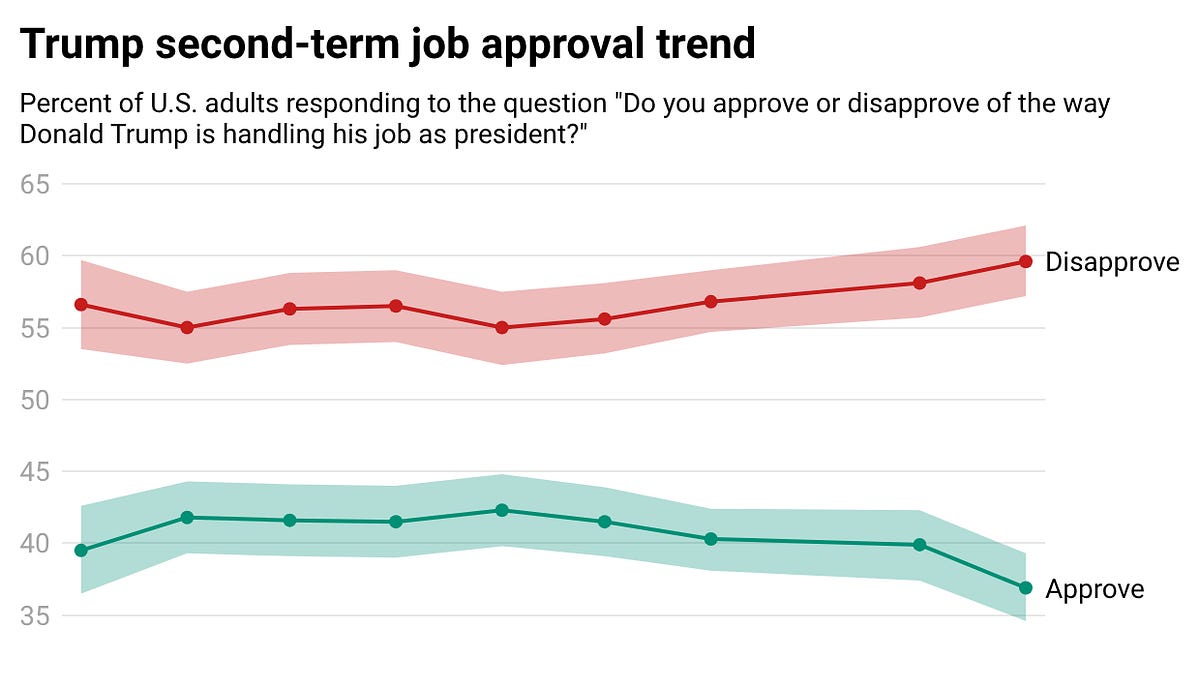
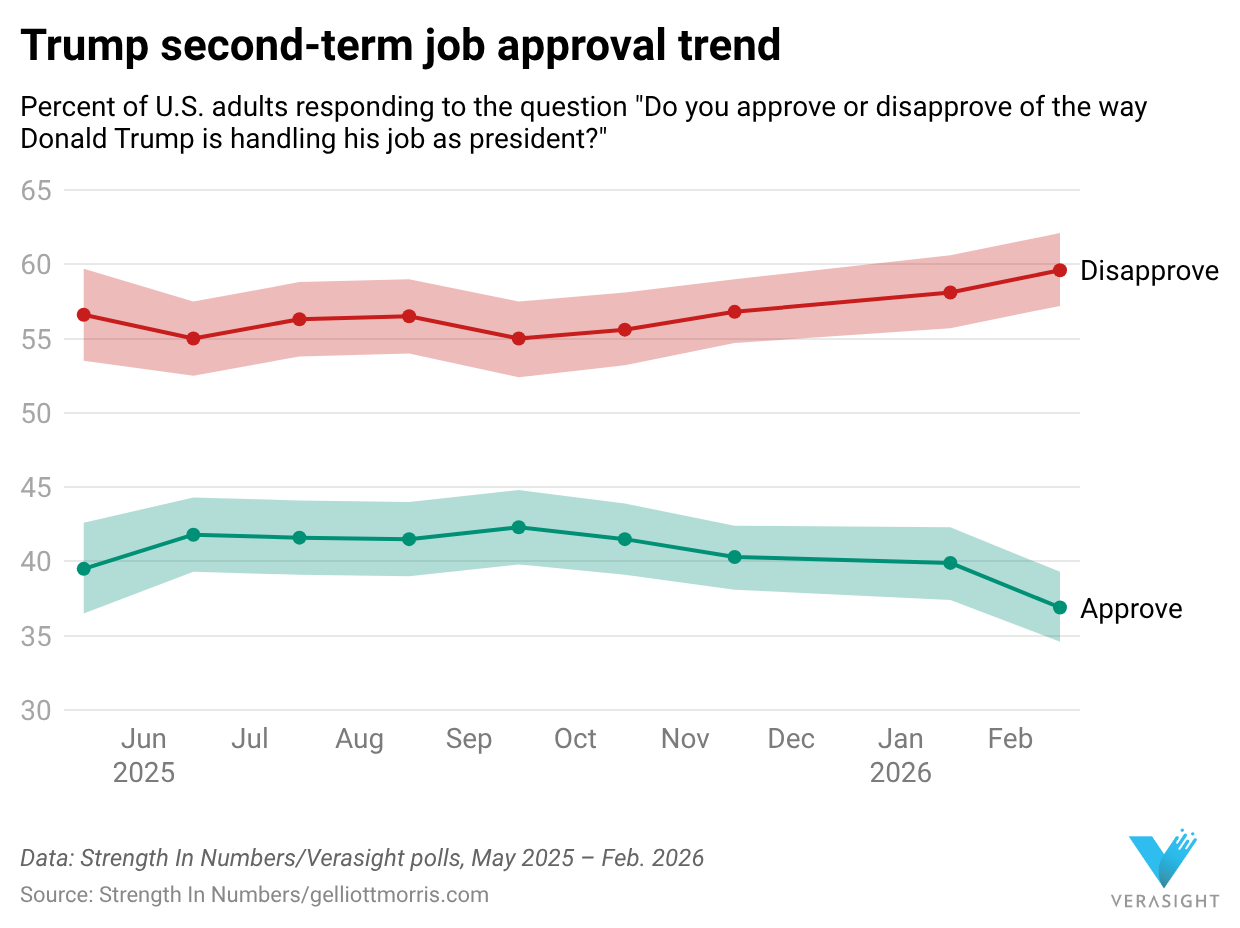
Presidential approval: 37% of U.S. adults approve of Trump’s job performance; 59% disapprove (net -22). Trump’s approval among political independents is just 20% in our data.
-
No positive issues left: Trump’s approval on border security — his one remaining bright spot — dropped from net +4 to net 0 over the last month. He is now underwater or even on every issue we test.
-
Trump approval on government funding collapses: Approval on government funding and social programs fell 7 points to net -26, the sharpest single-issue decline this month. Trump’s approval on health care also fell.
-
Spending priorities: Given a hypothetical $75 billion to spend on something, just 5% of Americans would spend it on immigration enforcement. 31% chose reducing grocery and housing costs.
-
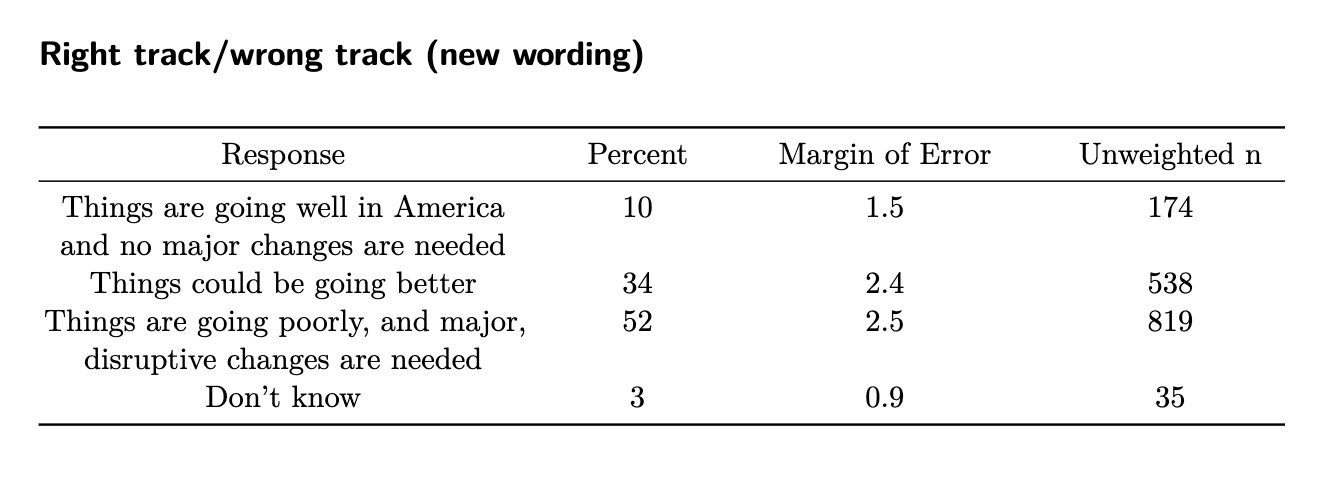
Direction of country: Only 10% say things are going well in America. 52% say things are going poorly and major changes are needed.
Note: This is the first of four articles releasing data from the February Strength In Numbers/Verasight poll. My goal is to publish one per day through Friday, all free. The next releases will have data on immigration and deportation reforms, perceptions of the parties and their strengths/weaknesses, and support for various institutional reforms, such as term limits for the Supreme Court or admitting Puerto Rico as a state. Subscribe to Strength In Numbers to get these results directly in your inbox.
Among registered voters, Democrats lead the generic House ballot 52% to 42%, with just 6% undecided. That’s a 10-point margin — up from the 8-point lead we recorded in January and the widest advantage in the history of the Strength In Numbers/Verasight poll.
The shift from D+8 to D+10 is modest but directionally consistent. Democrats have led in every monthly poll since we began the series, but the margin had hovered between D+4 and D+8 depending on the month. This is the first time it has hit double digits.
For context, the out-party typically gains ground on the generic ballot as a midterm approaches. As I wrote in my analysis of early 2026 midterm polling, the party out of power has gained an average of about 5 points between February and November in modern midterm cycles. If that pattern holds — and the starting point is already D+10 — Democrats would be looking at a margin deep into wave territory by Election Day.
That’s a big “if,” but the party’s strong position going into the midterm campaign cycle is undeniable.
Overall, 37% of adults approve of Trump’s job performance while 59% disapprove — a net rating of -22, down 4 points from -18 in our January poll. That’s the lowest we’ve recorded.
But overall, presidential approval ratings only tell us so much. What about how people feel on the issues? For the first time in our polling, Trump does not have a single positive issue rating:
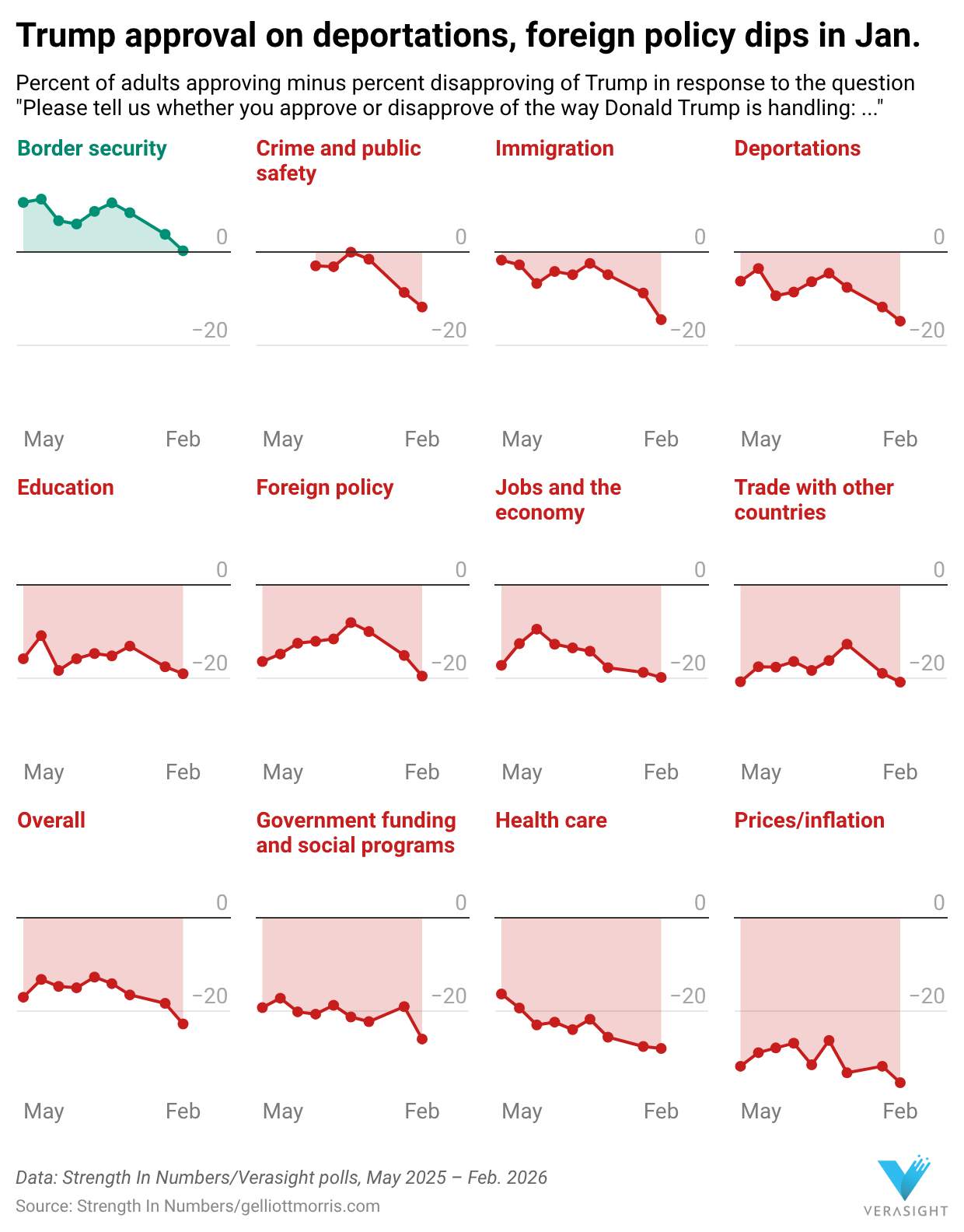
And here is how Trump’s issue approval ratings changed from our January to February polls:
Trump approval by issue (February vs. January):
-
Border security: +4 → 0 (-4)
-
Crime and public safety: -9 → -12 (-3)
-
Deportations: -12 → -15 (-3)
-
Immigration: -9 → -15 (-6)
-
Education: -18 → -19 (-2)
-
Foreign policy: -15 → -20 (-4)
-
Jobs and the economy: -19 → -20 (-1)
-
Trade with other countries: -19 → -21 (-2)
-
Gov. funding and social programs: -19 → -26 (-7)
-
Health care: -28 → -28 (0)
-
Prices/inflation: -32 → -35 (-4)
Every issue moved against Trump this month except health care, which held roughly steady. Three shifts stand out:
-
Government funding and social programs crashed 7 points, from net -19 to net -26. This may reflect a hit to the GOP over the current DHS shutdown or anger at the expiration of health care subsidies last month.
-
Immigration dropped 6 points, from net -9 to net -15. I’ll have more on this in tomorrow’s article, but the continued fallout from ICE enforcement operations — including the killings of Renee Good and Alex Pretti — is clearly dragging the president’s and his party’s numbers down on what was supposed to be his strongest issue.
-
Trump falls to a new low on prices, from -32 to -35. This has been his worst issue since we started polling, and it keeps getting worse. Voters in our survey named prices as their top concern by a wide margin — 32% called it the most important problem facing the country — and they’re giving the president his lowest marks on the thing they care about most.
And then there’s border security. In January, the issue was Trump’s one bright spot, with a 50% approval and 46% disapproval rating (+4). At 48/48 now (+0), Trump enters March without a single issue where more Americans approve than disapprove of his performance.
Only 10% of Americans say things are going well in the country right now. Another 34% say things could be going better, while a majority — 52% — say things are going poorly and major, disruptive changes are needed.
A big problem voters point out is mismatched issue prioritization. So what do voters actually want the government to focus on?
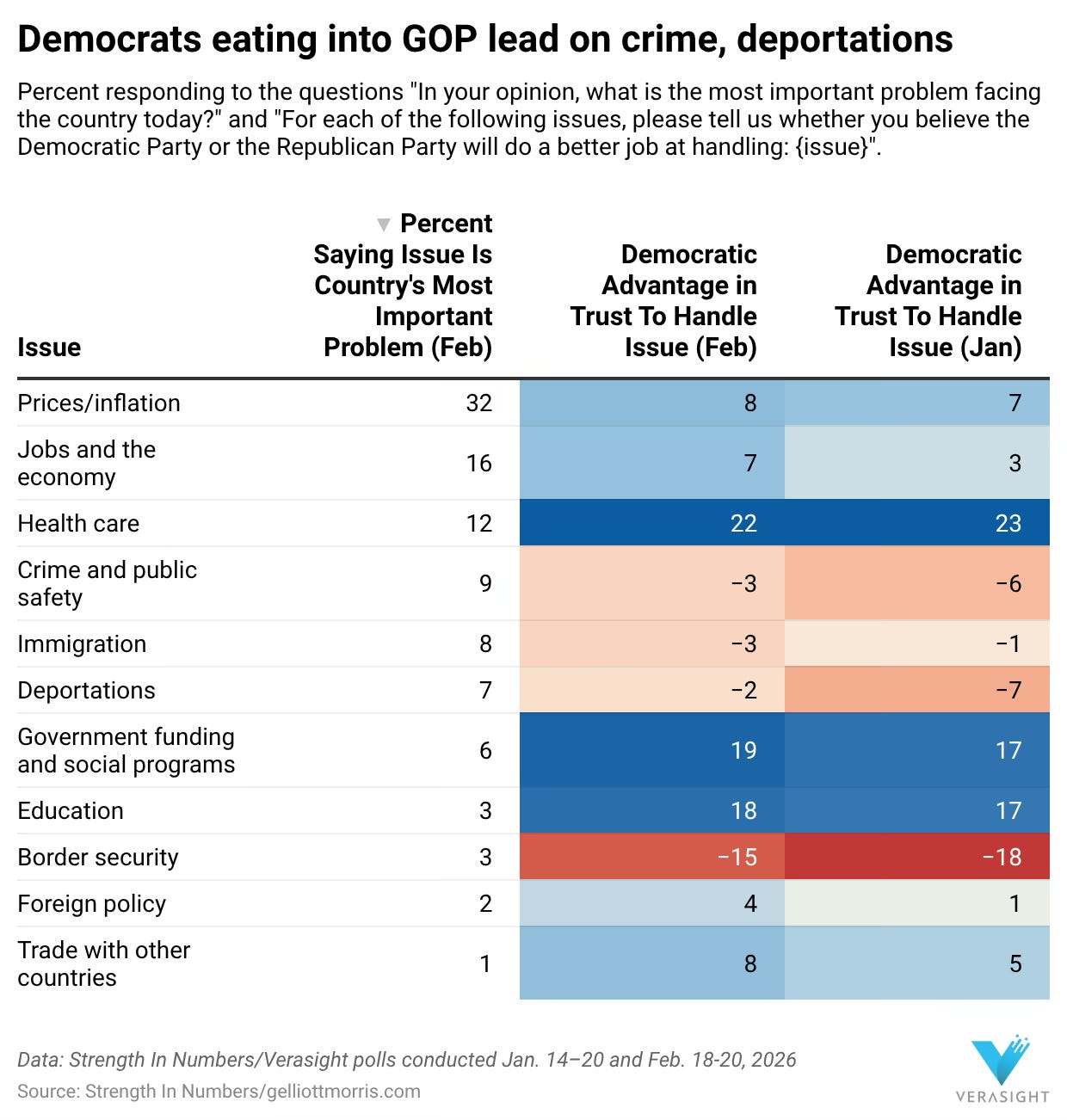
When asked to name the single most important problem facing the country today, prices and inflation led by a wide margin. Overall 32% of U.S. adults named it their top issue. Jobs and the economy came second at 16%, followed by health care at 12%, crime at 9%, and immigration at just 8%.
And on every one of these issues, voters trust Democrats more than Republicans:
-
Prices/inflation: Democrats lead by 8 points
-
Jobs and the economy: Democrats lead by 7
-
Health care: Democrats lead by 22
Here’s a table of the full issue prioritization and party trust data.
The chart below really drives home how tilted the current issue landscape is toward the Democrats. The party has a trust advantage on every single issue that ranks at 10% or above for most important issue.
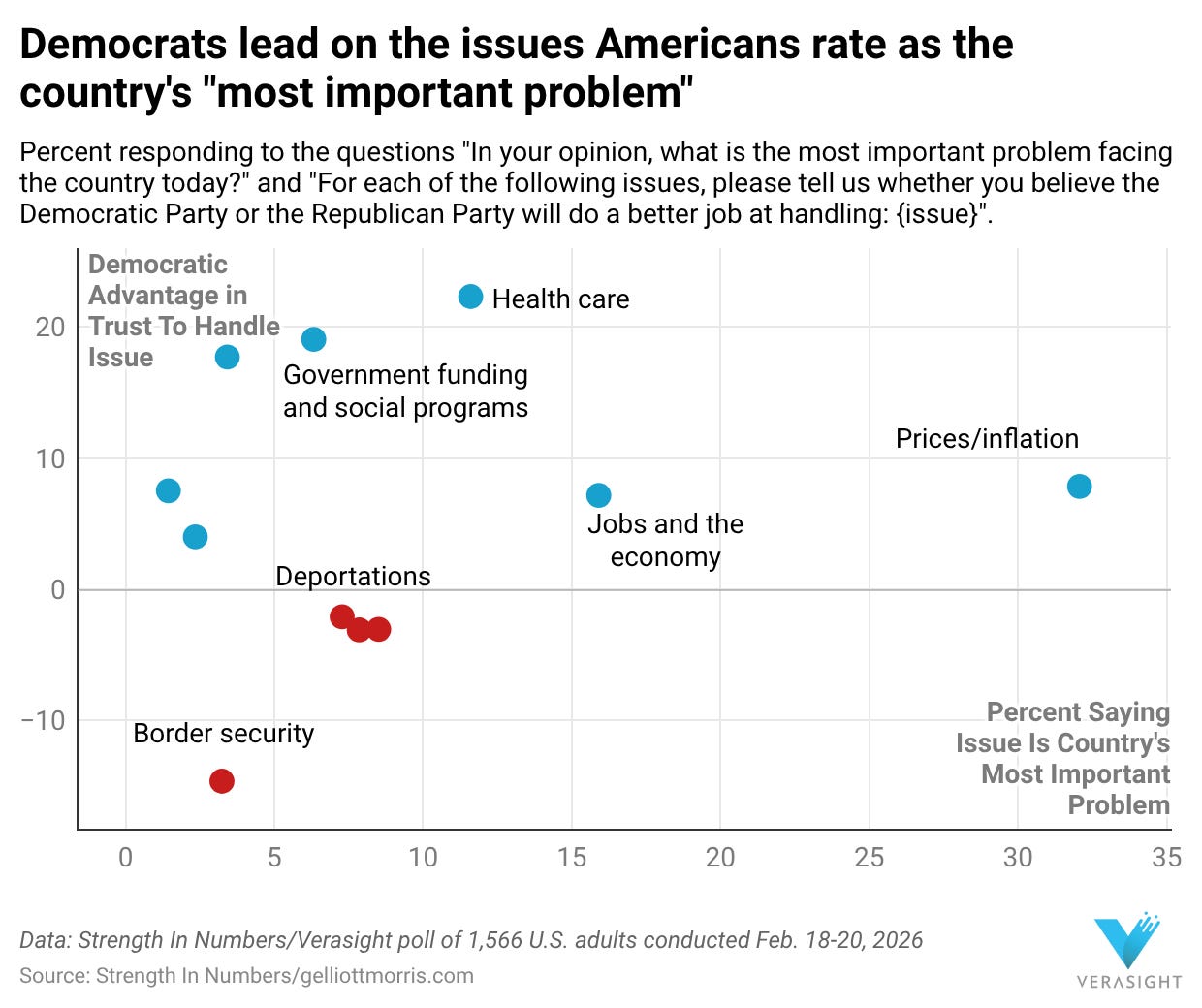
When they were asked which party voters trust to handle whatever issue they identified as the single most important facing the country, 46% of adults said Democrats and 38% said Republicans.
Democrats also lead on trust to handle government funding and social programs (D+19), education (D+18), trade (D+8), and foreign policy (D+4). Republicans maintain an advantage on border security (R+15), and narrow — and narrowing — leads on immigration (R+3), crime (R+3), and deportations (R+2). All three are within the survey’s margin of error from zero. In January, the GOP led on deportation trust by 7 points — now it’s 2. On crime, the Republican advantage has halved from 6 points to 3.
From our poll last summer, we know the public thinks the president is not focusing enough attention on the policies voters most want him to address. Another poll I did recently found that 69% of voters think Trump is focusing too much on deportations and not enough on inflation and the economy.
In this poll, we wanted to put the contrast in concrete, monetary terms for respondents. So we asked voters to tell us what they would like the government to spend a hypothetical $75 billion on. These were the results:
-
Reducing grocery and housing costs: 31%
-
Health care: 21%
-
Social Security: 13%
-
Public infrastructure: 9%
-
Tax cuts: 8%
-
Immigration enforcement and deportations: 5%
-
Veterans’ services: 5%
-
Education: 5%
-
Policies to combat climate change: 4%
The government is currently shut down over a question of whether to allocate an additional $11 billion to Immigration and Customs Enforcement while reforming the way the agency operates, or to pass the money along with no conditions. This poll suggests Americans would disapprove of the funding increase either way: Only 5% of adults say they would allocate a surplus to immigration enforcement and deportations relative to other options.
Add up the top three “kitchen table” items — groceries, health care, and Social Security — and you get 65%.
This is the worst monthly tracker for the Trump administration since we began the Strength In Numbers/Verasight poll in May 2025. The president’s job approval has cratered to net -22 and now, for the first time, he doesn’t have a single positive issue approval rating. The Democratic lead on the congressional generic ballot has widened to D+10 among registered voters — higher than the vote share they won in the 2018 “blue wave.”
Voters are frustrated with the direction of the country, they disapprove of how the president is handling virtually everything, and they trust the out-party on the issues they care about most. The president goes into his SOTU address with extreme headwinds. He will have to make major changes to dig himself out of this hole.
More results from this survey coming in the next few days.
You can download a full topline file, key crosstabs where they are mentioned in this article, and methodology statement using the link below:

The trends and maps on the interactive dashboard have been updated, as has the paywalled premium polling portal with crosstabs and more interactive graphics.
If you have any questions about this poll or the release, please email polling[AT]gelliottmorris.com.
Have a suggestion for next month’s poll? You know what to do!
Methods statement: Verasight collected the data for this survey from February 18-20, 2026. The sample consists of 1,566 United States residents ages 18 and above. The data are weighted to match population benchmarks of age, race/ethnicity, sex, income, education, region, metropolitan status, partisanship, and past vote. The margin of sampling error is +/- 2.5%. Topline document prepared by G. Elliott Morris for Strength In Numbers. While Strength In Numbers had input on question wording, all other methodological decisions were made and carried out by Verasight to ensure independence of the data-generating process behind these results.


First Appeared on
Source link






Leave feedback about this