

A curious ancient Roman artifact, long kept in a Dutch museum collection, has drawn renewed attention from archaeologists who believe they have finally solved the mystery of its undeciphered markings using AI.
Hewn from white Jurassic limestone quarried near Norroy in northeastern France, the unusual piece, known simply as “Het Romeins Museum Object 04433,” has quietly remained in the Roman Museum’s collection in Heerlen, Netherlands, since its discovery more than a century ago.
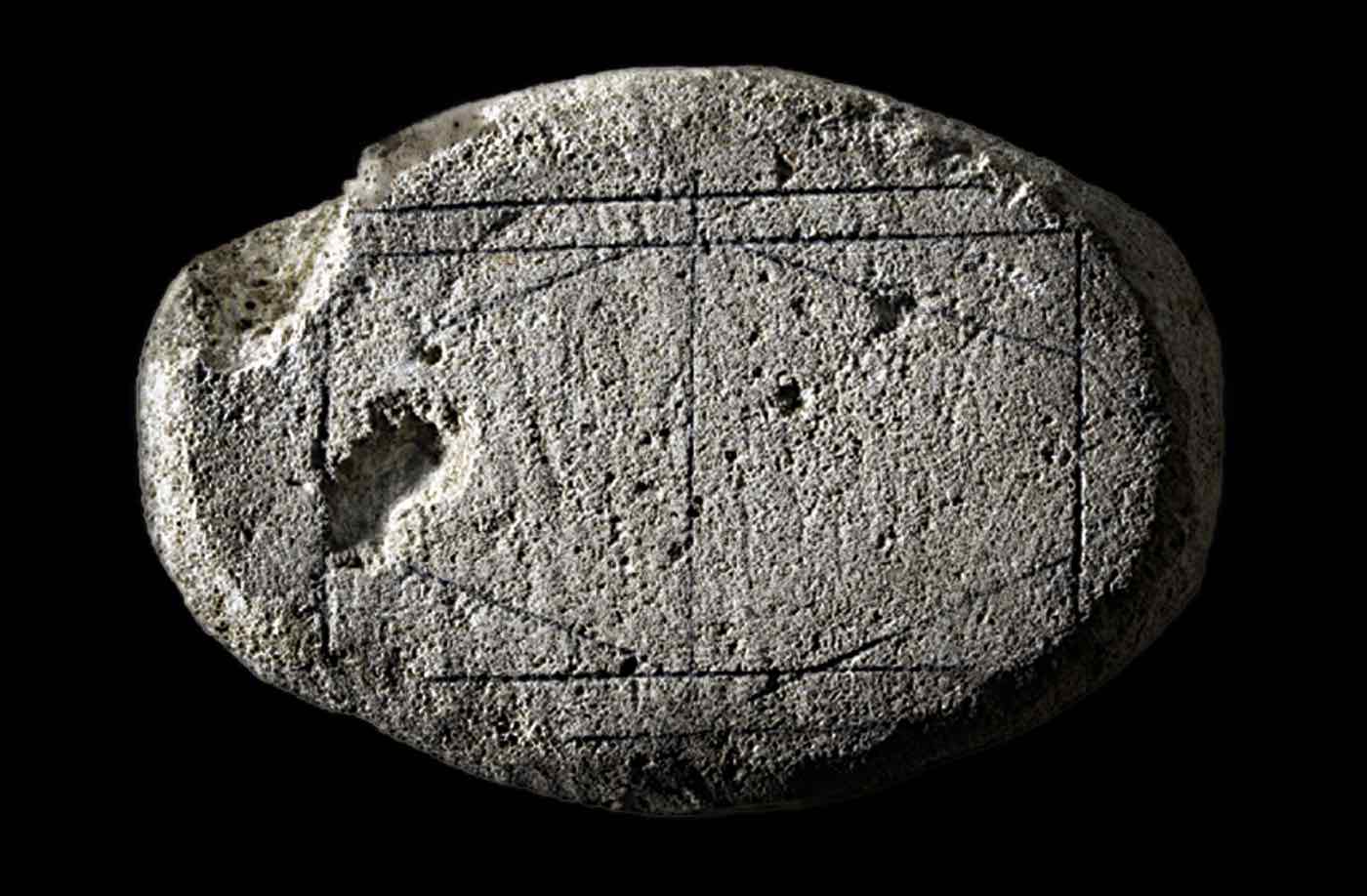
Uncovered during excavations at the Roman site of Coriovallum, the stone, which measures roughly 21 by 14 centimeters and weighs slightly more than 3 kilograms, might appear to the untrained eye like a simple brick.
A closer look, however, reveals something more complex. Throughout the Roman northern provinces, Norroy limestone was widely used in architecture; however, few examples of its use in brickmaking are known, and at Coriovallum builders instead relied on rougher Kunrader limestone from a nearby quarry.
Also, very unlike construction stones, Object 04433 appears to have been worked on all its faces, deliberately shaped and smoothed by its creators more than 2000 years ago. Even more curious is the pattern of incised lines that adorns the top of the stone, clearly setting it apart from even the most ornate Roman-era construction materials.
Possible Uses for a Roman Curiosity
Like many other unusual Roman-era objects whose purpose remains a mystery today, Object 04433 has prompted speculation over the decades about its likely purpose.
Among its possible uses, archaeologists have considered whether it might be an example of ancient Roman architectural plans, not unlike more famous examples such as the marble Forma Urbis Romae map or similar engraved floor plans uncovered at Baalbek. In both instances, however, the plans conveyed in these engravings were much larger and far more precise, with Object 04433 lacking the geometric accuracy or other telltale signs of Roman-era architectural drafting.
Another possibility was that Object 04433 was simply a decorative piece—possibly a single tile that once formed part of a larger pavement or mosaic. However, the object’s thickness and shape are unlike known examples of stone used for such purposes, with its beveled edges and other features making it a poor fit for a tiled surface.
The most widely accepted interpretation of the object’s use had been that it served as an ancient gaming board. Yet even this interpretation presents a few problems: namely, that the engraved design on its surface does not match any known Roman games, and instead features a unique pattern unlike any other Roman-era artifact ever identified.
Walter Crist, an archaeologist and now a visiting professor at Leiden University, also believed he was looking at an ancient gaming implement when he discovered the peculiar object during a visit to the Roman Museum in Heerlen in 2020, though agreeing that its features were unlike those he had observed in the past.
“The appearance of the stone, combined with the visible wear, strongly suggested a game,” Crist said, affirming that he “did not recognize the pattern among the ancient games I know.”
A Mystery Goes Under the Microscope
Given that its shape and markings alone could not convincingly identify Object 04433, Crist and his colleagues decided to pursue a different line of evidence: use-wear.
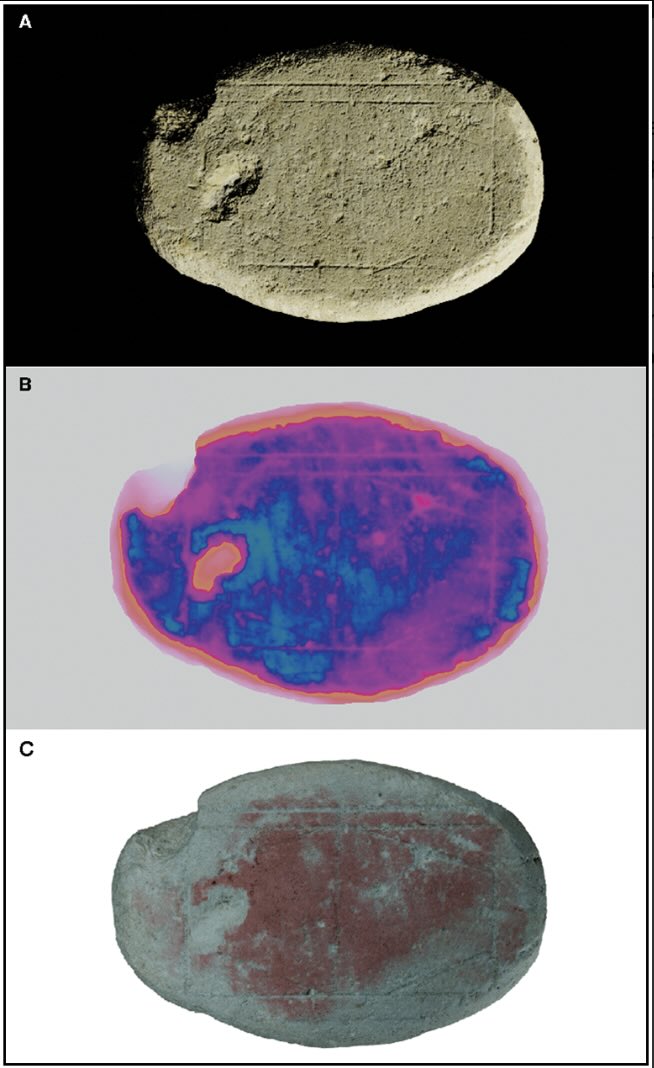
By examining microscopic wear patterns, researchers can determine whether a stone was produced by mechanical action and whether it was handled or repeatedly touched, which might provide clues about its use. In some instances, sufficient data can be obtained through use-wear analysis to help distinguish whether an artifact served a ritual purpose or was designed for a more practical function.
One thing that was clear to Crist and his colleagues was that Object 04433 was intentionally shaped and carefully marked with the incisions that adorned its surface. Through microtopographic analysis, a pattern of differential wear began to emerge, with some incised lines showing significant abrasion and a smoothed surface along their paths. In other cases, few—if any—significant traces of abrasion were discernible.
Testing Configurations
To help determine whether the wear patterns evident on certain portions of Object 04433 might correspond to a set of rules, Crist and his colleagues turned to artificial intelligence.
Employing a novel system developed by researchers at Maastricht University, the team had a pair of AI agents play 1,100 games using varying configurations based on a range of historical games documented throughout parts of ancient Greece, Italy, Spain, and Scandinavia. In total, they tested 130 different configurations against an array of different starting, movement, and end-of-game rules or conditions.
Throughout this process, Crist said the most challenging part for him and his colleagues had been designing their methodology.
“Research on games in archaeology is relatively rare,” Crist said in a statement, “and no one had tried using AI to identify a game that would reproduce the wear.”

Despite the challenges, the team successfully narrowed in on nine configurations that they found produced results that appeared to be a good match for the observed wear traces—all of which, according to Crist, were “variations of the same type of blockade game.”
Most well-documented examples of games played by the ancient Romans, including ludus latrunculorum, meaning “The Game of Soldiers,” and a backgammon-like game known as duodecim scripta, fall into the category of capture or race games. By comparison, blockade games—a variety of games previously recognized only in Europe from the Middle Ages onward—had never been observed in classical antiquity.
“Blocking games are not described in texts from the Roman era, but other evidence may point to an early history of this type of game that extends to the Roman period,” Crist and his colleagues write in a recent study detailing their work.
Although gaming implements that archaeologists believe are associated with blockade-type games have been uncovered across parts of Europe and are linked to periods predating the Middle Ages, the team says their recent findings now offer strong evidence for a much earlier history that pushes back the timescales for blockade games by several centuries.
Fundamentally, the team’s work also provides a strong example of AI’s ability to identify the rules of such ancient games when combined with existing archaeological evidence. “By combining AI simulation with use-wear analysis to identify and model traces of game play, it is possible to not only identify potential game boards, but also to rebuild playable rulesets that may provide indications regarding the ways that people played games in the past,” the researchers write.
The results, Crist and his colleagues say, “strengthens the understanding of our ludic heritage, and makes ancient life more accessible to people in the present,” while also challenging long-accepted timelines for the earliest emergence of blockade gaming in the ancient world.
The team’s recent study, “Ludus Coriovalli: using artificial intelligence-driven simulations to identify rules for an ancient board game,” was published in the journal Antiquity on February 11, 2026.
Micah Hanks is the Editor-in-Chief and Co-Founder of The Debrief. A longtime reporter on science, defense, and technology with a focus on space and astronomy, he can be reached at [email protected]. Follow him on X @MicahHanks, and at micahhanks.com.
First Appeared on
Source link






Leave feedback about this