

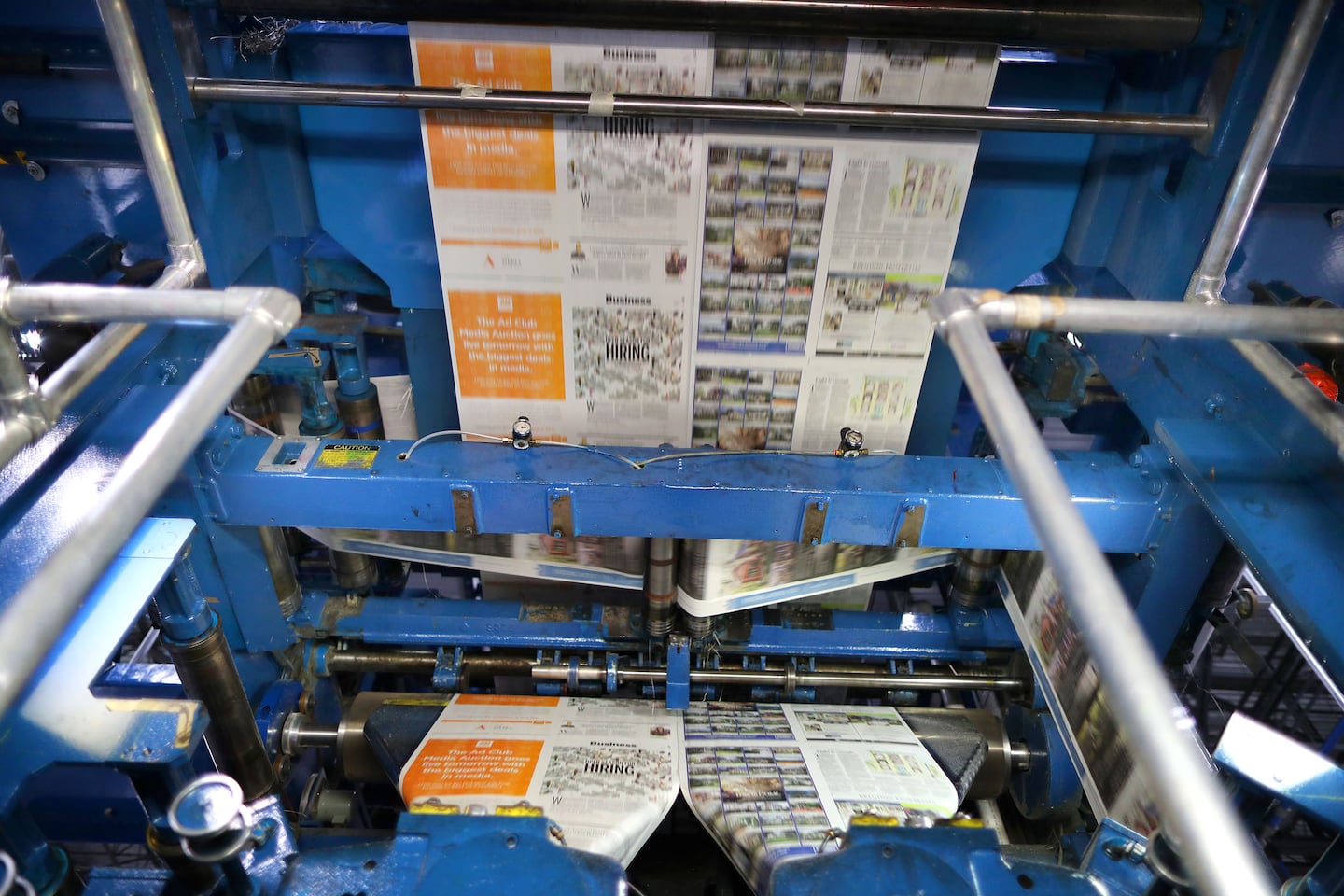
“We don’t take the decision lightly,” said Josh Russell, vice president of print operations at Boston Globe Media, in an interview. “We’re not confident that even if we got a crew in tonight, that we could get the papers on our trucks safely. We weren’t confident that that last mile would be doable.”
The blizzard also affected Monday’s delivery, with only 25 percent of papers having been delivered to subscribers.
While print subscribers will get Tuesday’s paper delivered on Wednesday, single copies of the paper will not be available in retail stores, said Jamie Nee, the Globe’s executive director of sales strategy and fulfillment.
By all accounts, including interviews with longtime pressroom employees and a review of the Globe historical archive, the decision marks the first time that management has called off production of a daily paper since the organization’s founding in 1872. (Labor strikes halted production on a few occasions in the 1950s and ‘60s.)
Even during the historic Blizzard of ‘78, the Globe printed a few thousand copies of the Feb. 7, 1978, edition, though its delivery trucks couldn’t get through the piles of snow around its old offices on Morrissey Boulevard.
The press workers of the Globe, many of whom have worked for the Globe for decades and commute from all over the state, aren’t used to days without a paper. Russell added that during previous storms there has “never been a question” as to whether pressmen and drivers would come in, which speaks to the historic nature of the decision not to publish Tuesday morning and the resilience of the print staff.
“They have a dedication to the process,” Dan Stenstrom, the superintendent of the pressroom who first joined the Globe in 1985, said of his colleagues. “As much as today gives them pause, they know they’ll be in there tomorrow.”
Chris Johnson, executive director of manufacturing at Boston Globe Publishing Services, said on Monday he got stuck on the way to the facility and was pulled out by another truck. Then, that truck and its driver went 30 feet and got stuck, prompting Johnson to help him out of the snow. He also was stopped by a fire truck that couldn’t move off of railroad tracks because the snow was so deep.
“It took me almost two hours to get to the plant and I got a four-wheel drive pickup truck,” he said. “It was just not going to work. The risk reward is upside down.”
The decision not to print a paper is rare at any paper.
Paul Tash, the longtime former chief executive and chair of the Tampa Bay Times, often grappled with printing delays during hurricane season. Sometimes the paper would be late, and sometimes there was no home delivery, but they always managed to get a print edition out in his 47 years there, he said.
But like many other papers, faced with a loss of readers and the advertising revenues that followed them, the Times has cut back on print to two days a week.
“It felt particularly poignant,” Tash said. “We thought, at the time, we needed to preserve the news or preserve the paper. We stuck with the news.”
The Globe has not been immune to the challenges of the media industry, but it has been able to sustain a seven-day print product while also being one of the rare, profitable newspapers in the country.
While print readers won’t be able to stain their hands with ink Tuesday, the Globe of course has continued to publish stories online.
That wasn’t the case in 1978, when the Globe couldn’t get its issue out the door.
The Globe rallied its staff to put together a paper during the historic 1978 storm, and cheers sprang up across the Morrissey Boulevard newsroom — which the Globe departed in 2017 — when its presses began to run for the Tuesday, Feb. 7 edition. But the press run was short-lived, as delivery trucks weren’t able to get more than a mile or two from the Dorchester building.
The snow continued through that Tuesday and Globe staff weren’t able to leave the building, which meant many employees — including in the newsroom — found furniture around the building to sleep on.
“Governor Dukakis told everyone to stay put, and yet the Globe resumed publication on Wednesday morning,” wrote Thomas Gagen, a former chief editorial writer for the Globe, in 2008.
The Globe’s headquarters are now at 53 State St. in downtown Boston, meaning the paper is no longer printed at the same location as its newsroom.
While the Globe had printed continuously since 1978, there have been delivery problems over the years.
Most notably, thousands of Globe subscribers did not receive print editions in 2016 for weeks after the Globe switched to a new distribution partner. Staff across the Globe volunteered to deliver papers as top staff worked to fix the problem.
Catherine Carlock and Jeremiah Manion of the Globe Staff contributed to this report.
Aidan Ryan can be reached at [email protected]. Follow him @aidanfitzryan.
First Appeared on
Source link




Leave feedback about this