

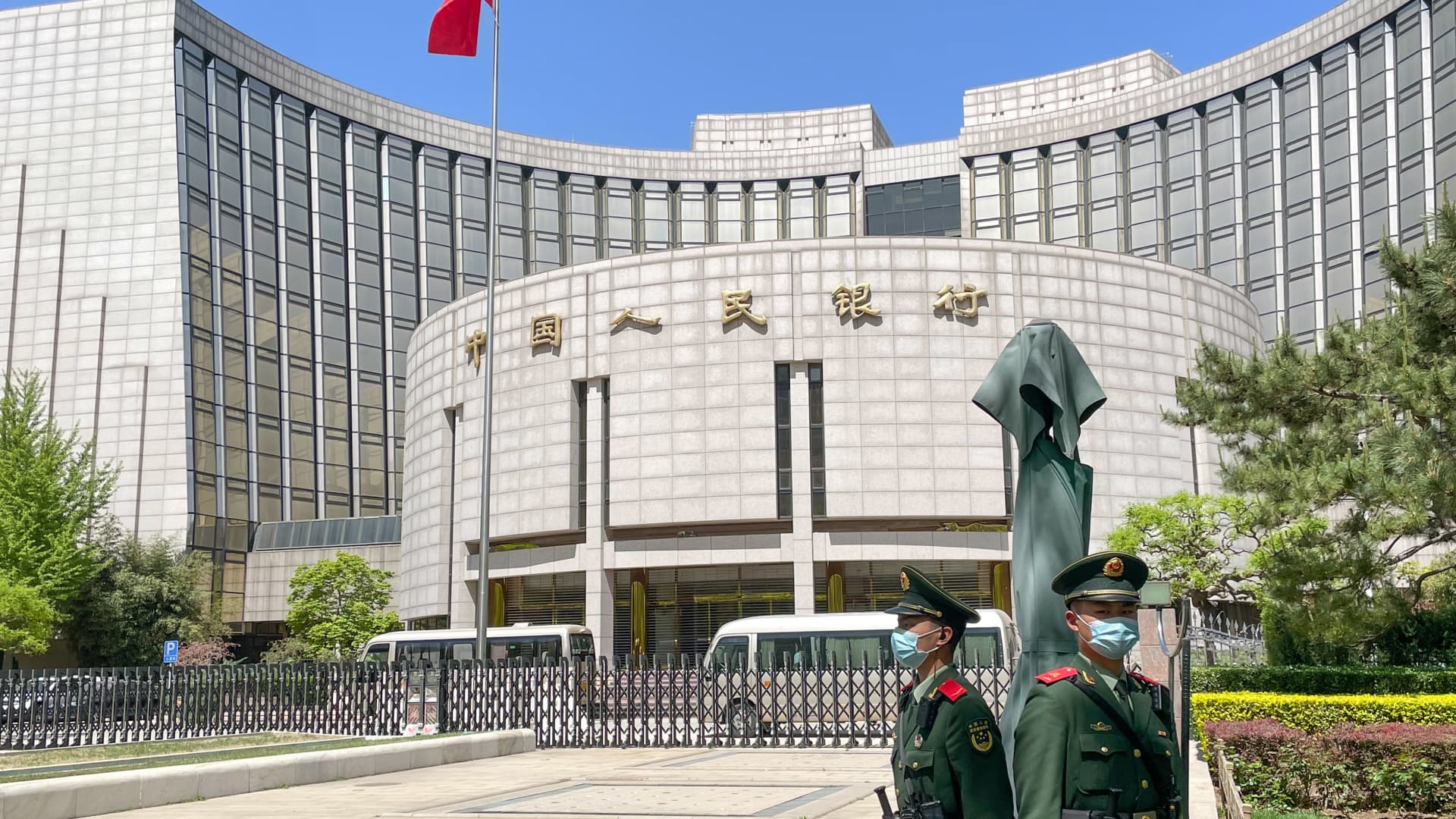
The People’s Bank of China (PBOC) building in Beijing, China, on Tuesday, April 18, 2023.
Bloomberg | Getty Images
China’s central bank kept its benchmark lending rates unchanged Tuesday as authorities navigate a balancing act of supporting a slowing economy while maintaining currency stability.
The People’s Bank of China held its 1-year and 5-year loan prime rates at 3% and 3.5%, respectively, keeping them steady for a tenth straight month despite stuttering economic growth.
The 1-year rate serves as the benchmark for most new and outstanding loans, while the 5-year level influences mortgages.
The world’s second-largest economy showed signs of slowing down in the final quarter of last year, expanding 4.5% year on year, its slowest pace since the country lifted its stringent Covid curbs in late 2022.
Chinese authorities have struggled to lift the economy out of an entrenched deflation as consumers cut back spending amid a prolonged real estate downturn, a bleak job market and uncertain income prospects.
Retail sales growth fell to a 3-year low of 0.9% in December while the GDP deflator — a metric that shows changes in prices of goods and services — has stayed negative for 11 consecutive quarters.
Policymakers have turned to promoting the consumption of services to boost overall spending, betting that elderly care services, leisure and tourism can help make up for the tepid demand in goods.
The Chinese yuan has continued to appreciate in recent months, with the offshore yuan strengthening from around 6.974 per U.S. dollar at the start of the year to 6.889 Tuesday morning, according to LSEG data.
The PBOC in recent weeks has signaled some tolerance for a gradual strengthening in its currency, with the dollar’s weakness paving the way for the yuan to extend its advance.
The central bank manages the yuan by keeping it within a band that is 2% on either side of a midpoint that it fixes each trading day. The officials have moved its so-called fixing level lower, dipping below the 7-benchmark for the first time in nearly three years in late January.
A strengthening yuan could test the country’s export machine already under pressure due to U.S. tariffs, eroding a competitive advantage for exporters who face price pressure from other manufacturing rivals.
Economists at ING forecast a fluctuation band of 6.85 to 7.25 this year as Beijing seeks to advance the internationalization of its currency. “The wildcard will be if the currency stability objective is softened in 2026,” the bank said.
First Appeared on
Source link






Leave feedback about this