

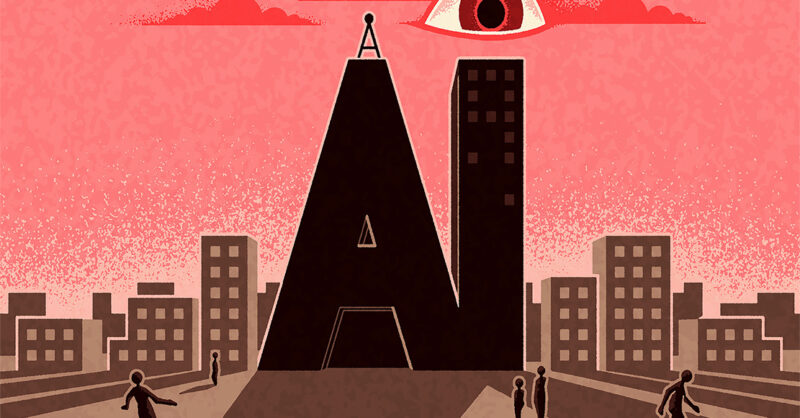
It’s been a big week for AI boosters. There is, of course, a very good chance that this opening sentence would be true if you’d read it at any point in the past few years, since “compiling a weekly list of AI news items” is truly, to use journalistic parlance, a piece of piss.
The AI Impact Summit landed in New Delhi, as Narendra Modhi welcomed thousands of soberly-suited futurists like George Osborne, who told us the UK would be “left behind if it doesn’t embrace AI”, and Rishi Sunak, who delivered a keynote entitled “AI Will Improve Your Life“. One might connect such enthusiasm to their newly minted jobs with OpenAI and Anthropic, respectively, but we are bidden to banish such cynicism from our minds.
At home, Keir Starmer launched a nebulous campaign to clamp down on AI chatbots, a note of caution which might have seemed more reasonable, had his science minister Liz Kendall not spent the past few weeks pumping AI guff from government websites. Outside of the political realm, we’ve seen AI’s data centre usage spell doom for almost all consumer electronics, Microsoft admit that its Copilot AI (which nobody on Earth is using) accessed sensitive email data, and the entire web melt down over a “Hollywood-destroying” video-creator which has subsequently been exposed as a face-replace fake, and… well, I think even the most patient reader’s tolerance for links-within-a-single article will reach its limits if I go much further than that.
If the tone of the above hasn’t given it away, I will own up to being a sceptic. I do, in fact, abhor AI hype with a vehemence that has become increasingly fanatical. As someone who sees it as a bubble perched upon a pyramid, I intuit clear signs that AI, while currently doing immense harm, is also bad at a large percentage of the things it claims to be good at, with no credible path toward doing one tenth of the things its boosters say it will in future, and that anyone who thinks otherwise is either sorely misinformed by people who should know better, or is themselves a financially compromised grifter, a disqualifyingly credulous rube, or both.

Subscribe to the New Statesman today for only £1 a week.
To be clear, there’d be much to hate about AI even if I didn’t think its hype represented a world-shattering bubble. I’d still abhor its near-perfect utility for generating scams, predatory chatbots, schizophrenia-enabling LLMs, non-consensual nudes and child sexual abuse material, or its proven harms in defence or governmental applications, which have seen algorithms directing everything from missile targeting systems to benefit claim databases, roles with devastating, life-or-death consequences, and zero human accountability.
I could slap on a pair of wellies and walk you through the immense environmental impacts caused by server farms from Georgia to Galway to Guizhou, or focus on its social demerits, its proficiency in spreading dangerous misinformation, its wholesale and profligate looting of artists’ work, the removal of humanity and usability from the services, websites and search engines we use every day.
I could get on my cultural high horse and rail against the horrifying inanity of its content, on the bloodless, chirpy miasma of false, PR-inflected slop that it barfs into our feeds every single day, on its credulity-mining of the isolated and vulnerable, on its grisly exploitation of our reanimated dead. I might even list its more mundane drawbacks, the sheer head-smacking frustration it prompts us all any time we open a website or document, or view any statement, image or video online.
Instead, I’ll suggest that maybe, just maybe, it’s economically alarming that even AI’s boosters loudly say that their technology will lead to tens of millions of job losses across every imaginable sector, while every unit of consumer electronics is now forecast to increase in price or scarcity as the planet scrambles to repurpose all its resources toward the AI gold rush. All to continue propelling a technology which must claw back the $700bn it’s spent cramming all those scams, theft, poison and doggerel into our eyes, before it can make its first dollar of profit. A technology which globally, in the world of Peak AI I have just described, makes less than $60bn per year combined.
The good news, of a sort, is that AI will likely never get so smart that it meaningfully, or even efficiently, replaces human labour, much less art or science, or human connection. The pathway toward AI being a “reliable, profitable and scalable” replacement for human beings is very narrow, and that path vanishes to micron-width once, say, the global economy shutters tens of millions of jobs while quadrupling the price of every component necessary for AI companies to keep making the tiny, marginal gains it needs merely to maintain its current level of cataclysmic unprofitability.
The bad news is that this means very little when a $700bn hype machine is currently telling every CEO on earth that their magical spellcheck technology means that they should sack tens of millions of employees while raising the price of every microchip on the planet. A hype machine staffed by avaricious tech companies and the sensible former politicians they employ. A hype machine giddily swallowed by governments and companies and journalists as they present themselves to Silicon Valley’s wallet inspectors, time and time again.
All of which leads to me believe that one day it will no longer have been a big week for AI boosters. I feel it may be sooner than we think. I fear it will be sooner than we hope. For, as with all such bubbles, that day may well be closer to the start than the end of our troubles.
[Further reading: Why men shouldn’t control artificial intelligence]
Content from our partners
First Appeared on
Source link


Leave feedback about this