

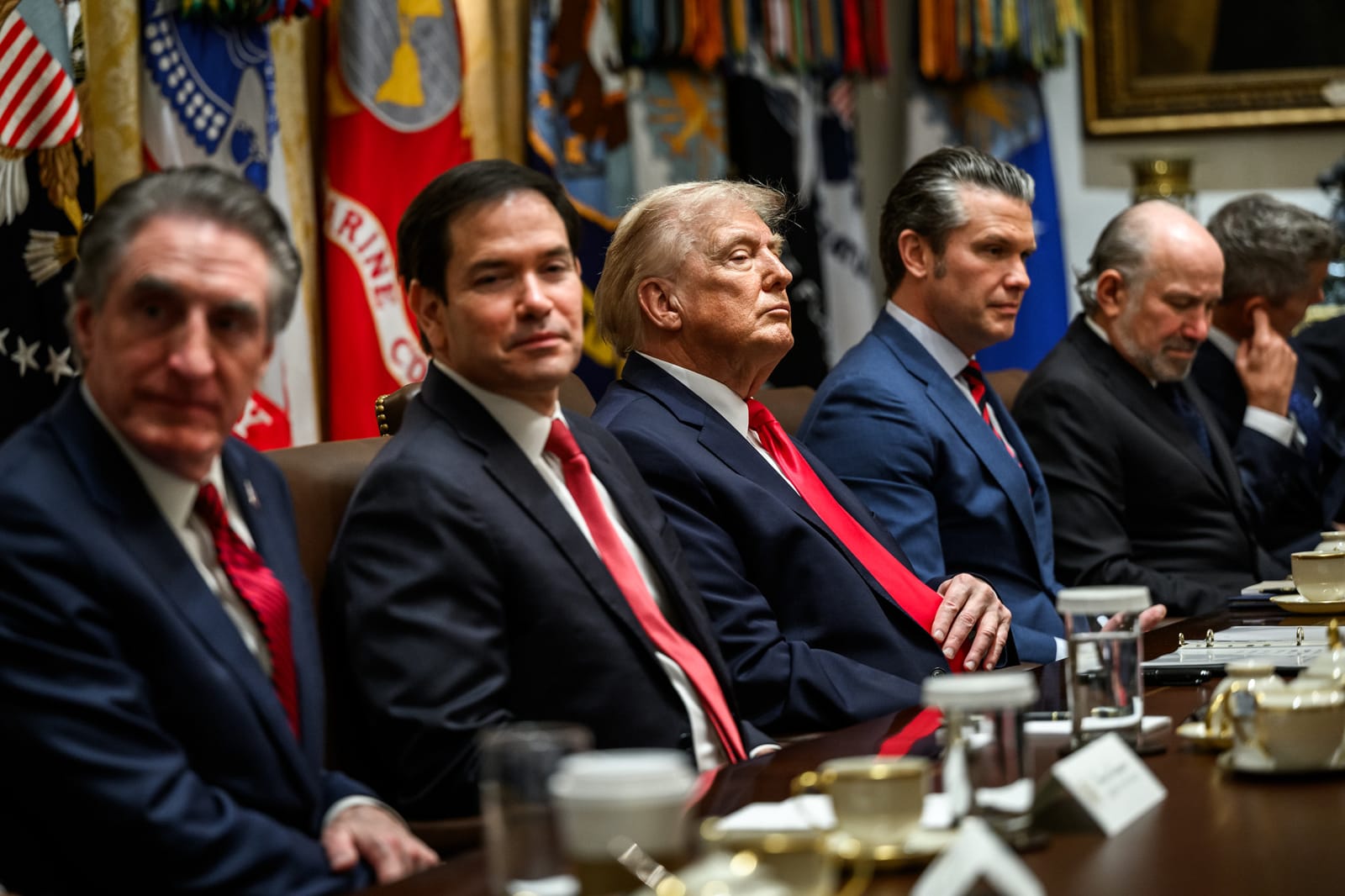
Donald Trump’s behaviour during this presidential term reveals a surprisingly deep strategic logic.
The core goal remains to restore absolute American superiority over China and Russia. But Trump wants to avoid confronting these major rivals directly. He is rather working to isolate Beijing and Moscow from their international partners and deprive them of any major means of external support.
At the same time, Trump is building a program of sustained economic, technology and other sanctions to markedly weaken the Chinese and Russian economies over the longer term.
The evidence for this strategic approach is fairly clear from the patterns of the administration’s behaviour.
Following the collapse of the Bashar al-Assad regime in Syria, Trump and some European leaders moved quickly to help the new administration of Ahmed al-Sharaa stabilise the country and embark on a peaceful, pro-Western future. Chinese and Russian influence is greatly reduced.
In Gaza, the US has brokered a peace deal and in southern Lebanon it has supported an extended ceasefire. However, Hamas and Hezbollah are working to reinforce their local political control and will probably only partially disarm. The result may be a weak peace on both fronts with modest Chinese and Russian influence.
The surprise arrest of Venezuelan President Nicolas Maduro to face charges in a New York court of conspiring to traffic cocaine to the United States has markedly changed the security environment in Central and South America. The restructured Venezuelan government, along with those of Colombia, Panama and Mexico, are now coordinating their security more closely with relevant US agencies.
The arrest of Maduro has also halted cut-price and “gifted” oil being supplied to China, Russia and other authoritarian states. And, as US Secretary of State Rubio recently emphasised, the US operation has removed the risk of China or Russia gaining control of the Venezuela’s oil reserves – the world’s largest.
Trump has also taken extraordinary steps to end the defence and security foot-dragging of the NATO and Asian allies.
An immediate consequence is that with Venezuelan oil shipments to Cuba now stopped, the long-running economic crisis in Havana is coming to a head with transport, electricity, some foods and even water being rationed. The Communist regime may soon collapse.
Iran is another weakened authoritarian state that is vulnerable to precision intervention by the United States and its allies. If, as seems likely, the US strikes Iranian nuclear and leadership targets in coming weeks, the regime will probably fall to a renewed public revolt. That, in turn, would likely end Iranian support for the Houthi rebels, Hezbollah, Hamas and other radical terrorist groups.
A pro-Western Iran would probably abandon “special deal” oil exports to China, Russia and other authoritarian states. When combined with Venezuela’s redirected oil trade, about half of China’s oil imports would no longer be supplied by close partners and, in the event of a Taiwan crisis, deliveries from most of its suppliers may cease.
Meanwhile, Trump has gone out of his way to maintain positive lines of communication with Russia’s Vladimir Putin and China’s Xi Jinping. Trump senses that there may be scope for deals to buy time to strengthen American and allied military capabilities, rebuild the alliance’s industrial base and allow tightening economic and technology sanctions to further weaken Russia’s and China’s strategic power.
Trump has also taken extraordinary steps to end the defence and security foot-dragging of the NATO and Asian allies, including by threatening the territorial integrity of Denmark and Canada. Steep rises in the defence budgets of most allies have now been announced. The Europeans have also agreed to carry the primary burden for their own security and for reinforcing the defence of Ukraine. Trump’s unpredictable wielding of US power has certainly gained the attention of the NATO allies. Xi and Putin have also learnt that Trump is not to be trifled with.
America’s strategic operations during the last year draw on key themes from Trump’s own book The Art of the Deal and Sun Tzu’s The Art of War. Notable features include indirect approaches to priority strategic goals, frequent assertions of superior capabilities, exaggerated ambit claims, intentional unpredictability to induce rival caution, operational deception, tactical surprise, precise use of military force for short periods, and economic and technology sanctions to drive opponents into long-term strategic decline.
Trump’s application of these measures has often been messy and imperfect but, overall, it has been effective in seizing the momentum in international security affairs.
At the core of Trump’s recently published National Defence Strategy is a “strong denial defence” of the First Island Chain stretching from Japan, through Taiwan and the Philippines to Indonesia. US operations during the last year reveal a deeper level of denial strategy – that of removing all major sources of external support from Beijing and Moscow. This deep denial strategy is shifting the balance of power back to the US and its allies.
There is plenty of scope for things to go wrong in the Taiwan Strait and elsewhere during the remainder of Trump’s term. But the regimes in Beijing and Moscow are both struggling with economic and political challenges and are now in the process of losing their major international partners. Their future prospects are deteriorating and the cold winds of isolation are growing stronger.
First Appeared on
Source link


Leave feedback about this