

Kyiv responded to Budapest’s threats to block a €90 billion EU loan and cut off electricity to Ukraine until oil transit through Russia’s Druzhba pipeline resumes on Monday – by blowing up a critical section of the pipeline deep in Russia.
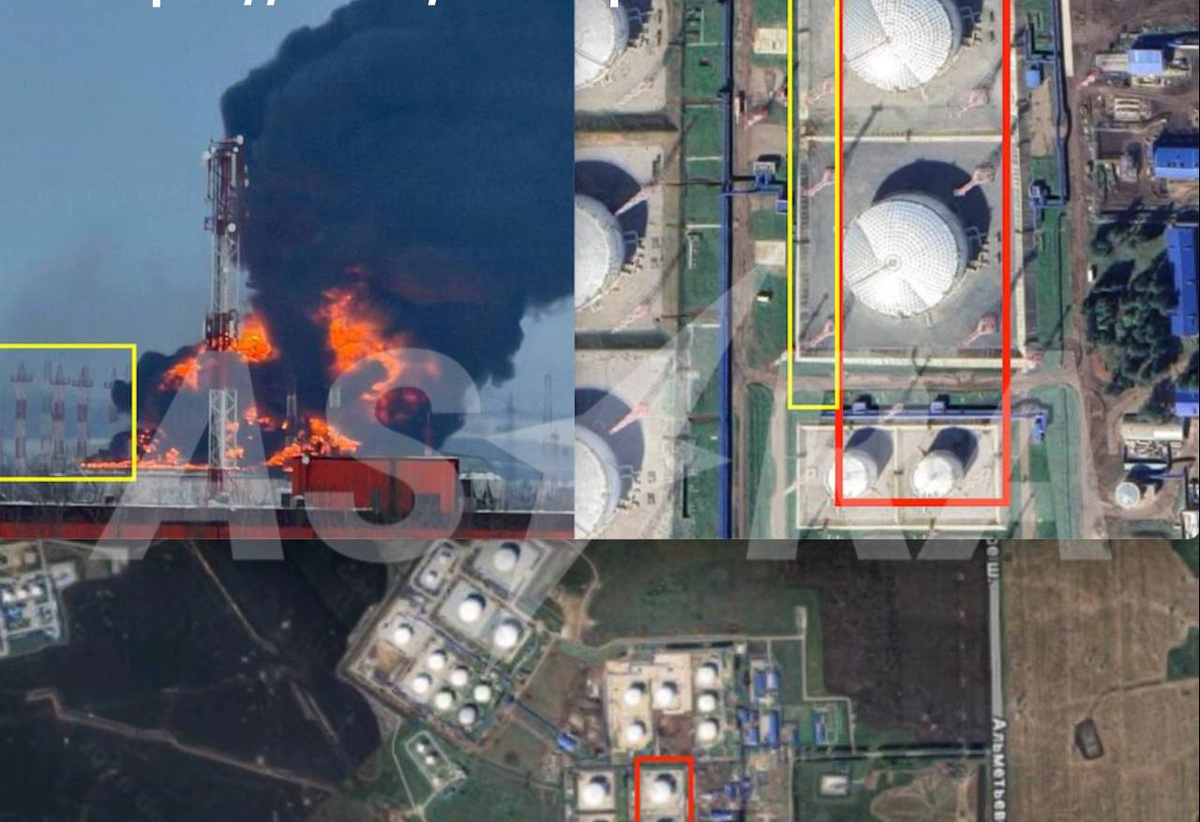
In the early hours of Monday morning, Ukrainian long-range kamikaze drones pummeled the Kaleykino oil pumping station near the town of Almetyevsk in Russia’s Tatarstan region, setting it ablaze and shutting down the operation of a critical transit node in the Druzhba pipeline system – the main artery for Russian crude oil deliveries to Hungary and Slovakia.
JOIN US ON TELEGRAM
Follow our coverage of the war on the @Kyivpost_official.
The 35-plus aircraft strike package launched by operators from Ukraine’s Unmanned Systems Forces (USF) flew through roughly 1,500 kilometers (930 miles) of Russian air space to score multiple hits on pump lines and crude oil storage reservoirs at the Transneft-operated facility, and ignite fires which caused black smoke to billow hundreds of meters into the sky.
In a Monday morning statement, Russia’s defense ministry acknowledged its forces had engaged “enemy drones” over the Tatarstan region in the pre-dawn and dawn hours of Monday, and claimed it had shot 35 aircraft down. There was no official comment on the damage or hits scored by the Ukrainian attack drones.
An article in regional newspaper RT-Respublika Tartarstan also acknowledged that Ukrainian drones had been engaged in air space over Almetyevsk, but reported that authorities had the situation fully under control.
Other Topics of Interest
Russian Missile Hits Mondelēz Factory in Sumy Region
A Russian missile strike targeted the Mondelēz production facility that produces Milka, Oreo, and Barni for the global market. The factory is located in Trostianets, Sumy region.
“In the Almetyevsk district of Tatarstan, cleanup efforts continue following a drone attack. All necessary emergency services are deployed at the scene, according to the Almetyevsk administration. We emphasize: there is no threat to the public. The situation is under control,” an official statement published by the newspaper said.
Geolocated social media footage showed a horizon turned orange by fire at the Kaleykino site. Substantial damage was confirmed by the independent Russian Astra news agency, citing eyewitnesses.
Ukraine’s General Staff took credit for the attack in a Telegram post, describing Kaleykino as one of Russia’s “key oil pumping stations.”
“It is here the process of mixing oil from different regions takes place before it is sent for export. The station ensures critical pressure and uninterrupted pumping of raw materials directly into the Druzhba oil pipeline, as well as to the oil refineries of Tatarstan. Now we can expect the whining of [Hungarian Prime Minister Viktor] Orbán and [Slovak Prime Minister Robert] Fico,” the AFU statement said.
Russia’s Druzhba pipeline system, an oil transportation network built in the Soviet era to ship Russia’s communist crude oil to capitalist Europe in exchange for hard cash, originates in Tatarstan, where it gathers crude oil from major producing regions such as western Siberia, the Urals, and the Caspian Sea area.
By 2022, the Kaleykino pumping and storage facility had become a critical bottleneck with about 100,000 tons of crude oil – roughly a quarter of Russia’s annual oil exports – passing through it annually.
Prior to Monday’s successful raid, Ukrainian strike drones hit the Kaleykino facility on the Druzhba pipeline on Jan. 14 with unreported results.
The strike on Kaleykino follows a string of successful USF operations throughout February. Two major oil refineries were targeted and damaged, one in the near-Arctic city Ukhta on Feb. 12 and one near Krasnodar on Feb. 17.
The Neftogorsk gas-processing facility in Samara region was subsequently hit on Feb. 19, with NASA satellites observing fires still burning there two days later.
On Dec. 3, 2025, an explosion hit the Druzhba pipeline in Russia’s Tambov region in what Russian authorities later called a sabotage attack linked with Kyiv operators. Russian oil shipments via the Druzhba pipeline to Hungary (and Slovakia) were halted on Jan. 27, because of damage to the pipeline on Ukrainian territory, blamed by Ukrainian officials on a Russian drone purportedly destroying pipeline sections and equipment in Ukraine’s Lviv region.
Hungary receives practically all its crude oil imports – according to energy industry estimates, around 80-90% – from Russia via the Druzhba pipeline. Orbán has accused Ukraine of attacking Hungarian energy security because of his outspoken support of the Kremlin and opposition to Ukraine’s fighting a war to recover Ukrainian territories occupied by Russia.
In personal social media comments made by Orbán on Feb. 20-21, the Hungarian leader accused Ukraine of failing to repair the damage to the Lviv pump station in order to prevent Russia from earning money from selling crude oil to Hungary.
Orbán said Budapest would retaliate by cutting off all electricity deliveries to Ukraine from Hungary, and vetoing a €90 billion EU war loan to Ukraine.
Hungarian Foreign Minister Péter Szijjártó echoed this threat on X, accusing Kyiv both of breaching its commitments to the EU and of “blackmail.”
“Ukraine is blackmailing Hungary by halting oil transit in coordination with Brussels and the Hungarian opposition to create supply disruptions in Hungary and push fuel prices higher before the elections,” he added.
Slovak Prime Minister Robert Fico followed suit. In a video address on Sunday, Fico said Slovakia would block diesel fuel and electricity from entering Ukraine until Russian oil transit to Slovakia via the Druzhba pipeline resumes.
On Feb. 18, Bratislava declared a state of emergency in the oil sector.
Daily attacked by Russia, Ukraine’s energy grid is to a large extent dependent on electricity imports from neighboring countries.
In peacetime, Ukraine imported around 2.1 GW of electricity monthly from eastern-tier EU states on average, with Hungary typically providing 40-50% of the total.
Damage from Russian missiles and drones, plus a relatively cold winter, pushed foreign electricity total usage by Ukraine in January 2026 to about 2.45 GW.
EU High Representative for Foreign Affairs and Security Policy, Kaja Kallas, in Monday comments to journalists in Brussels, said that the EU would discuss the sanctions package on Russia and Hungary’s opposition to it, and that in her view, Druzhba oil deliveries to Hungary and EU sanctions on Russia are not linked.
“I think there is not going to be progress regarding this today, but we will definitely make this push,” Kallas said. “As we have heard some very strong statements from Hungary, that is why I do not really see that they are going to change this unfortunately today, this position that they have… We should not tie together things that are not connected to each other at all.”
Hungary’s next parliamentary elections are scheduled for April 12, with frontrunner Péter Magyar and his center-right Tisza (Respect and Freedom) Party polling at least eight points ahead of Orbán’s far-right populist Fidesz party.
Magyar’s stance on the Russo-Ukrainian War is strongly pro-Ukrainian, advocating greater military aid to Ukraine and more sanctions against Russia.
First Appeared on
Source link






Leave feedback about this