

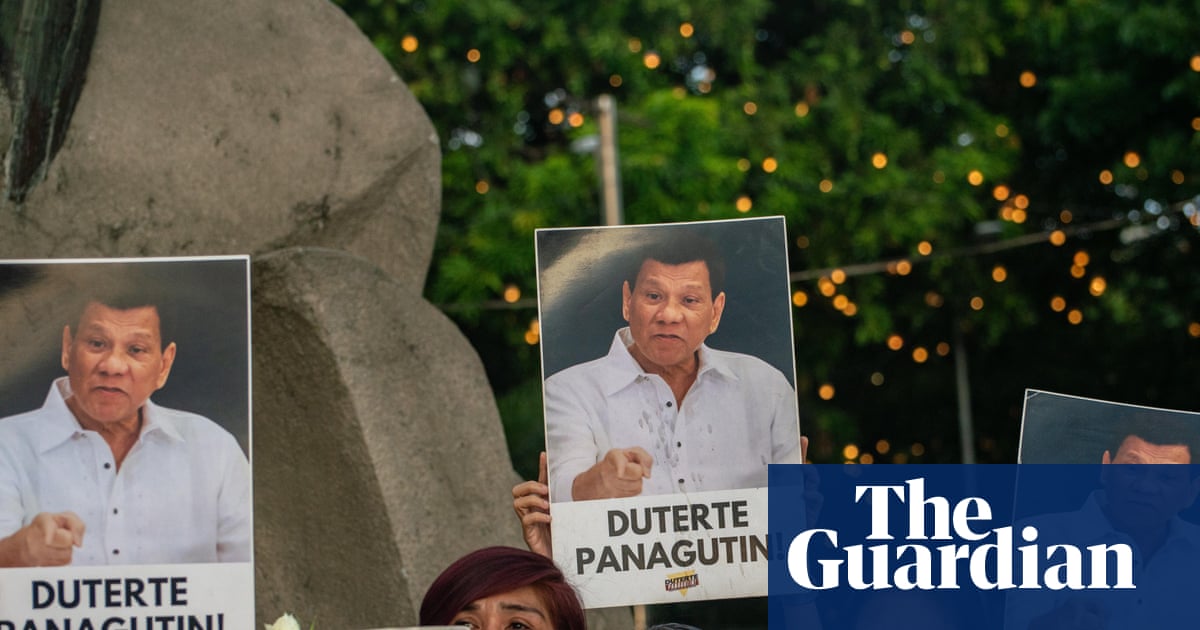
The pre-trial hearing for former Philippine leader Rodrigo Duterte for his alleged role in a deadly “drug war” is set to begin at the international criminal court on Monday, despite his refusal to attend the proceedings.
Duterte, 80, who was arrested in Manila and flown to The Hague last year, is accused of crimes against humanity over an anti-drugs crackdown in which thousands of people were killed.
The ICC will begin a pre-trial hearing to confirm the charges against him, even though Duterte announced last week that he would not appear, saying he is “old, tired and frail” and experiencing memory loss. He said “the claim that I oversaw a policy of extrajudicial killings is an outrageous lie”, and said he did not recognise the court’s jurisdiction.
Families of the victims, who have long waited for Duterte to face justice, have accused the former president of cowardice.
“He should face everything he did to us and to the families of the [other] victims,” said Sarah Celiz, 61, whose two sons Almon and Dicklie were killed in separate incidents in 2017.
Duterte’s supporters have tried to drum up sympathy for the former leader, citing his age and claims that he is unwell.
“He never showed us any mercy,” responded Celiz, who for years has campaigned for Duterte to be tried. “My son begged for mercy, but he showed none. So why should we show him mercy? No.”
Judges granted a request by Duterte’s defence to waive his right to attend this week’s hearings, but said the reasons given were “speculative”.
The court ruled last month that Duterte was fit to attend hearings, rejecting claims by his defence team that he cannot participate because of “cognitive impairment in multiple domains”.
Llore Pasco, whose two sons Crisanto and Juan Carlos were killed in 2017 during the anti-drug operations, said in a statement last week that Duterte was “just a coward desperate to escape accountability”.
The pre-trial hearing will determine whether there is sufficient evidence to establish “substantial grounds” to believe Duterte committed the charges of crimes against humanity of murder and attempted murder.
The hearing will conclude on Friday, and a written decision will be issued within 60 days. If confirmed, the case will then move to trial.
Duterte was elected in 2016 after promising a bloody crackdown that would rid the country of drugs.
As he was sworn into office he publicly encouraged civilians to kill addicts and said he would not prosecute police for extrajudicial executions. He later stated he would be “happy to slaughter” millions of drug addicts, in a speech in which he appeared to compare himself to Hitler. On a separate occasion, he admitted he had personally killed suspected criminals when he was mayor of his home city of Davao.
The ICC’s investigation into the anti-drugs killings covers alleged crimes committed from November 2011 to June 2016, including alleged extrajudicial killings in Davao, as well as across the country during his presidency up until 16 March 2019, when the Philippines withdrew from the court.
The total number of civilians killed in connection with the war on drugs is between 12,000 and 30,000, according to estimates cited by the ICC prosecutor.
In his statement last week, Duterte described his arrest as a “kidnapping” facilitated by the president Ferdinand Marcos Jr, saying he had been “forcibly pushed into a jet and renditioned to The Hague in the Netherlands in flagrant contravention” of the Philippines’ constitution and national sovereignty.
“I have accepted the fact that I could die in prison. But those that desire this fate for me should know that my heart and soul will always remain in the Philippines,” he said.
Even as the war on drugs provoked international outrage, Duterte remained highly popular at home. His daughter, the vice-president, Sara Duterte, announced last week that she will run for the presidency in the country’s 2028 election, with polling suggesting she will be a strong contender.
Some families of the victims who have spoken out against the war on drugs worry about retaliation if Sara Duterte is elected president.
But Celiz said she was unafraid. “Since my sons died, fear is no longer in my vocabulary,” she said.
She wanted the court to act quickly to deliver justice, she added. “[The ICC] is our only hope to obtain justice for the victims.”
Guill Ramos contributed reporting
First Appeared on
Source link
Leave feedback about this