

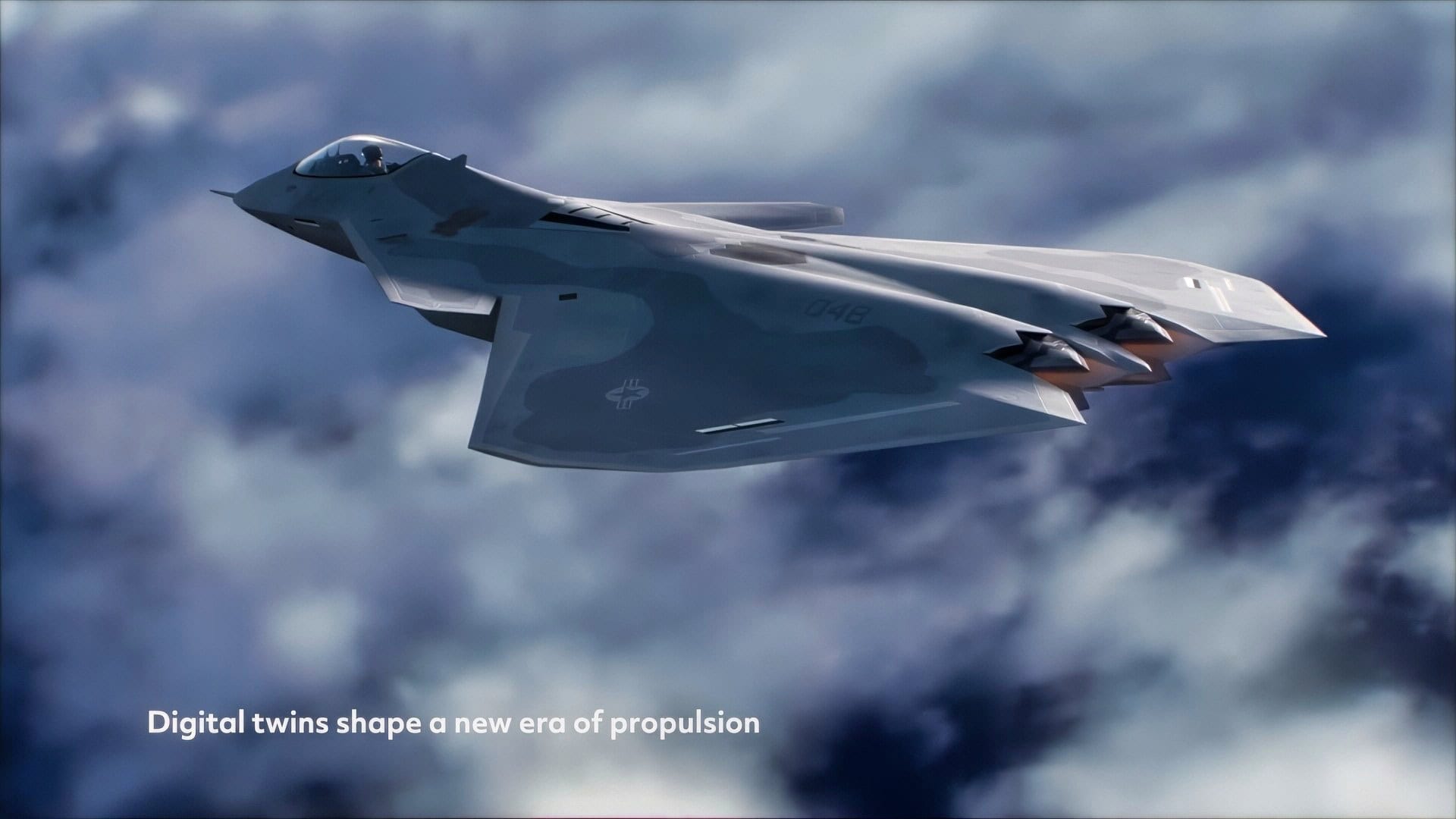
Summary and Key Points: On February 17, 2026, Pratt & Whitney released an update on its XA103 adaptive-cycle engine, featuring a notional 6th-generation fighter design widely identified as the Boeing F-47.
-The video revealed a tailless, blended-wing aircraft equipped with front canards, 2D thrust-vectoring nozzles, and a forward-positioned bubble canopy.
Shown is a graphical artist rendering of the Next Generation Air Dominance (NGAD) Platform. The rendering highlights the Air Force’s sixth generation fighter, the F-47. The NGAD Platform will bring lethal, next-generation technologies to ensure air superiority for the Joint Force in any conflict. (U.S. Air Force graphic)
-This configuration aligns with the U.S. Air Force’s Next Generation Air Dominance (NGAD) requirements for extreme stealth and maneuverability.
-While officials maintain the rendering is notional, the inclusion of specific features like a dorsal refueling port suggests a high-fidelity look at the platform Boeing was selected to build in March 2025.
Did Pratt & Whitney Just Accidentally Reveal the F-47 Fighter?
A newly released Pratt & Whitney update on its XA103 adaptive-cycle engine has provided a new look into the propulsion system intended to power the U.S. Air Force’s next-generation F-47 fighter, the centerpiece of the Next Generation Air Dominance (NGAD) program.
In a newly released video about the engine, viewers also got a look at a proposed next-generation fighter design that likely represents the shape and configuration of the next-generation NGAD fighter.
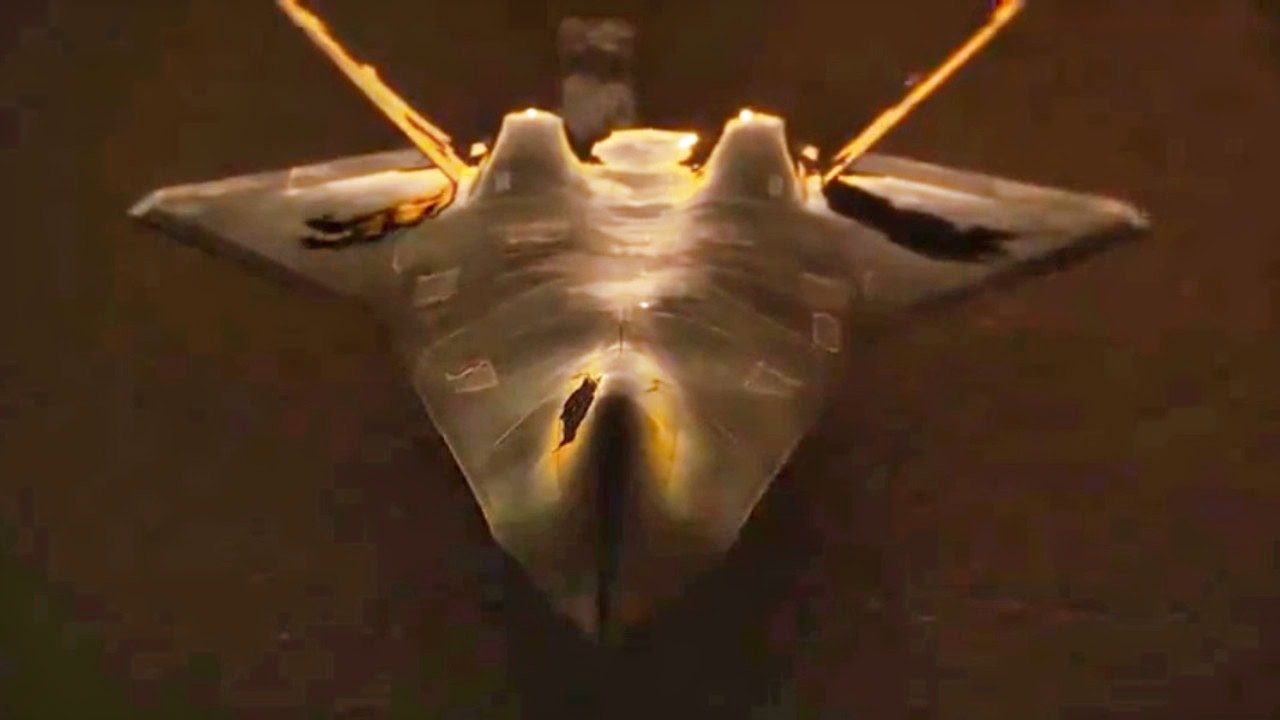
F-47 Fighter from Boeing. Image Credit: U.S. Air Force Screenshot.
The engine in question, currently under development within the Next Generation Adaptive Propulsion (NGAP) initiative, is designed specifically to meet the performance requirements of the sixth-generation aircraft that Boeing was selected to build in 2025, the successor to the F-22 Raptor.
The propulsion system is not simply another incremental upgrade but a foundational technology that determines whether the aircraft can achieve the range, speed, and power needed to operate in future contested environments. Without it, NGAD wouldn’t be NGAD – a program intended to replace the F-22 and ensure U.S. air superiority in conflicts against technologically advanced adversaries, particularly China.
What Just Happened
Pratt & Whitney this week shared a new video about the development of the XA103 adaptive-cycle engine, offering a look at the progress being made on the new propulsion system.
The video accompanying Pratt & Whitney’s XA103 engine update included imagery of a sixth-generation fighter aircraft configuration linked directly to the NGAD program, and analysts immediately noted that the aircraft’s design strongly resembled expected characteristics of the future F-47.
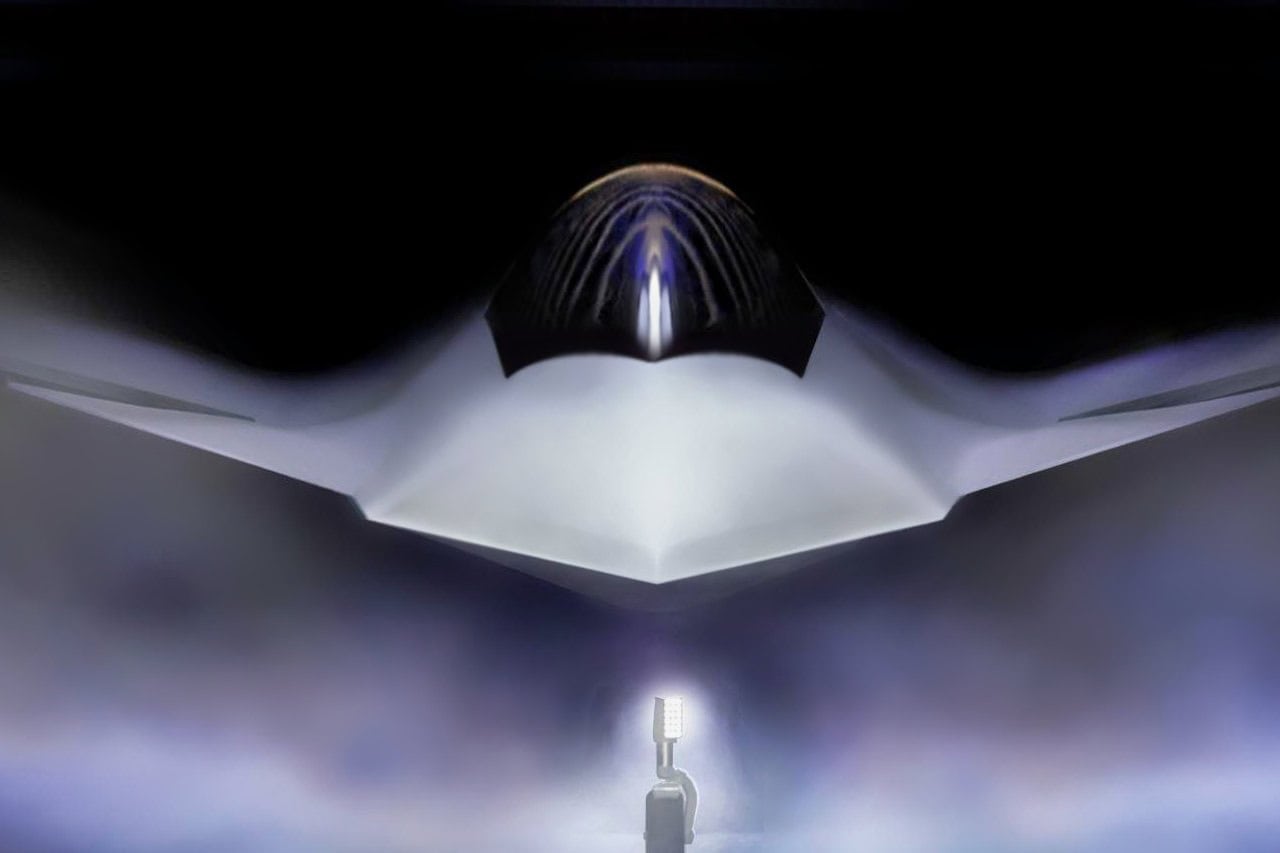
Shown is a graphical artist rendering of the Next Generation Air Dominance (NGAD) Platform. The rendering highlights the Air Force’s sixth generation fighter, the F-47. The NGAD Platform will bring lethal, next-generation technologies to ensure air superiority for the Joint Force in any conflict. (U.S. Air Force graphic)
Critically, the aircraft shown was not a generic jet. It displayed several specific and unusual design features that point toward a next-generation stealth fighter:
What the Video Revealed
The aircraft depicted in Pratt & Whitney’s February 17 video was not presented as a named platform, but its configuration aligns closely with what is known publicly about the Air Force’s Next Generation Air Dominance fighter and the F-47 specifically.
Because the XA103 engine is being developed under the Next Generation Adaptive Propulsion (NGAP) program exclusively to power NGAD, the appearance of a sixth-generation stealth fighter alongside that engine strongly suggests the imagery represents a conceptual or early visualisation of the aircraft itself. NGAP exists as a dedicated propulsion track for NGAD, separate from earlier adaptive engine efforts like the XA100 and XA101, and is intended to deliver the thrust, efficiency, and thermal management required by the future fighter.
One of the most striking aspects of the aircraft shown in the video was its apparent lack of traditional vertical stabilisers. Instead, the aircraft used a blended wing configuration with smooth, uninterrupted surfaces, a design approach widely associated with reducing radar cross-section and improving survivability in heavily defended airspace – meaning that the aircraft depicted was clearly stealthy. The Air Force has previously confirmed that NGAD will incorporate stealth characteristics exceeding those of current fighters like the F-22 and F-35, reflecting the need to penetrate advanced integrated air defence systems developed by adversaries such as China.
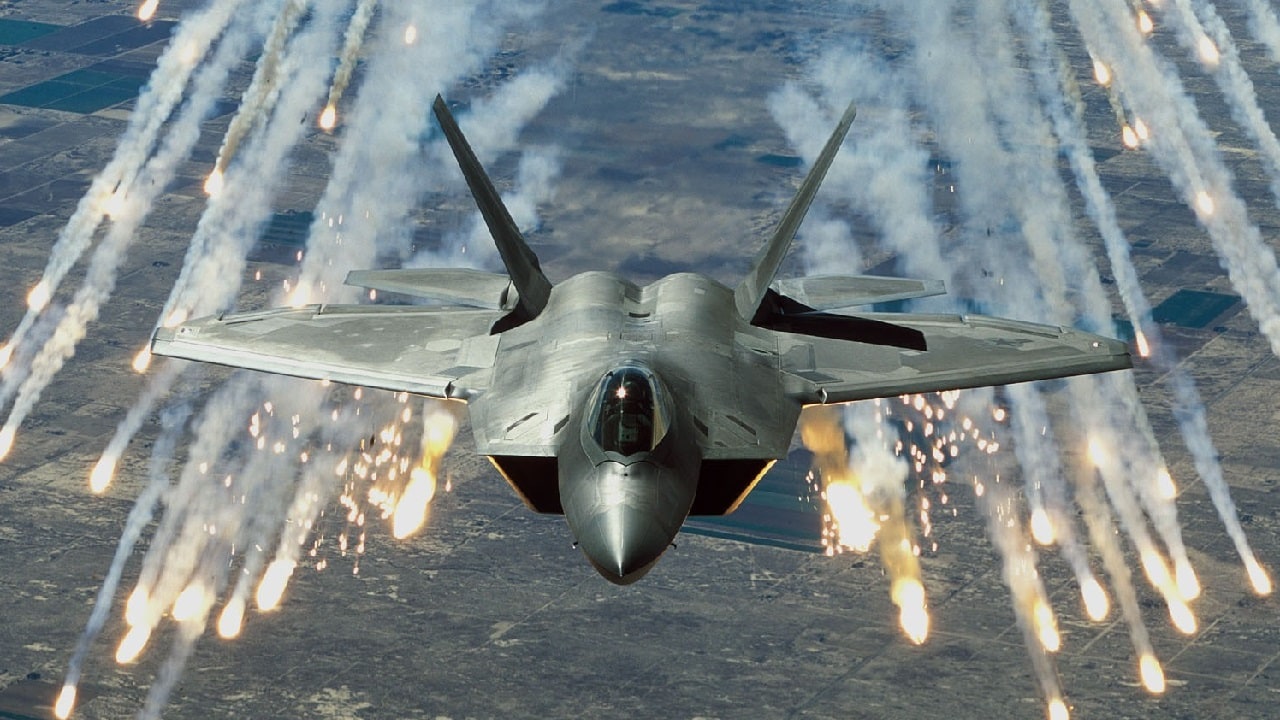
F-22 Raptor. Image Credit: Creative Commons.
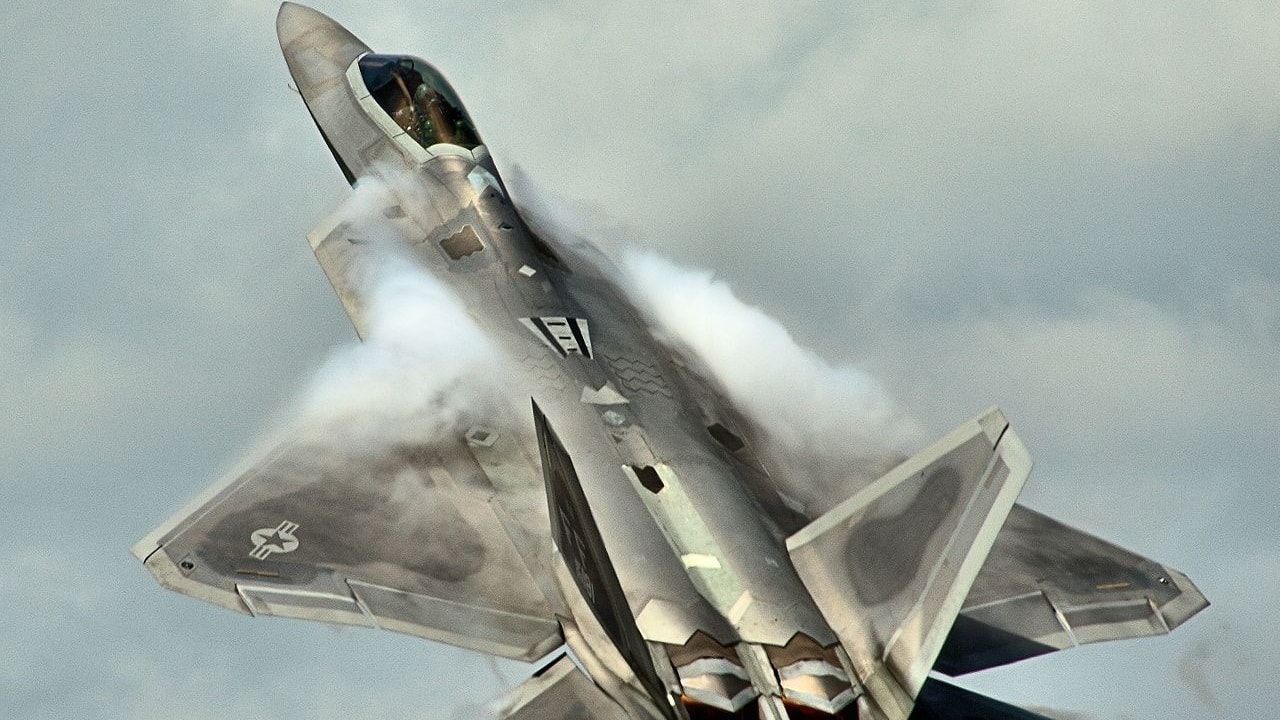
F-22 Raptor.
The aircraft also appeared to incorporate forward canards positioned behind the cockpit. While canards can improve maneuverability and aerodynamic control, their integration into a stealth aircraft requires careful shaping and flight-control software to avoid increasing radar visibility.
Their presence suggests NGAD designers are balancing extreme stealth with high aerodynamic performance, potentially enabling sustained high-speed flight and improved handling compared to earlier stealth fighters. Army Recognition’s analysis of the video noted the canards as part of a broader low-observable design philosophy that emphasises both maneuverability and range.
The cockpit itself was positioned far forward, with a bubble canopy integrated into the fuselage, a feature intended to maximise pilot visibility.
This is consistent with the Air Force’s NGAD concept, which retains a human pilot as the central decision-maker while controlling autonomous Collaborative Combat Aircraft operating alongside the crewed fighter. NGAD will function as part of a “family of systems,” with the crewed aircraft acting as a command node coordinating unmanned platforms.
The rear section of the aircraft appeared to feature twin engines with thrust-vectoring exhaust nozzles, similar in concept to those used on the F-22. Thrust vectoring enables pilots to control the aircraft’s direction via engine exhaust, enhancing maneuverability at high speeds and in combat.
This aligns with longstanding Air Force requirements for NGAD to maintain air superiority against highly maneuverable adversary aircraft.
And just as significant was the overall aerodynamic shape of the aircraft, which suggests it was optimized for long-range operations.
The aircraft appeared to incorporate features such as a dorsal aerial refuelling receptacle, reinforcing expectations that NGAD will be designed for extended missions over vast distances.
The U.S. Air Force announced in March 2025 that Boeing had been selected to develop the NGAD fighter under an engineering and manufacturing development contract, formally moving the program beyond design and into prototype construction, with the first flight planned for 2028 and operational fielding expected in the 2030s.
About the Author: Jack Buckby
Jack Buckby is a British researcher and analyst specialising in defence and national security, based in New York. His work focuses on military capability, procurement, and strategic competition, producing and editing analysis for policy and defence audiences. He brings extensive editorial experience, with a career output spanning over 1,000 articles at 19FortyFive and National Security Journal, and has previously authored books and papers on extremism and deradicalisation.
First Appeared on
Source link






Leave feedback about this