

I’ve been following Phillips P. O’Brien after I first became aware of him via Paul Krugman. Here’s what Krugman had to say about O’Brien in a conversation a year ago:
Phillips O’Brien is, as I said, a military historian who teaches at the University of St. Andrew’s in Scotland (although as you’ll immediately notice, he’s American by birth.) His latest book, The Strategists, is fascinating. But I first noticed his work when I read his 2015 book How the War Was Won, which transformed my understanding of what really happened in World War II. Much of what he said there has turned out to be hugely important in understanding the Ukraine war too, and I’ve depended a lot on his Substack to make sense of events.
(Since taking up an account on Substack, Krugman has been not only talking about his own areas of expertise — he’s also been talking with a lot of different people who can cover things outside of his wheelhouse. Most of his weekly postings are free, but a subscription allows access to his deep dives. Take a look at what’s he’s been up to.)
O’Brien had a conversation with Krugman about Venezuela, and it got into something important — how the U.S. is great at winning battles but loses wars. I’m going to put a long quote here because it applies to what’s happening in Ukraine, what matters — and why so many analyses get it wrong. Ukraine, after all, was expected to collapse right away with the initial invasion, and there’s been a steady stream of expectations that it was going to be overwhelmed sooner or later.
Krugman: One of the things that you wrote about that I thought was really interesting—it’s pre-Venezuela—you’ve been writing about how people and particularly Americans misunderstand war in general. Can you talk about that a bit because I think it’s very interesting.
O’Brien: The Venezuelan intervention was almost a textbook case. What I have been trying to say is that Americans get excited by operations or battles; the US military is actually brilliant at winning battles and pulling off operations. There’s probably no other military in the world that could have abducted Maduro as effectively as the US military did. That is what the US military does well: it has an object, it usually blows it up or it seizes it, and then goes home. The problem is that there’s a huge disconnect between doing that and achieving your strategic goals or winning a war. The United States didn’t lose a battle by any standard in the Vietnam War. They won every engagement with the Taliban in Afghanistan. But they didn’t win the wars because they were too obsessed with the engagement, with the operational brilliance, to see what they were actually doing—”how is this actually achieving our aims?” I think the U.S way of war is upside down. It does the granular really well, but it absolutely fails in looking at the bigger picture, and this is typical.
I think something that we’re seeing in Venezuela, and what the U.S always does, is downplay the important role of allies; that’s hugely important, working with other countries. In fact, I can tell you there is only one rule for an intervention that has any chance of success. The only way an intervention has any chance of success is if the people on the ground are going to fight for you. If you have allies who are willing actually to fight—like say, the Ukrainians—then you have a chance of success in an intervention. If you’re going to do the fighting, if you’re going to go into Afghanistan, Vietnam and infantilize the people who might support you, you’re going to lose that war. But that’s how the U.S. way of war operates, it infantilizes other countries, demeans them, says the U.S. can do everything, and then the U.S. ends up winning battle after battle and then losing the war because they can’t keep it going. This could be something we’re going to see in Venezuela if we keep seeing these kinds of interventions. We don’t actually have any support in Venezuela, we’re alienating the Venezuelan opposition with our behavior and we’re alienating a lot of other countries in the region. I think these countries are looking around and saying, “what the heck? Who’s going to support this?”
The Three Elements of the Strategy O’Brien Reports Ukraine is Attempting
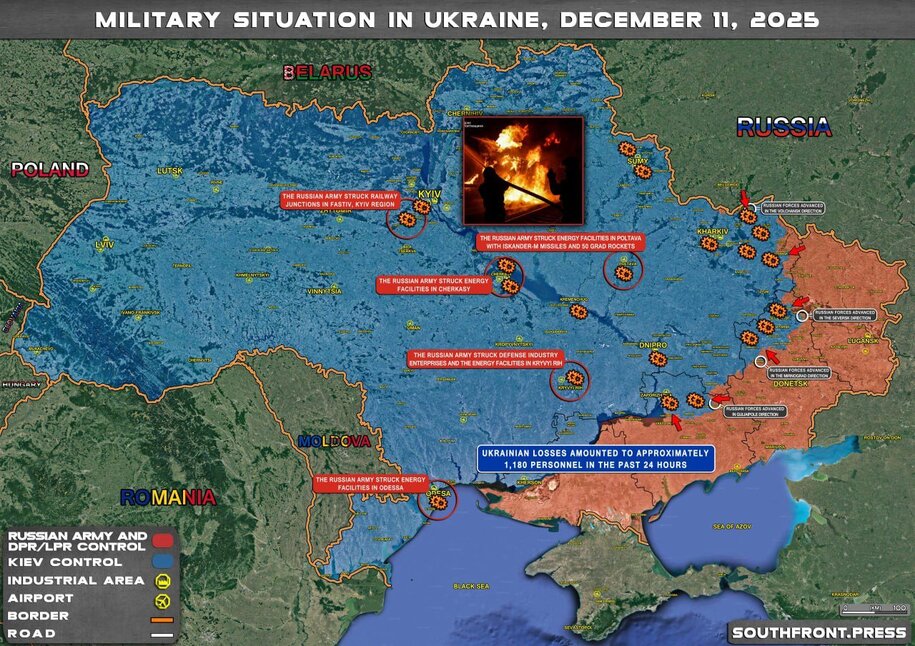
The press (and a lot of military analysts) judge how things are going by looking at things like where battle lines are drawn, what cities are in whose hands, etc. The battlefield in Ukraine is not like that.
There are no battle lines in the traditional sense. Instead the area being contested between Russian and Ukrainian forces is better described as a killing zone kilometers wide, where ground forces are under constant threat of annihilation by drones and precisely targeted missiles and artillery. If something can be ‘seen’ in the killing zone, it can be taken out, whether it’s a main battle tank or a ground pounder Russian conscript. Where that zone reaches and who dominates it is the critical thing to consider.
For Ukraine, learning how to operate effectively in this environment is key. O’Brien gets into the way they are going about it.
…The Ukrainians have been increasingly vocal about this, so it should come as no surprise. They see humans surviving on battlefield as increasingly difficult. The constant surveillance over the area of fighting has grown and become more intense and will probably get worse unless one side or the other achieves a technological step-change in capabilities.
As such, the Ukrainians are going into 2026 looking at the battlefield as first and foremost an attritional area where they want to raise Russian casualties and keep down their own. For new subscribers, here is an interview I did on the subject at the very end of 2025 with a retired Ukrainian general who is still heavily enmeshed in the Ukrainian strategic discussion.
What does this mean in practice?
The Ukrainians have been increasingly vocal about this strategy. Defense Minister Fedorov, a real breath of fresh air, has spoken of the Ukrainian goal of causing 50,000 Russian casualties a month in 2026. Moreover, he has mentioned that in January, Ukraine’s unmanned forces have evidence for having killed or wounded 30,000 Russians.
In other words, the Ukrainians believe that this plan is achievable.
Now this attritional plan is “strategic”. The Ukrainian goal is to progressively weaken the Russian army which should have significant impact across the Russian war machine. Causing losses above replacement level (Russia seems to have produced 30000-35000 new soldiers a month in 2025), turns the Russian army into a wasting asset. It will accelerate Russian problems in producing motivated forces and will mean those produced will be trained even more poorly. The Ukrainians also believe it will cause spillover effects across the economy and maybe even Russian politics. They do not believe that the Russian population will be fired with indignation about their own people (the Ukrainians are hard-headed on that) but they do believe the more and more the war is seen as quagmire with rising, unsustainable losses, the greater the impact will be. This is how Federov put it.
“If we reach the figure of 50,000, we will see what happens to the enemy. They perceive people as a resource, the problems with which are already obvious,”
The functional nature about how the Ukrainians approach this issue underlines its strategic nature. Its not just about the battlefield, it’s turning battlefield losses into an overall Russian resource and political problem. And at the same time the Ukrainians are working to reduce their own losses, but I will not go into that further now.
emphasis added
For obvious reasons, O’Brien cannot discuss the operational details of how Ukraine is minimizing its casualties, but in light of that, the idea that Ukraine needs to put more troops on the front line is just wrong-headed. O’Brien hints elsewhere that Ukraine has gotten very good at deploying small teams with critical skills when opportunities arise, and exploiting Russian vulnerabilities.
In the absence of specific details, I am tempted to picture it as akin to the way the late Gordon Dickson’s fictional Dorsai operate, not to mention John Boyd’s OODA loop.
There’s a video with Ken Burns discussing the scariest thing he ran across while researching the revolutionary war. He talks about Lincoln finding a general who finally understands “the arithmetic”, which was the North could keep afford to lose more troops than the South and win the war. Ukraine does not have the luxury of numbers — but as long as they can drive Russian casualties to the point where they can’t replace them fast enough to make up for their losses while minimizing Ukraine’s own losses to sustainable levels, the arithmetic works in their favor.
A recent NATO exercise showed that the lessons Ukraine has so painfully learned have yet to be implemented elsewhere.
One of the exercise episodes revealed the scale of the problem. A large NATO grouping, including a British brigade and Estonian units, operated as if full battlefield transparency did not exist. Units moved without sufficient concealment and deployed vehicles and equipment in easily detectable positions. A team of roughly ten operators was able within half a day to simulate the destruction of 17 armoured vehicles and conduct around 30 additional strikes, while more than 30 drones operated on an area smaller than 10 km². In the assessment of the exercise, two battalions were declared combat-ineffective.
If winning the battle of attrition is critical, what else is needed? Mid and long ranged weapons capable of crippling the Russian capacity to make war and disrupt the ability of Russia to get supplies and munitions to troops in the field.
Now, if the battlefield attritional strategy were all that Ukraine has been working on, it could be said that their horizons are rather limited and that they would be in a strategic wasteland. However, the Ukrainians have for the last year been working on a ranged weapons strategy to try and deal a significant, hopefully fatal blow, to the Russian war economy. It might be that western strategic analysts have such a poor understanding of war (remember many of them have and continue to see war as a battlefield-determined conflict) and that they spend much of 2022-2025 arguing against the importance of ranged fire for Ukraine, that they are left wanting in this area. The Ukrainians are actually ahead of them by a long way, but the western analytical community has real problems grasping this.
The Ukrainian ranged fire strategy has two main, linked goals. The key one is to wreck the Russian economy as much as possible. The Ukrainians understand that Russia is not strong economically, that it is hemorrhaging money and that Putin’s whole rule is based on access to capital. The second strategic aim is to cut off the Russian military from access to the supplies and military equipment made by that economy by attacking logistics.
emphasis added
In Summary:
This piece is already rather long and clearly in the coming weeks and months I will talk more about this strategy. However, in summation please understand that the Ukrainians are serious about having a victory strategy. The question is not whether they have a strategy, it is whether they can produce and deploy the systems needed to see it put into action. They want to cause losses significantly above replacement level for the Russian army in the field, starve the Russian war economy of capital and damage its production, and then devastate the connections between the two.
It is in my opinion about as sensible a strategy as they could devise. I hope that Ukraine’s supporters help it become a reality.
emphasis added
The Russian strategy is — as I understand it — to just keep throwing troops at Ukraine’s forces in the killing zones, and inflict massive damage on Ukraine with drone and missile strikes. Battle axe versus rapier.
Ukraine’s strategy is a winning strategy — IF they are given the support they need to carry it out. Russia’s biggest asset is the Trump regime and the way they have deprived Ukraine of critical resources. Ukraine and now Europe are aware that the U.S. is not a reliable partner.
O’Brien has some numbers here on how well Ukraine is doing at burning through Russian troops faster than Russia can replace them. As to what all the fighting is for, O’Brien lays out 4 key goals that Ukraine needs to truly win. Here’s an abridged version from O’Brien’s list:
- Ukraine must be a sovereign state with no limitations not placed on other European states. Ukraine can accept no inferior status to any other European state or to Russia. It cannot accept military limitations that others do not accept and it certainly cannot formalize an inferior position to Russia.
- Ukraine must not legally cede control of any of its land and cede no land that the Russians have so far seized.
- Ukraine must demand a clear and speedy path to EU membership. If NATO will be off the table for now as long as Trump is president, EU membership is not. Joining the EU is vital for Ukraine for economic, social and arguably military means.
- Ukraine must determine its own political future. One of the reasons that Trump/Putin have been desperate to dictate the speed and even process of the next Ukrainian election, is that they see this as a chance to destabilize Ukraine.
It’s easy to forget how the conflict in Ukraine is still going on, given all of the chaos Trump is generating in all directions all the time. Nonetheless, the outcome is going to be a defining test of Western democracies.
First Appeared on
Source link





Leave feedback about this