

Sign up for the Slatest to get the most insightful analysis, criticism, and advice out there, delivered to your inbox daily.
It was a bad week for the Make America Healthy Again movement.
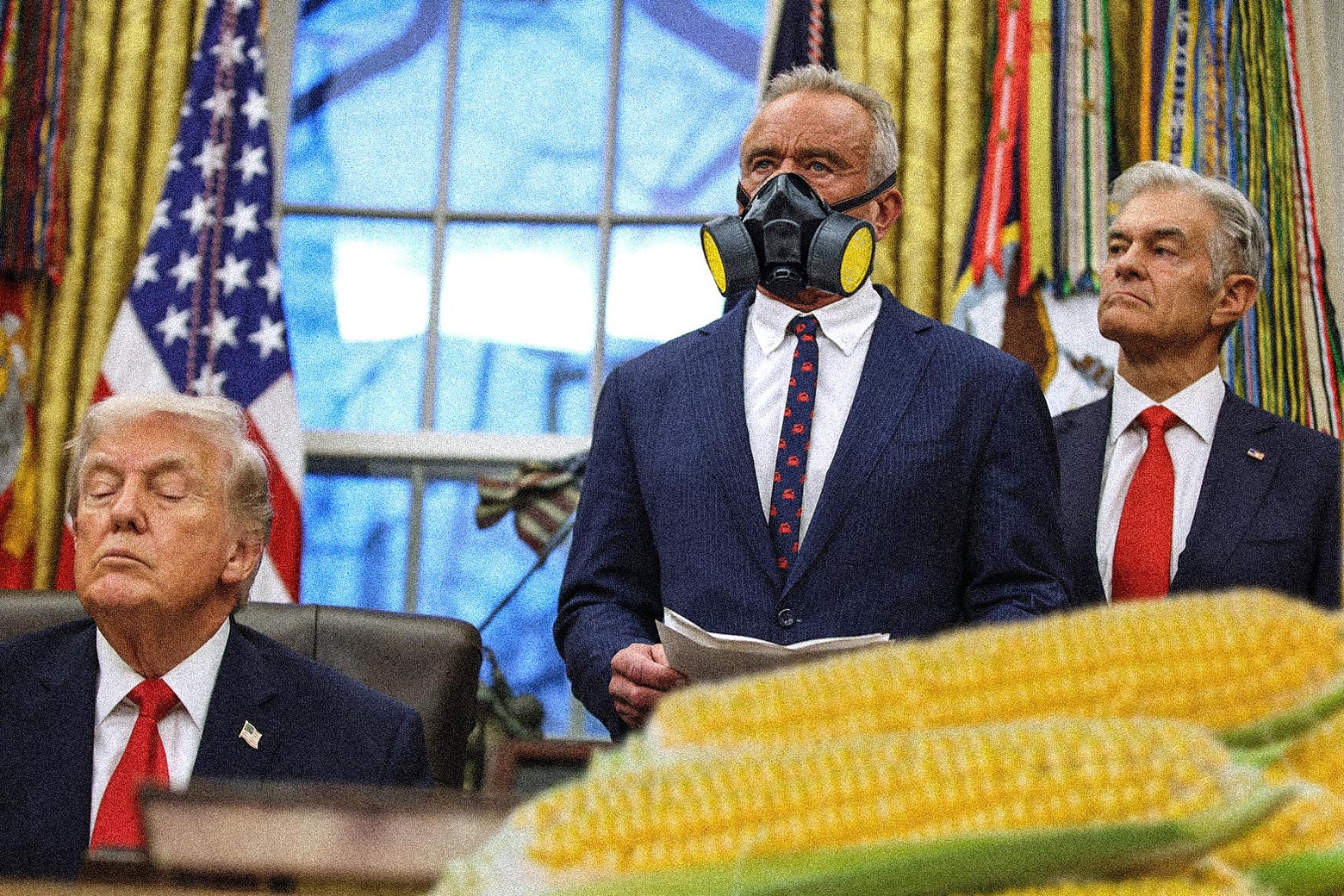
On Wednesday, President Donald Trump signed an executive order promoting the production of glyphosate, the chemical that powers the weed killer Roundup and a longtime target of the MAGA faithful. Glyphosate has also long been one of the main targets of the MAHA movement, which considers it a dangerous carcinogen poisoning the country. (Experts say that the pesticide’s danger to the public is minimal, but the scientific community is not in agreement about its health effects.)
Robert F. Kennedy Jr. himself took on Monsanto, Roundup’s manufacturer, in a successful 2018 case accusing the company of knowing that the chemical caused cancer. In 2024 he called glyphosate “one of the likely culprits in America’s chronic disease epidemic” and promised to ban it.
So what did the head of the Trump administration’s health department have to say about it now? “Donald Trump’s executive order puts America first where it matters most—our defense readiness and our food supply,” Kennedy said in a statement. “We must safeguard America’s national security first, because all of our priorities depend on it.”
It was a near echo of what Trump himself said when he declared glyphosate necessary to keeping the food supply chain steady and therefore “crucial to military readiness and national defense.” The president’s executive order, invoking a 1950s law meant for national security emergencies, creates the legal basis for glyphosate producers to be shielded from lawsuits and authorizes the Department of Agriculture to compel those companies to produce the pesticide.
To critics, Kennedy’s endorsement seemed like a confounding betrayal. He and the other most high-placed members of his coalition—the doctors who sit on panels and guide policy—stayed quiet as the MAHA moms were dealt a serious defeat.
It was a shock to the movement’s system. Alex Clark, a MAHA podcast host with Turning Point USA, wrote on social media that she started receiving messages from women abandoning the Republican Party over the glyphosate news. “Have we ever lost the midterms this early or is this a new record?” she wrote.
Vani Hari, a MAHA influencer with 2.3 million followers on Instagram, also expressed disbelief when the news broke. She said on social media that the government had given Bayer, which owns Monsanto, “a license to kill.” Trump had blessed “the mass poisoning of Americans.”
This is not what MAHA movement members had in mind when Kennedy snagged an influential post in Trump’s Cabinet. But the episode reveals not only a limit to Kennedy’s influence but also a political weakness in the very makeup of the MAHA movement that’s likely to emerge again and again.
We don’t know what happened inside the administration or how heavily Kennedy pushed back against the pro-chemical decision behind the scenes, but we know what the outcome was: Trump landed on a decision that large agricultural companies are going to love. And for MAHA, that’s a problem. This is unlikely to be the last time the president has to pick between MAHA and Big Agriculture, and it looks as if the latter faction clearly has the juice to get its way.
It’s not entirely surprising. Before the 2024 election, Trump courted Kennedy in an effort to win over crunchy Democrats and independents who can be swayed by the single issue of “health.” But Trump never put his heart into it. He said the MAHA buzzwords but never made “chronic diseases,” for example, a pet issue the way he cared about immigration or limiting rights for transgender people. And while Trump has given Kennedy lots of leeway in his campaign against vaccines, the health secretary’s influence on food policy seems far more limited.
There’s not much Kennedy can do about it. Trump isn’t slated to face voters again. And for Kennedy personally, quitting over glyphosate would mean forfeiting leverage over vaccine policy.
But in addition to exposing Kennedy’s limits, Trump’s pro-Roundup order—and MAHA’s reaction to it—revealed a brittleness to the movement as a whole.
“I personally don’t view it as a clear movement,” said Pamela Herd, a professor at the University of Michigan’s Gerald R. Ford School of Public Policy. “It’s a fragile political alliance.”
As Herd sees things, the leadership of the movement—the administration-friendly personalities and the most-high-profile influencers and media figures—cares most about propping up the supplement and wellness industry, as many of these individuals have their own financial interests in nontraditional health products. (“It’s not as much an ideology as it is an industry,” she said of MAHA leadership.) But the rank and file, the “MAHA moms,” can be divided into two broad categories, which we’ll call the individualists and the structuralists.
The structuralists want everyone to be healthier, as much as possible. They want clean water, chemical-free produce, and an elimination of anything that could be described as a “toxin.” They’re the MAHA hardcore, the women who see America’s chronic health struggles as the greatest issue facing the country.
The individualists, on the other hand, are decidedly more libertarian. They want to be able to send their kids to schools without vaccinations, to drink unregulated raw milk, and to be free to treat their illnesses with Ivermectin.
These two groups overlap heavily, but individualists and their focus on “freedom” pull most heavily from the conservative population that already supported Trump. This cohort, which was radicalized to care about these issues by the COVID public health measures, thinks about health in terms of what they can control, at a personal level. The difference in philosophy between these two cohorts is most apparent when it comes to pollution—something that’s entirely out of individual control, and therefore of little interest to the individualists. And because the individualists are the ones most synonymous with the MAGA base, their voice has more weight.
“The relevant question is who has the power,” Herd said. “And I think those with the most power and influence are in the individualist frame.”
Still, the question remains what this move will mean for those who care more about the structural issues and who may be Kennedy supporters before they’re Trump fans—or from people who have been steeped in the MAHA world long enough to have developed genuine fear of the pesticide. Conservative commentators such as Megyn Kelly have pointed to Kennedy’s past promises to vent their frustrations. And on Friday, Representative Thomas Massie, a Republican, announced his plan to introduce a bill to undo Wednesday’s order.
“I do think there’s some growing discomfort and questioning of what’s going on,” Herd said. “I think it’s possible this is sort of a tipping point.”
Recently, Kennedy has pivoted politically toward emphasizing healthy eating rather than interfering in vaccines. With his new dietary guidelines, statements blasting ultraprocessed foods, and celebrity-studded videos promoting working out (while wearing jeans), Kennedy is making his movement inoffensive and, to Trump, low-profile. Kennedy has proved he’s not a liability to the administration.
What he hasn’t proved, at least to his supporters, is that he’s any better than the champions who preceded him when it comes to facing the commercial interests behind the “toxins” he claims to hate.
On Friday, the Environmental Protection Agency adjusted its limits to pollution from coal-burning power plants, allowing them to release more mercury into the air. Just as Trump wanted the glyphosate for the farmers, his EPA wants to boost the coal industry by allowing more pollutants into the atmosphere, without concern for climate change or for the way mercury collects in streams and other waterways, eventually endangering people who consume seafood. Restricting mercury pollution was another key issue for Kennedy, something he personally championed in the past. The EPA’s announcement was yet another slap in the face to the MAHA movement.
But on Friday, after the news came out, Kennedy said nothing.

First Appeared on
Source link
Leave feedback about this